
Axial Length and Childhood Myopia: Why Cincinnati Parents Should Track Eye Growth
Axial Length and Childhood Myopia: Why Cincinnati Parents Should Track Eye Growth
When a child’s glasses prescription becomes more nearsighted, the numbers in diopters tell only part of the story. Myopia commonly progresses because the eye grows too long from front to back. Measuring that physical length—called axial length—can add objective information that a standard prescription alone cannot provide.
At See Well Eyecare, the Topcon MYAH helps us establish a baseline and monitor eye growth as part of individualized myopia management in Cincinnati. The measurement is useful, but it is not a diagnosis by itself and should never be interpreted without age, prescription, history and examination findings.
What Is Axial Length?
Axial length is the distance from the front of the eye to the retina at the back. It is measured in millimeters. In many children who develop myopia, the eye lengthens faster than expected, moving the retina farther behind the eye’s focusing system.
The Brien Holden Vision Institute’s axial-length guidance summarizes the distinction well: refractive error is central to diagnosing myopia, while axial length is especially useful for monitoring progression.
That means neither measurement replaces the other.
Prescription and Eye Growth Answer Different Questions
A refractive examination asks: How much lens power does this child need to see clearly?
Axial length asks: How is the eye’s physical size changing?
Two children can have similar prescriptions but different eye lengths because corneal shape and the eye’s natural lens also affect focus. Likewise, a prescription can appear fairly stable over a short interval while axial-length data adds context about ongoing growth.
The 2025 CLEERE study of axial length in children found that expected patterns vary by age, sex and race or ethnicity. Younger myopic children tended to elongate faster than older children. A single universal “normal number” therefore is not appropriate for every child.
What the Topcon MYAH Measurement Is Like
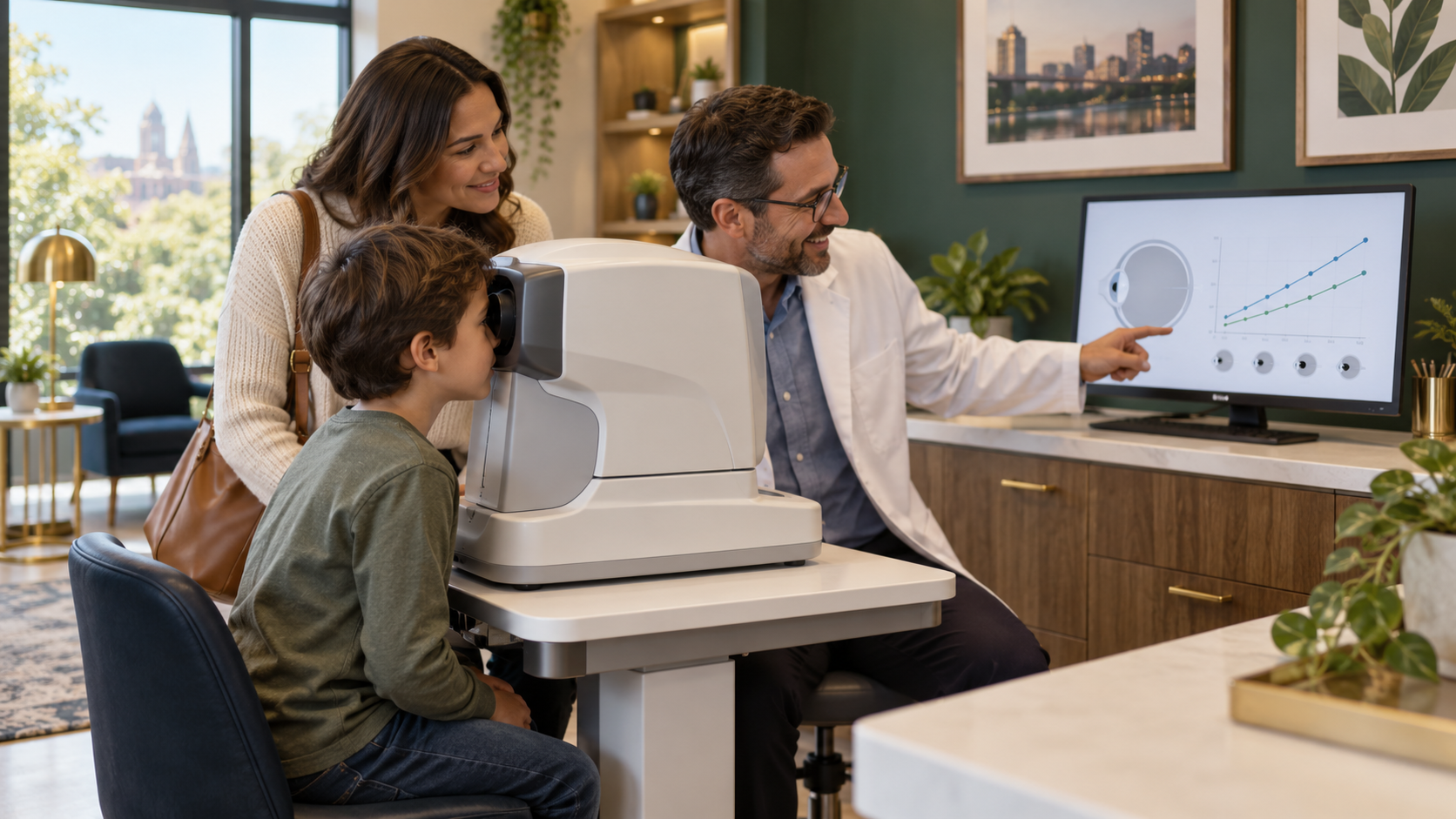
The Topcon MYAH uses optical biometry to measure axial length. The child looks into the instrument while it captures a rapid, noncontact measurement. Nothing touches the eye, and no radiation is involved.
The same platform can also provide corneal topography when clinically useful. Topography maps the front shape of the cornea and may be important when considering orthokeratology or evaluating unexpectedly irregular corneal shape. Axial length and topography are different tests, even though one instrument can perform both.
Why Trends Matter More Than One Number
One measurement provides a baseline. Repeated measurements show direction and rate.
When See Well reviews an axial-length trend, we consider:
the child’s age and stage of development;
current and previous prescriptions;
prior axial-length measurements;
family history of myopia;
treatment type and adherence;
changes in visual behavior; and
whether the measurement pattern is clinically meaningful.
Small differences can occur because of normal measurement variability and time-of-day or seasonal effects. We do not change treatment based on one isolated decimal point.
Axial Length Helps Evaluate Treatment Response
The International Myopia Institute’s 2025 intervention review prioritized clinical trials that included axial-length outcomes. This reflects a broader shift: effective myopia management aims not only to correct blur but also to slow excessive eye growth.
See Well’s parent guide to myopia management describes the treatment pathway. Options may include:
MiSight 1 day contact lenses for eligible children;
orthokeratology, including appropriate overnight lens designs; and
low-dose atropine prescribed off-label for selected children.
No treatment guarantees that progression will stop. The goal is to slow the rate compared with what might otherwise be expected, while maintaining clear vision, healthy eyes and a plan the child can follow.
A Stable Glasses Prescription Does Not Always End Monitoring
Prescription measurements have normal variability. Children can also compensate during testing, and contact-lens or orthokeratology wear may affect how refraction is interpreted. Axial length provides another objective data point.
The BHVI myopia resources emphasize structured assessment and follow-up rather than a one-time choice of treatment. Once a child is stable, visit frequency may be reduced, but the decision should reflect age, treatment and prior progression.
What Families Can Expect at See Well
A comprehensive pediatric eye examination first evaluates vision, refractive error and eye health. When myopia or meaningful risk is identified, a separate myopia-management evaluation can review:
refractive and family history;
axial length with the Topcon MYAH;
corneal topography when appropriate;
age-related progression risk;
treatment options and responsibilities; and
a follow-up schedule.
During the first treatment year, See Well generally reassesses around six months and again near twelve months, with timing adjusted for the modality, age and risk. The result may be to continue, reinforce adherence, adjust or combine treatment, or monitor more closely.
Keep the Device, Product and Follow-Up Connected
Myopia-control glasses and specialty contact lenses work only when the exact prescribed product is made, fitted and used correctly. Purchasing through See Well keeps the prescription, frame or lens selection, professional measurements, fitting, training, troubleshooting and follow-up connected.
For glasses, our optician can help choose a stable frame and use Optikam measurements when appropriate. For contact lenses, the office can coordinate exact products, manufacturer rebates when available, annual-supply convenience, shipping and temporary diagnostic lenses for purchasing patients when clinically appropriate.
Choosing the same local team for care and products also helps See Well continue investing in axial-length technology and specialty services for Cincinnati families. It does not make a treatment outcome guaranteed; it creates accountability around the plan.
Explore Hyde Park & Nearby Neighborhoods
See Well Eyecare is in Hyde Park (45208), close to Oakley (45209), Mariemont (45227) and Walnut Hills (45207). We see comprehensive pediatric patients beginning at age four and welcome families from throughout Cincinnati for dedicated myopia-management evaluations.
Local Events & Attractions | Curiosity Beyond the Classroom
Families can pair clear distance vision with local discovery at the Cincinnati Observatory, explore science and history at Cincinnati Museum Center, or check the current family calendar at the Cincinnati Zoo. Outdoor time is healthy and may help reduce the risk of myopia onset, but it does not replace treatment once a child’s myopia is progressing.
Frequently Asked Questions
Is axial length the same as a glasses prescription?
No. A prescription measures the lens power needed for clear focus. Axial length measures the physical distance from the front to the back of the eye.
Does a longer eye automatically mean my child has myopia?
No. Corneal and lens power also affect refractive error. Axial length must be interpreted with the full examination.
Does the MYAH touch the eye?
No. Optical biometry is a quick, noncontact measurement.
How often should axial length be measured?
Timing depends on age, treatment and progression. See Well commonly reassesses during the first treatment year and adjusts the interval based on response.
Can axial length prove that a treatment is working?
It adds important objective evidence, but no single measurement proves success. Trends in axial length, prescription, vision, eye health and adherence should be considered together.
How do I arrange a myopia-management evaluation in Cincinnati?
Use the appointment-request form and mention your child’s current prescription, age, prior changes and any family history of myopia.
About See Well Eyecare
See Well Eyecare is an independent Cincinnati optometry practice led by Dr. Rawzi Baik. We combine pediatric eye examinations, Topcon MYAH axial-length measurement, corneal topography and individualized treatment options to help families understand and manage childhood myopia.
Measure More Than the Prescription
If your child’s nearsightedness is increasing—or you want to understand whether treatment is slowing eye growth—schedule a dedicated myopia-management evaluation. Axial length turns “wait and see” into a measurable trend that families can review together with the doctor.
Primary keyword: axial length myopia Cincinnati
Supporting keywords: childhood myopia eye growth, Topcon MYAH Cincinnati, myopia management monitoring, pediatric myopia evaluation, axial elongation, Hyde Park optometrist
Quick Links
Helpful Articles

All Eye Care Services
Eye care for every stage of life, from routine exams and contact lens fittings to dry eye care, myopia management and medical eye visits. Dr. Baik helps you understand your options and choose care that fits your needs.

Keep In Touch
For non-urgent questions or to learn more about our services, contact us today!

We are an LGBTQ+ friendly clinic that believes all people deserve quality eye care
- 3330 Erie Avenue, Suite 14
Cincinnati, OH 45208 - Phone: (513) 268-8748
- Fax: (513) 268-8758
- Monday 9:00am - 3:00pm
- Tuesday 8:00am - 7:00pm
- Wednesday Closed
- Thursday 8:00am - 5:00pm
- Friday 8:00am - 3:00pm
- Saturday 9:00am - 2:00pm
- Sunday Closed
- Monday
- Tuesday
- Wednesday
- Thursday
- Friday
- Saturday
- Sunday
- Monday
- Tuesday
- Wednesday
- Thursday
- Friday
- Saturday
- Sunday
© 2026 See Well Eyecare. All rights Reserved - Accessibility Statement - Privacy Policy - Terms & Conditions - Sitemap
Managed and Designed by 