
Back-to-School Glasses That Can Keep Up With Your Child
Back-to-School Glasses That Can Keep Up With Your Child
Children’s glasses have a busy job.
They must stay comfortable through class, recess, homework, car rides and after-school activities. They may be placed on a desk, pushed into a backpack or bumped during play.
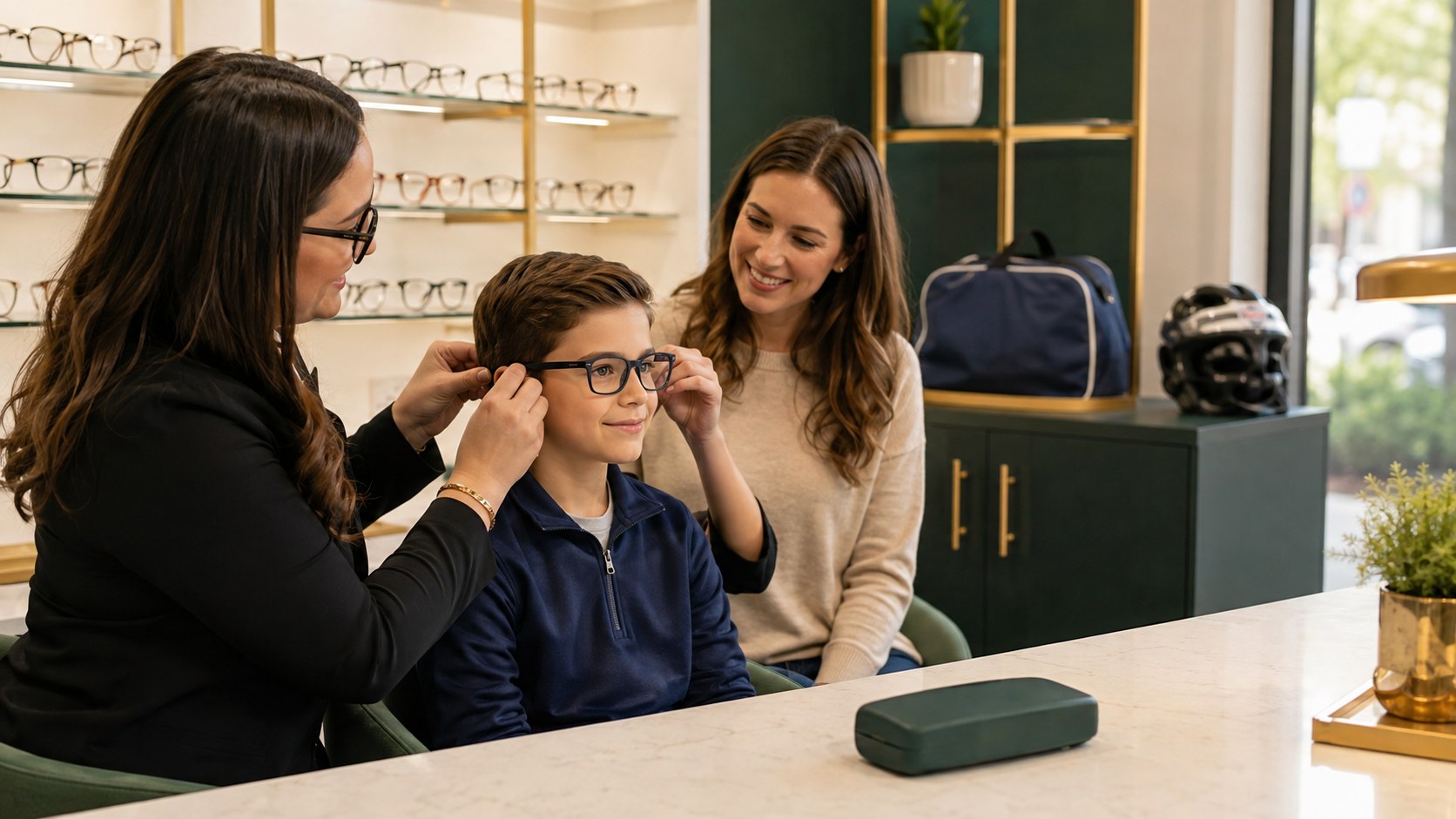
The right pair should help a child see clearly, feel confident and move through the day without constantly pushing the frame back into place.
Choosing children’s glasses is not only about color. Frame fit, lens position, lens material, comfort and after-purchase support all matter.
Here is what Cincinnati parents should consider when choosing back-to-school eyewear.
Start With an Accurate Prescription
If a child is squinting, sitting closer to screens or wearing an old prescription, begin with a comprehensive pediatric eye exam.
Children’s vision can change as they grow. The eye exam also checks more than prescription. Depending on age and need, it can evaluate focusing, eye coordination and eye health.
Bring the current glasses to the appointment. Even a scratched or poorly fitting pair can give the doctor and optician useful information about what needs to improve.
A Child’s Frame Must Fit Today
It can be tempting to buy a frame with extra room so a child can “grow into it.” Too much room may cause the glasses to slide, tilt or sit far from the eyes.
A well-fitted frame should:
sit level on the face;
remain stable when the child looks down;
fit the bridge without pinching or sliding;
keep the eyes well positioned within the lenses;
feel comfortable behind the ears;
avoid touching the cheeks or eyelashes; and
work with the child’s prescription and lens design.
Growth matters, but the glasses still need to work now.
Let the Child Help Choose
A child is more likely to wear glasses that feel like their own.
Give the child a small group of frames that fit well, then allow a choice among those options. This protects the optical needs while giving the child control over color and style.
Ask:
Do these feel comfortable?
Can you look down without them sliding?
Do the temples pinch?
Do you like how you look?
Would you feel comfortable wearing them to school tomorrow?
Confidence is part of successful eyewear. A technically good frame will not help if it remains in the case.
Frame Material and Construction Matter
No child’s frame is indestructible. Some designs are better suited to active routines than others.
The optician may consider:
flexible construction;
spring hinges or other hinge designs;
bridge style;
temple length;
the child’s prescription;
how easily the frame can be adjusted; and
whether the child is likely to remove the glasses often.
The best choice depends on the individual child. A frame that works well for a careful teenager may not be the best match for a younger child who is always moving.
See Well Eyecare offers a range of frame and lens choices, including practical options for families using vision benefits and those paying directly.
Choose Lenses for Real Life
Children need clear vision, but they also need lenses suited to daily wear.
Depending on the prescription and activities, recommendations may include:
an impact-resistant lens material;
scratch-resistant treatment;
anti-reflective treatment to improve clarity and reduce reflections;
ultraviolet protection; or
light-responsive lenses for a child who moves between indoors and outdoors.
No lens is scratch-proof or unbreakable. Children should still use a case and follow good care habits.
The best lens is not always the option with the longest list of features. It is the option that fits the prescription, activities, family priorities and budget.
Precise Measurements Help the Prescription Perform
The written prescription is only one part of a finished pair of glasses.
The optical team must also position the lenses in front of the child’s eyes. Measurements may include the distance between the pupils and the height of each eye within the selected frame.
At See Well Eyecare, our Optikam digital system can capture measurements with the frame adjusted on the child’s face. The measurements are saved and transmitted electronically, creating a consistent record.
Traditional hand measurements still have a place when they are the better choice. Technology supports the optician’s judgment; it does not replace it.
Accurate measurements are especially important when:
the prescription is stronger;
the two eyes have different prescriptions;
the lenses use a specialized design; or
the frame sits differently on the two sides of the face.
The Frame Must Be Adjusted Before and After the Lenses Are Made
Measurements should be taken after the selected frame has been adjusted to fit the child.
At pickup, the optician should check the frame again. The finished glasses should sit level, remain stable and feel comfortable.
Children grow and frames move. Return for an adjustment if the glasses:
slide down;
sit crooked;
leave painful marks;
feel loose behind the ears;
touch the eyelashes;
cause the child to look over the top; or
no longer feel comfortable.
Do not ask a child to tolerate a poor fit. A small adjustment may make the glasses easier to wear all day.
Build Better Glasses Habits
The Prevent Blindness children’s glasses guide recommends simple habits such as using both hands to remove glasses, keeping them in a case and returning for an adjustment when the frame slides or becomes crooked.
Teach your child to:
remove glasses with two hands;
place them in the case when not worn;
avoid setting lenses face down;
rinse away dust before wiping;
use the recommended cleaner and cloth;
avoid wearing glasses on top of the head; and
tell an adult when a screw feels loose or the frame bends.
Keep the case in the same part of the backpack each day so it is easy to find.
Consider a Backup Pair
A backup pair can prevent a broken frame from becoming several days of blurry schoolwork.
Backup glasses are especially useful for:
children with a stronger prescription;
families who travel;
students who cannot function comfortably without correction;
contact-lens wearers; and
children who play sports or split time between homes.
The backup pair does not have to look identical. It should have a current, appropriate prescription and a frame the child will actually wear.
Regular Glasses Are Not Sports Protection
Everyday prescription glasses are designed to correct vision. They are not a substitute for sport-specific protective eyewear.
Children participating in basketball, racquet sports, baseball, hockey and other activities may need protective eyewear designed for that sport. The correct eye guard should work with helmets or other equipment and meet the appropriate safety standard.
For hockey, a properly approved helmet and face protection are essential. For swimming, prescription goggles may help some children see more clearly around the pool without wearing everyday glasses near the water.
Tell the eye doctor and optician which sports the child plays. Clear vision and protection should be planned together.
When a Child Has Myopia-Control Glasses
Some children wear specialized spectacle lenses for myopia management. These glasses correct the prescription while using a lens design intended to slow progression in eligible children.
For these lenses, frame choice, lens placement, daily wearing time and follow-up are part of the treatment plan. A frame that slides or sits crooked should be adjusted promptly.
Myopia-control glasses require a dedicated evaluation and monitoring. They are not automatically the right choice for every nearsighted child.
Ask About Support and Warranty Terms
Children’s eyewear may need adjustment, repair or replacement.
Before ordering, ask:
What support is available after pickup?
What does the frame warranty cover?
What do the lens terms cover?
Are accidental damage and prescription changes treated differently?
Is there a deadline for using the benefit?
What records should the family keep?
Terms can vary by frame, lens and laboratory. Ask for the current information rather than relying on a general promise.
About See Well Eyecare
See Well Eyecare is a modern Cincinnati eye-care practice led by Dr. Rawzi Baik. Our professional team connects a thorough eye examination with personal frame guidance, precise measurements and continued support after pickup.
We care for adults and children age four and older. We accept vision benefits and welcome families who pay directly, with frame and lens choices for different needs and budgets.
Explore Hyde Park and Nearby Neighborhoods
Hyde Park: Our office is at 3330 Erie Avenue, Suite 14, close to Hyde Park Square, with free patient parking.
Oakley: Families from ZIP code 45209 can reach our optical quickly from Oakley Square and nearby schools.
Mariemont: Families from ZIP code 45227 visit us for pediatric eye care, professionally fitted eyewear and myopia-management services.
We also serve Mount Lookout, Walnut Hills, Columbia-Tusculum, Madisonville, Madeira and Anderson Township.
Local Events & Attractions
These upcoming Cincinnati-area activities are good reminders that children’s eyewear must work beyond the classroom:
Yayoi Kusama: All the Eternal Love I Have for the Pumpkins: On view at the Cincinnati Art Museum through October 18; timed tickets are required.
Fall Native Plant Sale: September 19 through October 11 at Cincinnati Nature Center’s Rowe Woods.
Cincinnati Cyclones First Face-Off: October 24 at Heritage Bank Center, with the puck scheduled to drop at 7:05 p.m.
Event schedules, admission and ticket availability can change. Check the organizer’s official page before visiting.
Frequently Asked Questions
Should I buy children’s glasses with room to grow?
A little room may be reasonable, but a frame that is too large can slide, tilt and place the lenses incorrectly. The glasses need to fit well now.
What makes a children’s frame durable?
Material, hinge design, bridge fit, adjustability and the child’s habits all matter. No frame is indestructible.
Are children’s lenses scratch-proof?
No. Scratch-resistant treatments can help, but lenses still need careful cleaning and case storage.
Why are professional measurements important?
They help place the prescription in front of each eye as intended. The chosen frame must be adjusted on the child before measurements are taken.
How do I know whether the glasses fit correctly?
They should sit level, stay up when the child looks down, avoid pinching and keep the eyes well positioned within the lenses.
Should my child have a backup pair?
A backup is helpful when a child depends on glasses for school, has a stronger prescription, wears contacts or travels frequently.
Can regular prescription glasses be used for hockey or basketball?
They correct vision but are not sport-specific protection. Ask about protective eyewear designed for the child’s activity.
Are myopia-control glasses fitted differently?
They require careful frame selection, measurements, daily wear and planned follow-up because the lens position is part of the treatment.
What if the new glasses keep sliding?
Return for an adjustment. Do not wait for the child to stop wearing them or try to bend the frame at home.
Choose Glasses With the Whole School Day in Mind
The right back-to-school glasses should provide clear vision, a stable fit and support when the child’s needs change.
Request a pediatric eye exam and eyewear consultation at See Well Eyecare or call (513) 268-8748. Tell us about school, sports and the problems with the current pair so we can plan for real life—not only the eye chart.
See Well. Be Well.
About the Author
Dr. Rawzi Baik earned his Doctor of Optometry degree and Bachelor of Science in Microbiology from The Ohio State University. His experience includes primary eye care, ophthalmology settings, community health, pediatric vision care, dry-eye care, clinical education, healthcare consulting and professional leadership.
This article provides general education. Eyewear and eye-protection recommendations should be individualized for the child’s prescription, fit and activities.
Quick Links
Helpful Articles
All Eye Care Services
Eye care for every stage of life, from routine exams and contact lens fittings to dry eye care, myopia management and medical eye visits. Dr. Baik helps you understand your options and choose care that fits your needs.

Keep In Touch
For non-urgent questions or to learn more about our services, contact us today!

We are an LGBTQ+ friendly clinic that believes all people deserve quality eye care
- 3330 Erie Avenue, Suite 14
Cincinnati, OH 45208 - Phone: (513) 268-8748
- Fax: (513) 268-8758
- Monday 9:00am - 3:00pm
- Tuesday 8:00am - 7:00pm
- Wednesday Closed
- Thursday 8:00am - 5:00pm
- Friday 8:00am - 3:00pm
- Saturday 9:00am - 2:00pm
- Sunday Closed
- Monday
- Tuesday
- Wednesday
- Thursday
- Friday
- Saturday
- Sunday
- Monday
- Tuesday
- Wednesday
- Thursday
- Friday
- Saturday
- Sunday
© 2026 See Well Eyecare. All rights Reserved - Accessibility Statement - Privacy Policy - Terms & Conditions - Sitemap
Managed and Designed by 