
Bifocals vs. Progressive Lenses in Cincinnati: Which Is Better for You?
Bifocals vs. Progressive Lenses in Cincinnati: Which Is Better for You?
If menus, text messages or medicine labels are becoming harder to read after age 40, you are probably noticing presbyopia—the gradual loss of the eye’s ability to focus comfortably up close.
Reading glasses can help, but many people want one pair that works for driving, conversations, shopping and near tasks. That usually brings up two choices: a traditional lined bifocal or a no-line progressive lens.
Neither option is automatically better. The right lens depends on how you move through the day, which distances matter most, how much intermediate vision you need and whether the measurements are matched correctly to the frame on your face.
At See Well Eyecare, our optician does more than ask whether you want a line. We review your prescription, work environment, screens, hobbies, chosen frame and previous lens experience before recommending a design.
What is a bifocal lens?
A bifocal contains two distinct prescription areas:
The upper portion is generally used for distance.
A visible segment near the bottom provides near power for reading.
The line marks an immediate change from distance to near. That can be an advantage for patients who want a clearly defined, often generous reading area without navigating a gradual corridor.
Bifocals remain useful for many people. They are not outdated simply because progressives exist.
What is a progressive lens?
A progressive addition lens changes power gradually from the distance area near the top, through intermediate distances in the middle, to near vision lower in the lens. There is no visible bifocal line.
The major functional difference is intermediate vision. A progressive can provide useful focus for dashboards, store shelves, a person across a desk and selected computer distances in addition to far and near vision.
The tradeoff is that progressives contain areas of peripheral blur created by the power transition. Lens design, prescription, frame size, measurements and wearer behavior all affect how noticeable those areas feel.
Bifocal versus progressive at a glance
| Feature | Lined bifocal | Progressive lens |
|---|---|---|
| Distance vision | Upper lens | Upper lens |
| Intermediate vision | Usually limited | Designed into the corridor |
| Near vision | Distinct segment | Lower portion with gradual transition |
| Visible line | Yes | No |
| Change between powers | Abrupt | Gradual |
| Side blur | Usually less complex | Expected to some degree, varies by design |
| Adaptation | Often straightforward | Requires learning where to look through the lens |
| Cosmetic appearance | Segment is visible | Looks like a single-vision lens |
When a bifocal may be the better choice
A lined bifocal can be an excellent option when:
You want a large, clearly located reading area.
You have worn bifocals successfully for years.
Intermediate computer vision is not a major priority.
You have difficulty adapting to a progressive corridor.
A particular visual or mobility concern favors a more distinct division.
Some patients prefer knowing exactly where distance stops and near begins. There is no reason to move a happy, functional bifocal wearer into a progressive simply because the newer lens sounds more sophisticated.
When a progressive may be the better choice
A progressive is often attractive when:
You want one pair for distance, intermediate and near vision.
You regularly use dashboards, laptops, tablets or store shelves.
You prefer no visible bifocal line.
You move among several distances throughout the day.
You are willing to learn the lens’s visual zones.
Progressives are especially useful for active patients whose day does not stay at two fixed distances. A teacher, physician, business owner, parent or retiree may shift continuously from across-the-room vision to arm’s-length tasks and reading.
What does the Varilux portfolio add?
“Progressive lens” describes a category, not one identical product. Designs vary in corridor behavior, near area, intermediate width, binocular balance, personalization and performance in motion.
See Well Eyecare offers the Varilux progressive portfolio so the lens can be matched to the patient rather than treating every wearer as if they have the same needs. Some patients need a dependable everyday design. Others value more advanced customization, a broader usable area or support for a highly mobile, screen-heavy routine.
Varilux XR series is a premium option designed around both eyes working together and the way wearers shift their gaze among distances while moving. Essilor describes the design as using behavioral modeling to predict visual behavior and position focus zones. The official Varilux XR professional page provides the manufacturer’s design information and supporting study disclosures.
Manufacturer performance statements do not mean every patient will experience identical results. Prescription, fit, frame, measurements and adaptation still matter. We recommend a lens based on the patient—not on the longest feature list.
Why the frame changes the measurements
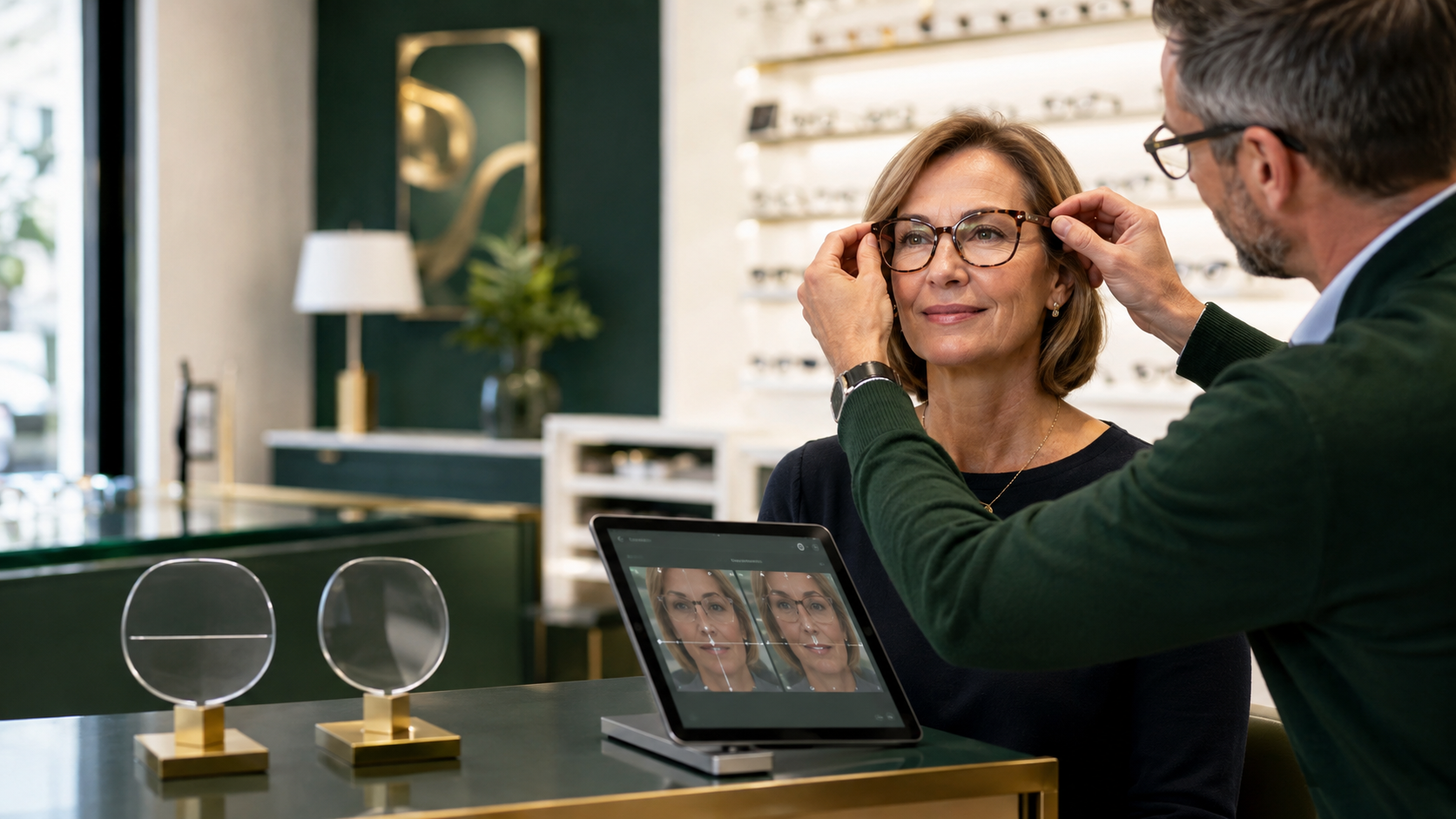
Your progressive measurements are not merely numbers that belong to your face forever. The final optical position changes with the selected frame and how it sits.
Important variables include:
Monocular pupillary distances
Fitting height in each lens
Frame tilt
Distance from the back of the lens to the eye
Frame wrap
Bridge position
How the frame settles after adjustment
The same person can require different fitting heights in two different frames. That is why a PD written on a prescription does not replace measurements made after the final frame has been selected and adjusted.
How Optikam improves consistency
See Well uses Optikam digital measurements to help collect frame-specific information consistently. The patient wears the adjusted frame while the system captures measurements that can be reviewed, saved and transmitted electronically.
This reduces dependence on a single quick ruler reading and creates a trackable record. Traditional measurements still have an important place when the frame, patient position or clinical situation makes them more appropriate. Technology supports professional judgment; it does not replace it.
Our optical team then communicates the frame, prescription, lens design, material, treatment and measurements to the laboratory as one coordinated order.
Explore our professionally fitted eyewear and Cincinnati optical.
Why frame choice matters for progressives
A frame should have enough usable lens depth for the chosen design while fitting securely on the face. A frame that constantly slides changes where the patient looks through the corridor. A frame that is too shallow may restrict the available zones. Excessive tilt or poor bridge contact can make a good lens feel wrong.
Our selection includes designer, independent and budget-conscious frames. The best frame is not automatically the most expensive one—it is the frame that fits, supports the prescription and works with the chosen lens design.
Patients sometimes arrive with an older Warby Parker, Costco or online frame they enjoy. We can use that experience constructively: what stayed in place, what slipped, where the vision worked and which distances felt limited. The goal is education, not criticism.
Are more advanced progressive lenses worth it?
They can be, particularly for patients with higher prescriptions, meaningful right-left differences, demanding intermediate tasks, prior adaptation difficulty or a strong desire for wider usable zones.
The value of a more advanced design is not a guarantee of perfect edge-to-edge vision. All progressives have optical tradeoffs. The potential benefit is more deliberate control of those tradeoffs and greater personalization.
For eyewear used from morning through evening, lens quality, measurements, coatings and professional support often matter more than patients initially expect. You are not only buying a frame—you are choosing the surface through which you will drive, work, shop and see the people around you.
What to expect during progressive adaptation
Many patients adapt quickly; others need several days or longer. Helpful habits include:
Wear the new glasses consistently rather than alternating constantly with an old prescription.
Point your nose more toward the object until you learn the usable zones.
Lower your eyes—not your entire head—for reading.
Move your head slightly for peripheral targets.
Use extra care on stairs and curbs during early wear.
Return for an adjustment if the frame slides or sits unevenly.
Do not assume that blur, headache or imbalance must simply be tolerated. A frame adjustment, measurement review or prescription evaluation may be appropriate.
When one pair is not enough
An everyday progressive tries to support many distances, but no lens can maximize every task simultaneously. Someone who spends eight hours at several monitors may benefit from a separate computer or office lens with a wider intermediate workspace. A golfer may prefer a design emphasizing distance and dashboard vision. A detailed hobby may need its own focal distance.
Multiple pairs are not duplication when each solves a different problem. Ask our team about currently available multiple-pair benefits when ordering eyewear; offers and eligibility can change.
Explore Hyde Park and nearby neighborhoods
See Well Eyecare is located in Hyde Park (45208), minutes from Oakley (45209) and Mariemont (45227). We help Cincinnati professionals, parents and active adults choose eyewear based on their work, driving, screens and recreation—not just the numbers on the prescription.
Free parking is available behind our Erie Avenue office. Bring your current glasses so we can learn what is and is not working before selecting the next pair.
Local Events & Attractions
A Living Museum of Botanical Splendor opens at Krohn Conservatory on Saturday, August 29, and continues daily through September 27. A mix of near botanical detail, walking and room-distance displays is a useful reminder of how often vision shifts during an ordinary outing.
Germania Society Oktoberfest runs Friday through Sunday, August 28–30. Outdoor walking, menus, signs and evening lighting put several progressive zones to work.
Cincinnati Parks hosts Stanbery Park Habitat Restoration on Saturday, August 29, from 9 a.m.–noon. Wear secure eyewear and use appropriate protective lenses for volunteer tasks involving branches or debris.
Event schedules and requirements can change. Check the official organizer before attending.
Frequently asked questions
Are progressive lenses the same as no-line bifocals?
People often use that phrase, but a progressive provides a gradual range from distance through intermediate to near. A traditional bifocal contains two distinct zones separated by a visible line.
Which is easier to get used to?
Many patients find the distinct bifocal segment straightforward. Many others adapt easily to progressives and prefer the intermediate vision and no-line appearance. Prescription, design, measurements and prior experience matter.
Can I drive in progressive lenses?
Yes, properly prescribed and fitted progressives are commonly used for driving. Distance vision is generally through the upper lens, with intermediate vision available for the dashboard. New wearers should adapt carefully before relying on unfamiliar eyewear in demanding conditions.
Are Varilux XR lenses right for everyone?
No single progressive design is best for everyone. Varilux XR may be valuable for patients seeking a premium, motion-aware design, but goals, prescription, frame, measurements and budget-conscious preferences should guide the recommendation.
Why can’t you use the same PD for every frame?
PD is only one part of fitting. The frame changes fitting height, tilt, wrap, vertex distance and where the lenses sit relative to each eye.
Can I buy the frame online and have progressive lenses made later?
Sometimes, but the frame must be suitable, structurally sound and capable of supporting the prescription and fitting dimensions. Warranty and adjustment limitations may apply to frames not purchased through our office.
Why do online progressives sometimes feel different?
Remote ordering may rely on limited measurements and cannot fully assess how the selected frame rests on the face. Some patients do well, but complex prescriptions and progressive designs often benefit from professional adjustment, measurement and follow-up.
Do I still need separate computer glasses if I have progressives?
Possibly. An everyday progressive includes intermediate vision, but a task-specific office lens may provide a wider workspace for prolonged multi-monitor use.
What happens if I cannot adapt?
Contact our office rather than giving up. We first check frame alignment, fit, measurements, prescription and how the lenses are being used. Eligible warranty or satisfaction provisions depend on the specific order and timing.
Choose the lens around your real life
The better question is not whether bifocals or progressives win in general. It is which design supports the distances you use every day.
Bring your current glasses and a description of your work, screens, driving and hobbies. Request an eye-exam or optical appointment with See Well Eyecare, and our staff will help you choose a frame and lens design that work together.
About See Well Eyecare
See Well Eyecare is a modern Cincinnati optometry practice led by Dr. Rawzi Baik in Hyde Park. Our professional staff provides comprehensive examinations, contact-lens care, pediatric eye care, medical eye care and personalized optical services with advanced measurement technology and ongoing support.
About the author
Dr. Rawzi Baik is a Cincinnati optometrist and founder of See Well Eyecare. He believes an eyewear recommendation should begin with how the patient actually sees, works and moves—not simply which lens category appears on an order form.
This article provides general education and does not replace an individualized examination or optical recommendation. Product availability, manufacturer specifications and warranty terms may change.
Quick Links
Helpful Articles
All Eye Care Services
Find personalized eye care excellence with our comprehensive services. From eye exams to advanced diagnostics, trust us for all your vision needs.

Keep In Touch
For non-urgent questions or to learn more about our services, contact us today!

We are an LGBTQ+ friendly clinic that believes all people deserve quality eye care
- 3330 Erie Avenue, Suite 14
Cincinnati, OH 45208 - Phone: (513) 268-8748
- Fax: (513) 268-8758
- Monday 9:00am - 3:00pm
- Tuesday 11:00am - 7:00pm
- Wednesday Closed
- Thursday 9:00am - 4:00pm
- Friday 8:00am - 5:00pm
- Saturday 9:00am - 3:00pm
- Sunday Closed
- Monday
- Tuesday
- Wednesday
- Thursday
- Friday
- Saturday
- Sunday
- Monday
- Tuesday
- Wednesday
- Thursday
- Friday
- Saturday
- Sunday
© 2026 See Well Eyecare. All rights Reserved - Accessibility Statement - Privacy Policy - Sitemap
Managed and Designed by 