
Your Child’s Myopia Prescription Changed—What Should Happen Next?
Your Child’s Myopia Prescription Changed—What Should Happen Next?
When a child needs stronger glasses again, parents often hear, “They are growing.” That may be true—but repeated increases in nearsightedness deserve more than another prescription and a vague plan to check again someday.
A stronger pair of glasses helps the child see clearly now. Childhood myopia follow-up in Cincinnati asks a different question: how quickly is the myopia progressing, and would an evidence-based treatment help slow future eye growth?
Whether the change was noticed at school, a pediatric visit, a hospital clinic or a routine eye examination, the next step should connect the new prescription with the child’s history and measurements.
Start With the Pattern, Not One Prescription
Bring previous prescriptions and dates whenever possible. A sequence is more useful than a single number because it shows how quickly the child’s nearsightedness has changed.
Dr. Baik also reviews:
- age when myopia began;
- family history;
- current glasses or contact-lens use;
- time spent outdoors and at near work;
- treatment adherence;
- visual acuity and focusing findings; and
- eye health.
The International Myopia Institute’s clinical-management report recommends structured follow-up and notes that axial-length measurements, when available, are useful at intervals such as every six months.
Why Axial Length Adds Information
Axial length is the front-to-back length of the eye. In many children with progressing myopia, the eye becomes longer. Refraction tells us the focusing prescription; axial length helps document physical eye growth.
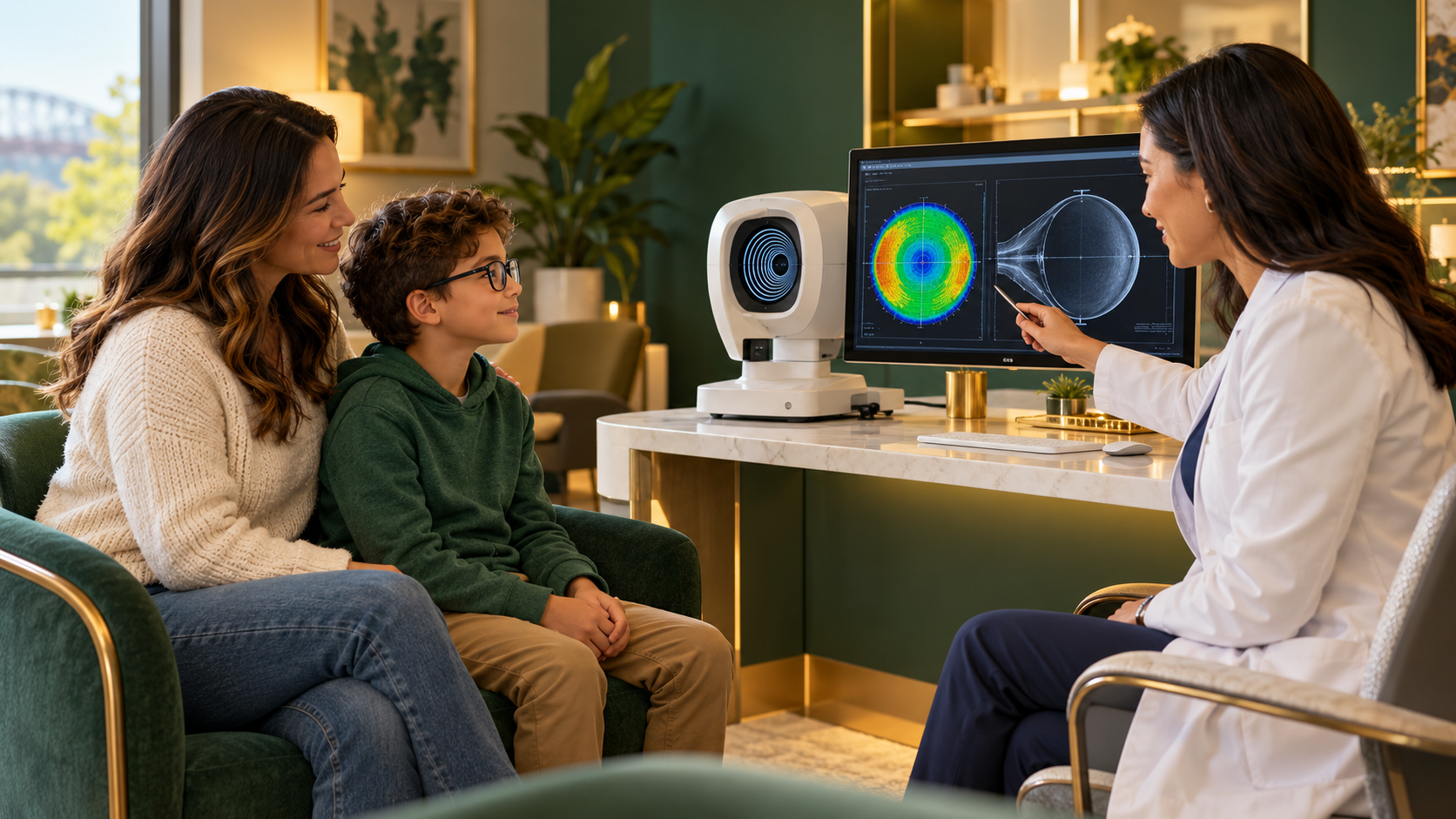
See Well uses the Topcon MYAH for axial-length measurement during appropriate myopia-management evaluations. One measurement cannot predict everything. Repeated measurements taken with a consistent method help show whether the eye’s growth pattern is changing.
The IMI clinical-trials and instrumentation report explains why both refractive and axial outcomes matter when evaluating myopia-control strategies.
A Regular Eye Exam and a Myopia Visit Have Different Jobs
A pediatric eye examination evaluates vision, prescription, focusing, alignment and eye health. A dedicated myopia-management visit goes further into progression, treatment candidacy, baseline measurements, risks, responsibilities and follow-up.
At See Well, this may include comparing four distinct approaches:
- Essilor Stellest spectacle lenses;
- MiSight 1 day soft contact lenses;
- orthokeratology/CRT worn overnight; and
- low-dose atropine used off-label in the United States.
These are not interchangeable products, and eligibility differs.
Keep the Treatment Distinctions Clear
The FDA authorization for Essilor Stellest lenses applies to spectacle lenses designed to correct myopia while slowing progression in children within the authorized parameters.
MiSight 1 day labeling specifies initiation for eligible children ages 8–12 with defined prescription and astigmatism limits. It is a daily disposable contact lens and requires contact-lens readiness and corneal-health oversight.
FDA information for orthokeratology lenses describes overnight corneal reshaping for temporary vision correction. Myopia-management use requires careful fitting, topography, hygiene and follow-up.
Low-dose atropine is prescribed off-label for myopia control in the United States. The LAMP randomized trial found concentration-dependent effects, while U.S. evidence reminds clinicians that results vary by formulation and population. “Off-label” does not mean prohibited; it means the exact concentration and indication are not FDA-approved.
For a full side-by-side overview, read See Well’s Cincinnati parent guide to myopia options.
Follow-Up Is Part of the Treatment
The product does not work independently of the care plan. Follow-up may assess:
- corrected vision and prescription change;
- axial-length change;
- lens fit or corneal topography;
- ocular-surface health;
- side effects;
- wearing or dosing consistency; and
- whether the plan remains appropriate.
Do not change atropine concentration, stretch contact-lens replacement, sleep in daily lenses or continue an uncomfortable lens without guidance. If a child stops wearing the treatment, tell the doctor honestly. The goal is to understand what is happening, not to assign blame.
Buying Where the Myopia Care Lives
When prescribed lenses, drops or devices are obtained through See Well, the product, instructions, measurements and follow-up stay connected. The team can confirm the exact lens design, support authentic supply channels, provide handling education, help with eligible manufacturer programs and troubleshoot problems with the child’s records in view.
This continuity does not guarantee a particular rate of control. It reduces the chance that a treatment change, product substitution or adherence problem becomes disconnected from the clinical plan.
Explore Hyde Park & Nearby Neighborhoods
See Well Eyecare provides pediatric eye care and myopia management in Hyde Park (45208), convenient to Oakley (45209), Mount Lookout and Mariemont (45227). Families can combine treatment-specific visits with a familiar neighborhood team rather than rebuilding the history at each prescription change.
Local Events & Attractions | HallZOOween on October 17–18
The Cincinnati Zoo’s official calendar lists HallZOOween from noon–5 p.m. on October 17–18. Outdoor family time is healthy and enjoyable, but it should complement—not replace—prescribed myopia treatment and monitoring.
Frequently Asked Questions
How much prescription change is “too much”?
There is no single threshold for every child. Age, time interval, axial length, starting prescription and risk factors all affect interpretation.
Why return every six months if my child can still see?
Clear vision in current glasses does not show whether the eye is continuing to lengthen. Follow-up measures progression and checks treatment safety.
Can my child switch from Stellest to MiSight or Ortho-K?
Possibly, but the decision requires a new candidacy review. Age, prescription, astigmatism, corneal shape, maturity, lifestyle and previous response matter.
Does outdoor time replace myopia management?
No. Outdoor time is encouraged, but it is not a guaranteed substitute for treatment in a child with established progressive myopia.
Is myopia treatment covered by vision insurance?
Coverage varies and is often limited. See Well can review available benefits and explain private-pay options without promising reimbursement.
Do Not Wait for the Next Stronger Prescription
If your child’s prescription is changing, request a myopia-management evaluation. Bring old prescriptions, current eyewear and any treatment records so the next recommendation is based on the full pattern.
About the Author
Dr. Rawzi Baik is the owner and optometrist at See Well Eyecare, an independent Hyde Park practice serving Cincinnati. He earned his Doctor of Optometry degree from The Ohio State University and provides comprehensive, pediatric and myopia-management care with clear explanations and individualized follow-up.
Primary keyword: childhood myopia follow-up Cincinnati
Supporting keywords: child prescription getting stronger, axial length monitoring, myopia management Hyde Park, pediatric eye doctor Oakley, six-month myopia visit
Quick Links
Helpful Articles

All Eye Care Services
Eye care for every stage of life, from routine exams and contact lens fittings to dry eye care, myopia management and medical eye visits. Dr. Baik helps you understand your options and choose care that fits your needs.

Keep In Touch
For non-urgent questions or to learn more about our services, contact us today!

We are an LGBTQ+ friendly clinic that believes all people deserve quality eye care
- 3330 Erie Avenue, Suite 14
Cincinnati, OH 45208 - Phone: (513) 268-8748
- Fax: (513) 268-8758
- Monday 9:00am - 3:00pm
- Tuesday 8:00am - 7:00pm
- Wednesday Closed
- Thursday 8:00am - 5:00pm
- Friday 8:00am - 3:00pm
- Saturday 9:00am - 2:00pm
- Sunday Closed
- Monday
- Tuesday
- Wednesday
- Thursday
- Friday
- Saturday
- Sunday
- Monday
- Tuesday
- Wednesday
- Thursday
- Friday
- Saturday
- Sunday
© 2026 See Well Eyecare. All rights Reserved - Accessibility Statement - Privacy Policy - Terms & Conditions - Sitemap
Managed and Designed by 