
Can Your Child See the Board? Vision Warning Signs During the First Weeks of School
Can Your Child See the Board? Vision Warning Signs During the First Weeks of School
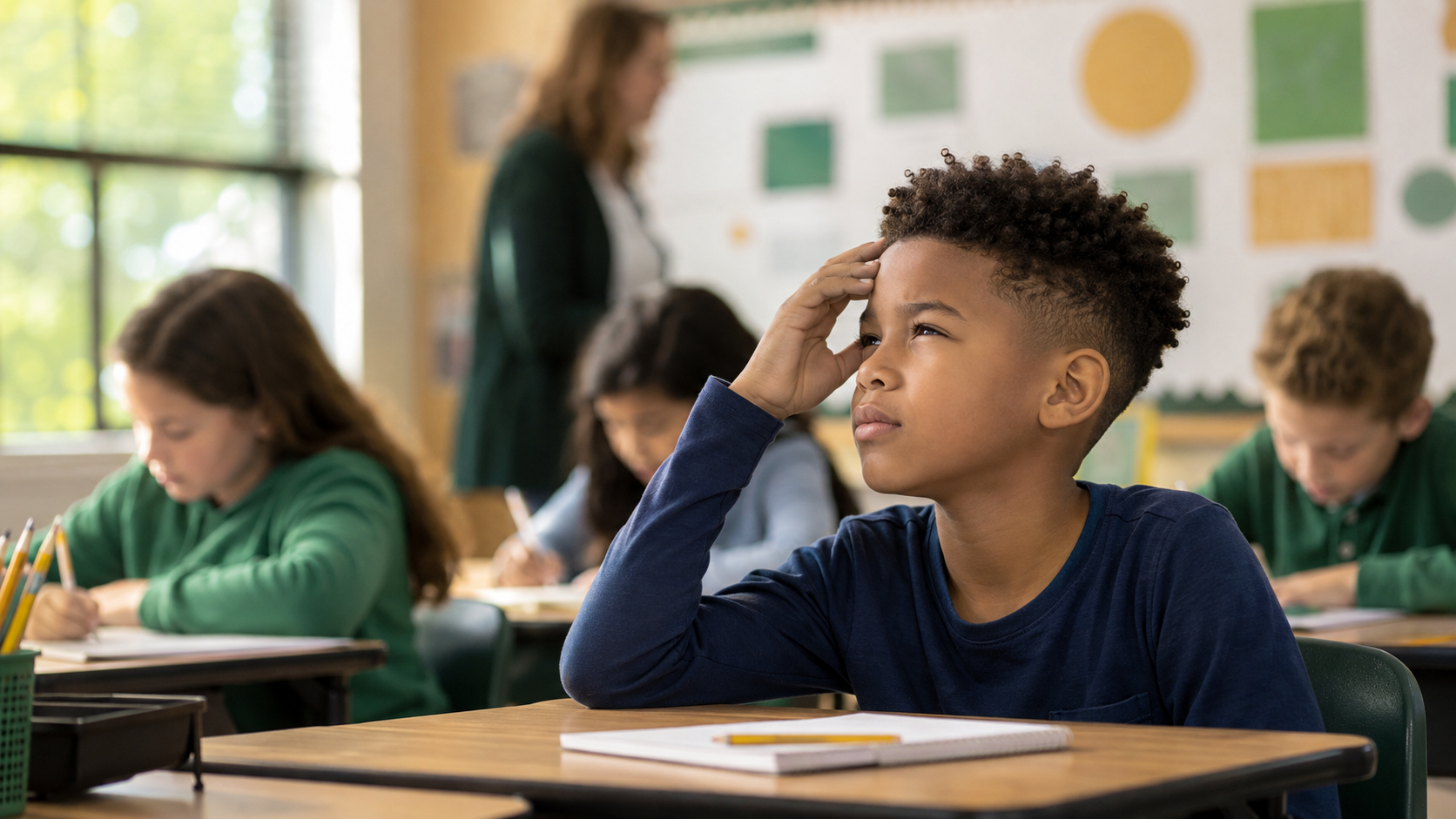
The first weeks of school give parents and teachers a new view of how a child uses vision.
At home, a child may sit close to a television or choose a comfortable distance from a tablet. In a classroom, the child must look across the room, copy from the board, read small print, move between near and far and stay focused for hours.
That change can reveal vision problems that were easy to miss during summer.
If your child begins squinting, complaining of headaches or avoiding reading, do not assume the new school routine is the only cause. A comprehensive pediatric eye exam can help determine whether vision is adding to the struggle.
Distance-Vision Signs: The Board Looks Blurry
Nearsightedness—also called myopia—often makes nearby work look clear while distant objects look blurry.
A child may not say, “The board is blurry.” Instead, you or the teacher may notice that the child:
squints across the room;
asks to move closer to the board;
copies from a classmate;
misses information shown at the front of the room;
has trouble recognizing people at a distance;
moves closer to the television; or
struggles to follow a ball, puck or player across a field or rink.
Older students may blame the projector, the lighting or a seat near the back. Those details are still useful. If moving closer consistently helps, distance blur deserves attention.
Near-Vision Signs: Reading Takes Too Much Effort
Clear distance vision is only one part of classroom success.
Children also use near vision to read, write, draw, use a tablet and complete worksheets. Watch for:
holding books very close;
losing place while reading;
using a finger to stay on the line;
skipping words or lines;
avoiding longer reading assignments;
rubbing the eyes;
closing or covering one eye;
tilting the head; or
becoming tired quickly during homework.
These signs do not prove that an eye problem is present. They tell us that a closer look may be useful.
The American Optometric Association’s school-aged vision guidance notes that headaches, eye rubbing, avoidance of near work, losing place and holding reading material close can be signs of a vision concern.
Headaches and Eye Fatigue After School
The school day asks the visual system to work for long periods. A child who seems fine in the morning may complain later in the day.
Ask when the headache begins:
Is it after reading?
Is it after computer work?
Is it above the eyes or across the forehead?
Does it improve on weekends?
Does it happen with blur, double vision or nausea?
Headaches have many possible causes. An eye exam does not replace a medical evaluation when one is needed. It can help determine whether prescription, focusing, eye coordination, dryness or visual demand may be contributing.
Seek prompt medical care for a severe sudden headache, headache after an injury, headache with weakness or confusion, or other concerning neurologic symptoms.
A Child May Avoid What Is Hard to See
Vision problems do not always look like blur.
A child may:
say reading is boring;
rush through written work;
avoid puzzles or detailed projects;
have a short attention span for near tasks;
prefer listening over reading;
become upset during homework; or
perform better when someone reads instructions aloud.
These behaviors can have many causes. Vision is one part of the picture.
An eye exam does not diagnose dyslexia, ADHD or a learning disability. It helps identify or rule out eye and vision problems that could make schoolwork less comfortable or efficient.
Watch How the Eyes Look and Move
Some signs are visible even when the child does not complain.
Schedule an evaluation if you notice:
one eye turning inward or outward;
frequent closing of one eye;
a new head tilt;
unusual blinking;
persistent redness;
repeated eye rubbing;
a drooping eyelid; or
unequal appearance of the pupils.
An eye that suddenly turns, a new drooping eyelid, unequal pupils with new symptoms, double vision or sudden vision change may need urgent evaluation.
Sports Can Reveal Vision Problems Too
The first weeks of school often bring soccer, football, hockey, swimming and other activities back onto the family calendar.
Vision skills used in sports include:
clear distance vision;
depth perception;
peripheral awareness;
tracking; and
eye-hand coordination.
A child who repeatedly swings late, loses sight of the puck, misjudges distance or cannot see a coach’s signal may need a vision check. Not every sports mistake comes from the eyes, but a clear and comfortable visual system provides a better starting point.
Regular glasses and contact lenses are not sports eye protection. Ask about activity-appropriate protective eyewear when a sport carries eye-injury risk.
What Teachers May Notice First
Teachers see children using vision in a setting parents cannot fully recreate at home.
Useful teacher observations include:
the child moves closer to the board;
written work does not match spoken answers;
the child loses place when copying;
attention fades during reading;
one eye is covered during desk work;
the child asks what is written across the room; or
performance changes based on seat location.
Ask for specific examples. “She cannot see the board from the third row” is more helpful than “She seems to have trouble seeing.”
Bring the teacher’s note to the eye exam if possible.
When the Prescription Keeps Changing
If a child’s distance prescription becomes stronger, ask whether myopia is progressing.
Myopia often begins during the school years. Standard glasses make distance vision clear, but they do not answer every question about progression.
Depending on age, prescription, eye health and history, Dr. Baik may recommend a separate myopia-management evaluation. That visit can include added measurements and a discussion of treatment choices designed for eligible children.
Myopia care is individualized. No treatment is right for every child, and no treatment can promise that progression will stop completely.
Help Your Child Describe the Problem
Children may give better answers when questions are simple and specific.
Instead of asking, “Can you see?” try:
Can you read what the teacher writes from your seat?
Does one eye see better than the other?
Do words stay clear while you read?
Do you ever see two of something?
Do your eyes hurt or feel tired after school?
Do you move closer because it looks clearer?
Are your glasses comfortable all day?
Avoid leading the child toward one answer. The goal is to understand the experience, not to test the child at home.
What to Bring to the Eye Exam
Bring:
current and previous glasses;
contact-lens boxes for teens who wear contacts;
screening results;
teacher observations;
a medication and allergy list;
family eye history; and
examples of when symptoms occur.
See Well Eyecare examines children age four and older. A parent or legal guardian should be present for check-in, the examination and checkout whenever possible.
About See Well Eyecare
See Well Eyecare is a modern Cincinnati eye-care practice led by Dr. Rawzi Baik. We take time to listen to children and parents, use age-appropriate testing and explain the findings in plain language.
Our team provides pediatric eye exams, myopia management, contact-lens care, medical eye care and professionally fitted eyewear for children age four and older, teens and adults.
Explore Hyde Park and Nearby Neighborhoods
Hyde Park: See Well Eyecare is located at 3330 Erie Avenue, Suite 14, near Hyde Park Square and the Cincinnati Observatory.
Oakley: Our free parking and Erie Avenue location are convenient for families from Oakley, ZIP code 45209.
Walnut Hills: Families and students from the Walnut Hills High School area in ZIP code 45207 can reach our office in minutes.
We also welcome families from Mariemont, Mount Lookout, Madisonville, Columbia-Tusculum, Madeira and Anderson Township.
Local Events & Attractions
Give your child a reason to look up, look far away and enjoy Cincinnati after the school day:
Family Astronomy Night: September 3 at the Cincinnati Observatory in Hyde Park, designed for families with children ages 5–12.
Saturday Nature Squad: Enchanted Forest: October 3 at Cincinnati Nature Center’s Rowe Woods.
Ohio Renaissance Festival: Weekends from September 5 through November 1 in Waynesville, with a different theme each weekend.
Registration, admission and schedules can change. Check the organizer’s official page before visiting.
Frequently Asked Questions
What is the most common sign that a child cannot see the board?
Squinting, moving closer and asking to change seats are common clues. Some children copy from classmates or avoid admitting that the board is blurry.
Can a child have a vision problem without failing a screening?
Yes. A screening may not evaluate every focusing, coordination, prescription or eye-health concern assessed during a comprehensive exam.
Are headaches after school always caused by the eyes?
No. Headaches have many causes. The timing and pattern can help determine whether an eye exam or medical evaluation is appropriate.
Why does my child hold books close?
It may be habit, comfort, blur or another vision issue. An examination is needed to understand the cause.
Can too much screen time cause the same signs?
Long periods of close work can cause fatigue and dryness, but persistent blur, headaches or avoidance should not automatically be blamed on screens.
Should I ask the teacher for information?
Yes. Seat location, copying problems and changes during reading can give the eye doctor useful real-world context.
What if my child’s prescription keeps getting stronger?
Ask whether the myopia is progressing and whether a dedicated myopia-management evaluation is appropriate.
Can teenagers wear contact lenses for school or sports?
Many can, depending on eye health, maturity and safe handling. A contact-lens evaluation is separate from the comprehensive exam.
Schedule an Exam When the Signs Are Fresh
Do not wait months to see whether a child simply “adjusts” to blurry or uncomfortable vision.
Request a pediatric eye exam at See Well Eyecare or call (513) 268-8748. Share the warning signs and any teacher observations when scheduling so our team can plan the appropriate visit.
See Well. Be Well.
About the Author
Dr. Rawzi Baik earned his Doctor of Optometry degree and Bachelor of Science in Microbiology from The Ohio State University. His experience includes primary eye care, ophthalmology settings, community health, pediatric vision care, dry-eye care, clinical education, healthcare consulting and professional leadership.
This article provides general education and does not replace an individual examination, diagnosis or emergency care.
Quick Links
Helpful Articles
All Eye Care Services
Eye care for every stage of life, from routine exams and contact lens fittings to dry eye care, myopia management and medical eye visits. Dr. Baik helps you understand your options and choose care that fits your needs.

Keep In Touch
For non-urgent questions or to learn more about our services, contact us today!

We are an LGBTQ+ friendly clinic that believes all people deserve quality eye care
- 3330 Erie Avenue, Suite 14
Cincinnati, OH 45208 - Phone: (513) 268-8748
- Fax: (513) 268-8758
- Monday 9:00am - 3:00pm
- Tuesday 8:00am - 7:00pm
- Wednesday Closed
- Thursday 8:00am - 5:00pm
- Friday 8:00am - 3:00pm
- Saturday 9:00am - 2:00pm
- Sunday Closed
- Monday
- Tuesday
- Wednesday
- Thursday
- Friday
- Saturday
- Sunday
- Monday
- Tuesday
- Wednesday
- Thursday
- Friday
- Saturday
- Sunday
© 2026 See Well Eyecare. All rights Reserved - Accessibility Statement - Privacy Policy - Terms & Conditions - Sitemap
Managed and Designed by 