
Cincinnati Construction, Rain & Glare: Is Your Vision Ready for I-75 and the Brent Spence Drive?
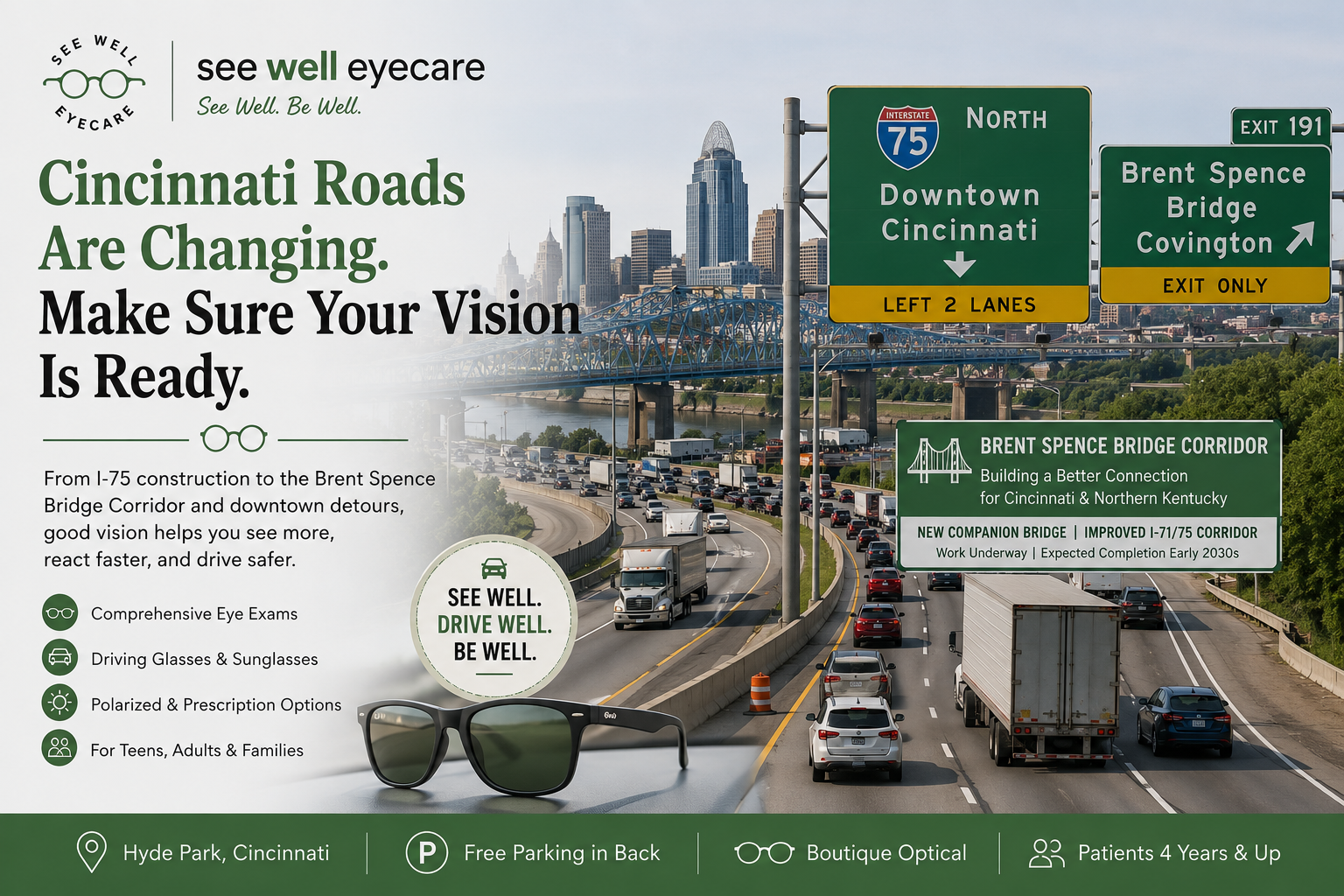
Cincinnati Construction, I-75 & Night Driving: Is Your Vision Ready for the Road?
If you've driven through Cincinnati lately, you've probably had at least one moment when you've thought:
"Was that lane always there?"
Between I-75 construction, the Brent Spence Bridge Corridor project, downtown ramp closures, construction near the Clay Wade Bailey Bridge, changing traffic patterns around Northern Kentucky, and seemingly endless orange barrels, driving around Cincinnati requires more attention than ever.
Then add our normal Cincinnati driving challenges: heavy truck traffic on I-75, potholes, faded or temporary lane markings, sudden rainstorms, nighttime glare, and drivers making last-second lane changes.
We can't fix Cincinnati traffic at See Well Eyecare.
But we can help with one thing that matters every time you get behind the wheel:
Making sure you're seeing the road as clearly and comfortably as possible.
Cincinnati Is Entering Years of Major Road Construction
The Brent Spence Bridge Corridor project isn't a small resurfacing project.
It includes a new companion bridge next to the existing Brent Spence Bridge, rehabilitation of the existing bridge, approximately five miles of I-71/75 improvements in Kentucky, and three miles of I-75 improvements in Ohio. Heavy construction began in spring 2026, with the new companion bridge currently expected to open in 2031 and approach work substantially complete by 2033.
That means Cincinnati drivers are going to be navigating construction for years.
Current work has already brought lane shifts, overnight interstate closures, long-term ramp closures in Covington, and significant changes to downtown access. Second Street has also been reduced near the Clay Wade Bailey Bridge, while several I-71, I-75, and U.S. 50 ramps around downtown are being closed, replaced, or rerouted.
For people traveling between Cincinnati and Northern Kentucky—including drivers navigating the river crossings and construction around the Licking River area—familiar routes may not always look or operate the way they used to.
When lanes shift and signs change, good vision becomes even more important.
And Then There Are the Trucks on I-75
Anyone who regularly drives I-75 knows how different the experience feels when you're surrounded by tractor-trailers.
There's a reason.
I-75 is a major national freight corridor connecting regions from Canada toward Florida, and the Brent Spence corridor handles enormous volumes of commercial traffic. The project identifies the corridor as one of the country's worst truck bottlenecks and reports that more than $400 billion in freight travels through it annually.
When you're driving beside a semi, your available sightlines can change quickly.
Add construction barriers, narrower-feeling lanes, temporary markings and a nighttime rainstorm, and the visual demands become considerably greater.
You need to recognize brake lights, lane markings, construction signs, merging vehicles and changing traffic patterns quickly.
That's not the time to discover your distance prescription isn't quite as sharp as you thought.
"I Can See Fine—Except When I Drive at Night"
We hear versions of this frequently.
Someone may see perfectly well during the day but feel much less confident after sunset.
Night driving creates different visual challenges. Contrast decreases, headlights create glare, road markings may become more difficult to distinguish, and rain can make everything worse.
A wet road can reflect headlights, streetlights and construction lighting directly back toward the driver.
Suddenly you're trying to distinguish:
Where is my lane?
Is that a construction barrier or the shoulder?
Where does this exit actually start now?
Is that truck coming into my lane?
Research has found measurable relationships between visual function and driving performance under glare and reduced-visibility conditions.
If you find yourself avoiding nighttime driving, struggling with road signs, bothered by headlights, or simply feeling less confident behind the wheel than you used to, mention it during your next comprehensive eye exam.
Cincinnati Rain Doesn't Help
Cincinnati weather has a special talent for changing halfway through your drive.
A sunny commute can quickly become a downpour.
Rain reduces contrast while wet pavement increases reflections from headlights and streetlights. Construction zones can make those conditions even more visually demanding.
Temporary lane markings, concrete barriers and unfamiliar traffic patterns require drivers to process visual information quickly.
Your glasses prescription may be only one part of the equation, but making sure you're seeing your best is an easy variable to address.
New Teenage Driver? Put an Eye Exam on the Checklist
There's another group we think about when discussing Cincinnati's changing roads:
Teenage drivers.
Getting a driver's license is exciting. But new drivers don't yet have years of experience anticipating what other drivers are about to do.
They're learning to scan intersections, watch mirrors, recognize hazards, maintain following distances and navigate unfamiliar roads—all simultaneously.
Now imagine learning those skills while navigating Cincinnati construction, heavy I-75 traffic, trucks, nighttime headlights and rain.
Before your teenager starts driving regularly, consider scheduling a comprehensive eye exam.
A basic vision screening and a comprehensive eye examination aren't the same thing.
We can evaluate whether your teenager is seeing clearly at distance and determine whether a prescription or updated eyewear could help them see their best behind the wheel.
Sunglasses Aren't Just About Looking Good
Bright Cincinnati afternoons present another driving challenge: glare.
Low-angle sunlight can significantly interfere with a driver's ability to see what's happening ahead. Research using simulated low-sun conditions has demonstrated deterioration in driving performance when glare is present.
That's one reason we frequently recommend quality polarized sunglasses for daytime driving.
Polarized lenses are designed to reduce reflected glare from surfaces such as pavement and vehicles.
That can make driving in bright conditions more visually comfortable, particularly when glare is coming off the road.
But dark lenses aren't automatically good lenses.
Proper UV protection, optical quality, lens color, prescription accuracy and polarization all matter.
And sunglasses—including polarized sunglasses—should not be worn for nighttime driving.
Prescription Sunglasses Can Be a Game Changer
If you need glasses to drive, there's no reason you should have to choose between your prescription and sunglasses.
Prescription sunglasses give you clear distance vision while helping manage bright sunlight and glare.
They can be especially useful for Cincinnati commuters who spend significant time driving during sunrise or late afternoon.
At See Well Eyecare, we carry a curated collection of sunglasses and can create prescription and polarized options based on your individual needs.
And because our optical is right on Erie Avenue, you can actually experience how different lenses perform in natural sunlight instead of choosing sunglasses entirely under indoor lighting.
Your Driving Glasses Should Be Designed for Driving
One thing patients don't always tell their optometrist is how they use their eyes.
Tell us.
If you spend an hour every day commuting on I-75, that's useful information.
If headlights bother you at night, tell us.
If you struggle seeing lane markings when it rains, tell us.
If your teenager just received their driver's license, tell us.
If you frequently travel between Cincinnati and Northern Kentucky, tell us.
Your prescription and eyewear recommendations should take your actual lifestyle into consideration.
Depending on your individual situation, we can discuss prescription changes, lens designs, anti-reflective treatments, prescription sunglasses, polarization and other options that may improve visual comfort.
From I-75 to Downtown Cincinnati, Your Eyes Have a Lot to Process
Think about everything your visual system may encounter during one Cincinnati commute.
You're traveling south on I-75 beside several tractor-trailers.
Traffic slows unexpectedly.
Your usual downtown exit has changed.
Construction barriers narrow your field of view.
Temporary signs direct you toward a different lane.
You approach the Brent Spence corridor.
It begins raining.
Then dusk arrives and headlights start reflecting from the wet pavement.
None of these situations is unusual.
Put them together, and seeing your best becomes much more important.
Cincinnati's infrastructure is undergoing a major transformation. The Brent Spence project alone encompasses roughly eight miles of I-71/I-75 through Ohio and Kentucky, including substantial reconstruction around downtown Cincinnati and Northern Kentucky.
You can't control the construction.
You can't control the weather.
You definitely can't control the other drivers.
But you can make sure your own vision isn't making the drive harder.
When Should You Schedule an Eye Exam for Driving Concerns?
Consider scheduling a comprehensive eye exam if you've noticed that:
- Road signs aren't clear until you're closer to them.
- Night driving has become noticeably more difficult.
- Headlights seem increasingly bothersome.
- You squint while driving.
- Rain makes lane markings difficult to distinguish.
- You're uncomfortable driving at dusk.
- Your current glasses prescription is several years old.
- Your teenager is beginning to drive.
- You've started avoiding certain roads or driving conditions because you don't feel confident in your vision.
Sometimes the solution is straightforward.
Other times, these symptoms give us a reason to investigate further.
Either way, we'd rather know about them.
Cincinnati's Roads Are Changing. Make Sure Your Vision Is Ready.
The Brent Spence Bridge Corridor project will eventually transform how Cincinnati and Northern Kentucky connect.
Getting there is going to require some patience.
Heavy construction began in 2026, the companion bridge is expected to open in 2031, and portions of the overall approach work are expected to continue through 2033.
That's a lot of Cincinnati commuting between now and then.
At See Well Eyecare, our job isn't to tell you how to navigate the next detour.
It's to help make sure you can see it.
Whether you're a teenager learning to drive, a parent spending afternoons driving between school and activities, a professional commuting downtown, or someone traveling I-75 between Cincinnati and Northern Kentucky every day, we'd be happy to help you see your best.
Stop by See Well Eyecare in Hyde Park
See Well Eyecare is an independent Cincinnati optometry practice conveniently located on Erie Avenue in Hyde Park, between Hyde Park and Oakley.
We provide comprehensive eye exams, contact lens care, medical eye care, and a full-service boutique optical with prescription eyewear and a curated collection of sunglasses.
Come check out our polarized sunglasses and prescription sunglass options, or schedule an eye exam if you're wondering whether your vision could be better behind the wheel.
And after navigating all that Cincinnati construction, here's some good news:
We have free patient parking behind our building.
Schedule Your Eye Exam
Schedule an appointment at See Well Eyecare
Or call us: (513) 268-8748
See Well. Drive Well. Be Well.
Visit See Well Eyecare in Hyde Park
After navigating Cincinnati traffic, construction zones, and changing road conditions, getting to your eye doctor should be the easy part.
See Well Eyecare is an independently owned optometry practice conveniently located at 3330 Erie Avenue, Suite 14, in Hyde Park, between Hyde Park and Oakley and in the same building as Hyde Park Pediatrics.
Our office is convenient for patients throughout Hyde Park, Oakley, Mount Lookout, Mariemont, Madeira, and Greater Cincinnati. We are also close to Hyde Park School, Kilgour School, and nearby Montessori schools, making our location convenient for families and young drivers.
We're near neighborhood favorites including Coffee Emporium and St. Francis Apizza, and just down Erie Avenue from Cincinnati's iconic Mushroom House.
See Well Eyecare provides comprehensive eye exams for patients ages 4 and older, contact lens care, medical eye care, pediatric eye care, and a full-service boutique optical featuring prescription eyewear, sunglasses, and polarized and prescription sunglass options.
Whether you're looking for a Hyde Park optometrist, an eye doctor near Oakley, new driving glasses, or a quality pair of polarized sunglasses for Cincinnati's sunny days, we'd be happy to help you find an option that fits your vision, lifestyle, and personal style.
And after dealing with I-75 and Cincinnati construction, here's one thing you won't have to worry about:
Free patient parking is available behind our building.
Quick Links
Helpful Articles
All Eye Care Services
Eye care for every stage of life, from routine exams and contact lens fittings to dry eye care, myopia management and medical eye visits. Dr. Baik helps you understand your options and choose care that fits your needs.

Keep In Touch
For non-urgent questions or to learn more about our services, contact us today!

We are an LGBTQ+ friendly clinic that believes all people deserve quality eye care
- 3330 Erie Avenue, Suite 14
Cincinnati, OH 45208 - Phone: (513) 268-8748
- Fax: (513) 268-8758
- Monday 9:00am - 3:00pm
- Tuesday 8:00am - 7:00pm
- Wednesday Closed
- Thursday 8:00am - 5:00pm
- Friday 8:00am - 3:00pm
- Saturday 9:00am - 2:00pm
- Sunday Closed
- Monday
- Tuesday
- Wednesday
- Thursday
- Friday
- Saturday
- Sunday
- Monday
- Tuesday
- Wednesday
- Thursday
- Friday
- Saturday
- Sunday
© 2026 See Well Eyecare. All rights Reserved - Accessibility Statement - Privacy Policy - Terms & Conditions - Sitemap
Managed and Designed by 