
CRT and Orthokeratology for Childhood Myopia in Cincinnati
CRT and Orthokeratology for Childhood Myopia
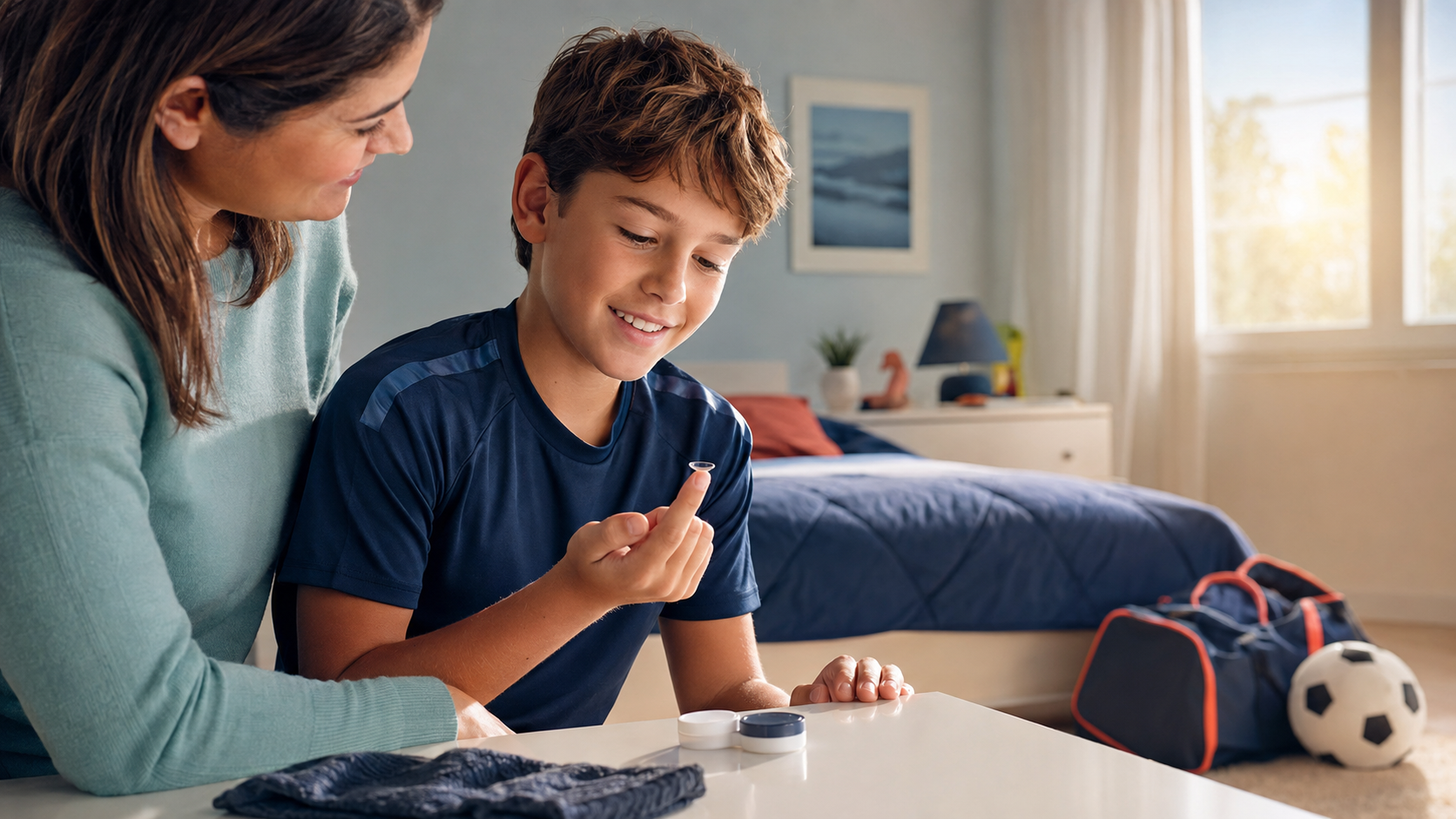
For a child who plays sports, swims, dances, or simply dislikes wearing glasses during the day, the idea of waking up with functional vision can be very appealing. Orthokeratology—often called Ortho-K—uses specially designed rigid gas-permeable contact lenses worn during sleep to temporarily reshape the front surface of the eye.
At See Well Eyecare, Dr. Rawzi Baik uses detailed measurements, corneal topography, and individualized follow-up to determine whether Bausch + Lomb CRT®/orthokeratology is an appropriate option for a child with myopia.
How Does Ortho-K Work?
The cornea is the clear front surface of the eye. An Ortho-K lens applies a controlled fluid-force pattern across the tear layer while the child sleeps, temporarily changing the cornea’s shape. The lens is removed in the morning, and the reshaped cornea provides clearer unaided vision during the day.
The effect is temporary and reversible. Regular overnight wear is generally needed to maintain daytime correction. If lens wear is discontinued, the cornea gradually returns toward its original shape and the child’s underlying prescription returns.
CRT, Arise, and FDA Wording
Bausch + Lomb’s corneal reshaping systems include CRT and the newer Arise™ fitting platform. These are prescription orthokeratology technologies used for temporary reduction of myopia through overnight corneal reshaping.
It is important to describe the regulatory status accurately. In the United States, these Bausch + Lomb lenses are cleared for overnight orthokeratology and temporary vision correction. They are not specifically FDA-approved with a labeled indication to slow childhood myopia progression. However, peer-reviewed research on orthokeratology as a treatment category supports a myopia-control effect in many children, particularly a reduction in axial elongation. Using Ortho-K for myopia-management purposes should therefore be discussed with informed consent and individualized clinical judgment.
No treatment works equally for every child, and Ortho-K does not cure or permanently remove myopia.
Why Active Children May Like Ortho-K
Potential advantages include:
Reduced dependence on glasses or daytime contacts.
Unobstructed peripheral vision for many sports.
No concern about glasses slipping during active play.
No daytime contact lens to dry out or become displaced.
A reversible, nonsurgical option.
The potential to slow axial elongation based on the broader orthokeratology evidence base.
Swimming still requires careful planning because exposing contact lenses or lens-care equipment to water increases infection risk. Ortho-K lenses should not be worn while swimming, showering, or in a hot tub, and they should never be rinsed or stored in tap water.
Who May Be a Candidate?
Ortho-K may be considered for a child who:
Has progressive myopia within a treatable range.
Has healthy eyes and a suitable corneal shape.
Is motivated to reduce daytime reliance on glasses.
Can cooperate with lens insertion, removal, cleaning, and follow-up.
Has a parent or caregiver able to supervise treatment consistently.
Participates in sports or activities where daytime glasses or contacts are inconvenient.
It may not be appropriate when a child has active eye inflammation or infection, significant ocular-surface disease, poor hygiene, an unsuitable corneal shape, or an inability to follow the prescribed care routine.
Why Corneal Topography Is Essential
Corneal topography creates a detailed map of the cornea’s curvature. At See Well Eyecare, the Topcon MYAH helps us evaluate whether the cornea is suitable, design and assess the lens fit, and compare the treatment pattern over time.
Topography is not merely an optional photograph. It helps us identify lens centration, treatment-zone shape, areas of excessive bearing or clearance, and changes that may require a lens adjustment.
Axial Length and the Myopia Calculator
Ortho-K changes the cornea to improve daytime vision, but myopia management also requires attention to the growth of the eye itself. Axial-length measurement with the Topcon MYAH helps us monitor whether the eye is continuing to elongate.
The Brian Holden Vision Institute Myopia Calculator can support a parent-friendly discussion of expected progression and treatment scenarios. It cannot predict an individual child’s outcome, and it does not replace measurements or clinical judgment.
The Ortho-K Fitting Process
1. Dedicated consultation
We review prescription history, age, family history, lifestyle, screen and near-work habits, outdoor time, eye health, and treatment goals. This is separate from a comprehensive eye examination.
2. Baseline measurements
Testing may include refraction, visual acuity, axial length, corneal topography, pupil assessment, tear-film evaluation, and slit-lamp examination.
3. Lens design and training
The measurements guide a customized lens design. The child and caregiver receive hands-on training in insertion, removal, cleaning, disinfection, and safe storage.
4. Early follow-up
Follow-up commonly occurs soon after the first night or early in treatment, then at additional intervals while vision and fit stabilize. Exact timing depends on the child and findings.
5. Ongoing monitoring
Periodic visits evaluate daytime vision, refraction, lens condition, corneal health, topography, wearing habits, and axial-length change. Replacement lenses may be needed because of wear, deposits, prescription change, fit change, damage, or loss.
Safety and Family Responsibility
Overnight contact lens wear carries a risk of complications, including corneal infection. That risk cannot be eliminated, but careful candidate selection, hygiene, supervision, and timely follow-up are central to safer wear.
Families should follow these principles:
Wash and thoroughly dry hands before handling lenses.
Use only prescribed lens-care products.
Never expose lenses, cases, or care products to tap water.
Replace the case and solutions as directed.
Never wear a damaged lens.
Do not wear lenses during an eye infection or significant illness unless instructed.
Stop lens wear and contact the office promptly for pain, marked redness, light sensitivity, discharge, or reduced vision.
Frequently Asked Questions
Will my child see perfectly after the first night?
Some children notice substantial improvement quickly, while others need several nights or lens adjustments. Temporary backup glasses may be useful during the early fitting period.
Is Ortho-K permanent?
No. Its corneal reshaping effect is temporary and generally requires regular overnight wear.
Does Ortho-K stop myopia completely?
No. Research supports a slowing effect for many children, but progression can continue and individual results vary.
Is there an age requirement?
Readiness, hygiene, supervision, prescription, corneal shape, and eye health matter more than a single universal age. Children approximately 6–18 may be evaluated, but not every child in that range is a candidate.
Can Ortho-K be combined with atropine?
Combination therapy may be considered when progression remains concerning, but it requires an individualized discussion about evidence, expected benefit, side effects, and monitoring.
About See Well Eyecare
See Well Eyecare is an independent optometry practice led by Dr. Rawzi Baik. Our myopia program combines careful clinical evaluation, Topcon MYAH measurements, corneal topography, patient education, and accessible follow-up. We take time to determine whether a child and family are genuinely prepared for overnight lens care.
Explore Hyde Park & Nearby Neighborhoods
Our Erie Avenue office is convenient to families in Hyde Park, Oakley, and Mariemont, with free parking. Parents can reach us from Hyde Park Square, the Oakley business district, and Mariemont’s family-centered neighborhoods without traveling to a large hospital campus.
Local Events & Attractions
Active families may enjoy Wasson Way, Ault Park, the Cincinnati Observatory, youth sports throughout the area, and seasonal activities around Hyde Park Square and Oakley. Confirm current schedules with event organizers.
Schedule a CRT/Ortho-K Consultation
If your child wants clearer daytime vision without glasses—or you are exploring Ortho-K as part of a myopia-management plan—schedule a dedicated consultation with See Well Eyecare. We will evaluate corneal shape, prescription, eye growth, lifestyle, and readiness before recommending a customized approach.
Myopia Management in Cincinnati
Quick Links
Helpful Articles
All Eye Care Services
Eye care for every stage of life, from routine exams and contact lens fittings to dry eye care, myopia management and medical eye visits. Dr. Baik helps you understand your options and choose care that fits your needs.

Keep In Touch
For non-urgent questions or to learn more about our services, contact us today!

We are an LGBTQ+ friendly clinic that believes all people deserve quality eye care
- 3330 Erie Avenue, Suite 14
Cincinnati, OH 45208 - Phone: (513) 268-8748
- Fax: (513) 268-8758
- Monday 9:00am - 3:00pm
- Tuesday 8:00am - 7:00pm
- Wednesday Closed
- Thursday 8:00am - 5:00pm
- Friday 8:00am - 3:00pm
- Saturday 9:00am - 2:00pm
- Sunday Closed
- Monday
- Tuesday
- Wednesday
- Thursday
- Friday
- Saturday
- Sunday
- Monday
- Tuesday
- Wednesday
- Thursday
- Friday
- Saturday
- Sunday
© 2026 See Well Eyecare. All rights Reserved - Accessibility Statement - Privacy Policy - Terms & Conditions - Sitemap
Managed and Designed by 