
Something in Your Eye? First Aid for Foreign Bodies and Corneal Scratches in Cincinnati
Something in Your Eye? First Aid for Foreign Bodies and Corneal Scratches in Cincinnati
A speck of dust may wash out with tears. A metal fragment from grinding can penetrate the eye. Both may initially feel like “something is stuck,” which is why the circumstances and symptoms matter.
If you have a foreign body or corneal scratch in Cincinnati, do not rub the eye or reach for tweezers. Gentle rinsing may help with loose surface debris, but an embedded object, high-speed impact or change in vision needs immediate professional care.
Why a Tiny Particle Can Hurt So Much
The cornea is the clear front surface of the eye and is densely supplied with nerves. A superficial scratch can cause sharp pain, tearing, redness, blurred vision and strong light sensitivity. The American Optometric Association’s corneal-abrasion guide explains that particles may also become trapped under the upper eyelid and scrape the cornea with each blink.
Common causes include:
windblown dust, sand or grit;
a fingernail, paper edge or makeup applicator;
sawdust, plant material or yard debris;
a torn contact lens;
metal generated by drilling, hammering or grinding; and
broken glass or another high-speed projectile.
The sensation can remain after a loose particle has left because the cornea may already be scratched. That is one reason persistent symptoms should not be treated by repeatedly probing the eye.
What to Do Immediately
For a small, loose particle with no high-speed impact, the American Academy of Ophthalmology’s first-aid guidance supports these simple steps:
Wash and dry your hands.
Do not rub the eye.
Blink several times and allow natural tears to work.
Rinse gently with clean water or sterile saline.
Remove a contact lens if it comes out easily; do not put it back in.
Arrange prompt care if discomfort, redness, light sensitivity or blurred vision continues.
The Mayo Clinic’s corneal-abrasion first-aid instructions also advise against touching the eye with cotton swabs, tweezers or other instruments.
When You Should Not Try to Remove It
Do not attempt home removal when:
the object appears embedded;
the eye will not close normally;
the object is on the colored part of the eye;
glass or metal struck the eye at high speed;
there is a cut, puncture or irregular pupil;
fluid or tissue appears to be leaking;
vision is reduced; or
pain is severe.
The National Library of Medicine’s foreign-object guidance specifically advises emergency evaluation after possible metal fragments from hammering or grinding. Do not press on the eye, and do not pull out a protruding object. A loose shield—such as the bottom of a clean paper cup—may help prevent accidental pressure while traveling for emergency care.
Chemical exposures follow a different priority: start continuous irrigation immediately rather than spending time looking for an object. Our Cincinnati emergency eye-care page explains how See Well evaluates urgent eye concerns, but severe trauma, penetration or major vision loss belongs in an emergency department.
What an Eye-Care Professional Checks
During an urgent examination, the clinician may:
measure vision in each eye;
examine the eyelids and turn the upper lid when appropriate;
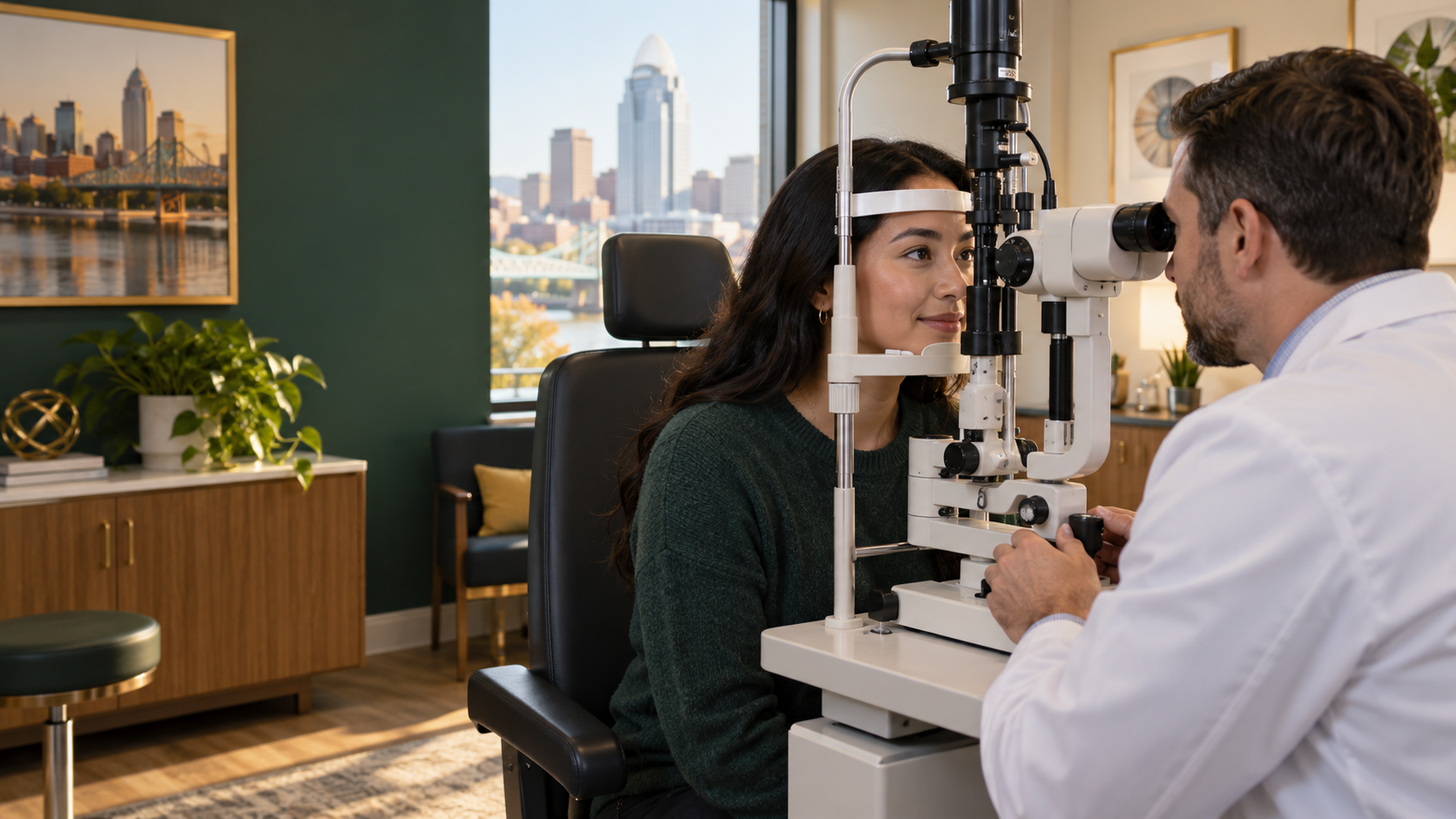
use magnification to look for a retained particle;
place fluorescein dye on the tear film to highlight a scratch;
assess the depth and location of the injury;
look for infection, inflammation or penetration; and
determine whether treatment, follow-up or specialist referral is needed.
Treatment depends on what happened. It may involve removal under magnification, lubrication, a prescribed antibiotic, pain control or close follow-up. Contact-lens wearers need particular caution because a painful red eye can also represent microbial keratitis. Do not restart lenses until the clinician says the surface has healed and contact-lens wear is safe.
Why Follow-Up May Matter
Many uncomplicated abrasions heal quickly, but “quickly” does not mean every injury is harmless. The MedlinePlus eye-emergency overview notes that persistent pain, light sensitivity, redness or vision change after an injury deserves medical attention.
Follow-up helps confirm that:
the epithelium has closed;
no particle remains;
an infection is not developing;
a metal fragment has not left a rust ring; and
symptoms are improving as expected.
If pain worsens, vision declines or discharge appears, contact the treating clinician promptly rather than waiting for the planned visit.
Prevention for Yardwork, Home Projects and Work
Ordinary eyeglasses are not impact protection. The AOA’s workplace eye-safety guidance emphasizes selecting protection appropriate to the task. Safety eyewear should fit well, provide the needed side coverage and carry the correct rating for the hazard.
At a comprehensive eye examination, tell us about woodworking, construction, gardening, cycling or other activities that expose you to debris. We can discuss vision correction that works with suitable protective eyewear instead of asking ordinary dress glasses to perform a job they were never designed to do.
Explore Hyde Park & Nearby Neighborhoods
See Well Eyecare is located at 3330 Erie Avenue, Suite 14 in Hyde Park (45208), with free parking behind the building. We are convenient for patients coming from Oakley (45209), Mount Lookout and Columbia-Tusculum who need a local eye doctor for routine or urgent concerns.
Local Events & Attractions | Ault Park and Fall Projects
Cooler days bring more yardwork, cycling and time outdoors around Ault Park. Whether trimming branches at home or riding on a windy trail, use task-appropriate eye protection and keep hands away from the eyes until they are clean.
Frequently Asked Questions
Can I rinse a speck out with tap water?
Clean running water is reasonable for gently rinsing a loose surface particle when there is no penetrating or high-speed injury. Sterile saline is also appropriate. Do not delay urgent care to find a special solution, and do not irrigate an obviously punctured eye.
Why does it still feel like something is there after the particle came out?
The particle may have scratched the cornea, or another fragment may remain under the eyelid. Persistent pain, tearing, redness, light sensitivity or blur warrants a medical eye examination.
Can I use leftover antibiotic or numbing drops?
No. Leftover medication may be inappropriate, expired or contaminated. Numbing drops used during examinations are not intended for unsupervised home use because repeated use can damage the cornea and hide worsening symptoms.
Should I patch the eye?
Do not apply a pressure patch without professional direction. Management depends on the injury. If an object is protruding, protect the area from pressure and go directly for emergency care.
When is the emergency department the right choice?
Go immediately for a penetrating injury, high-speed metal or glass impact, severe trauma, major vision loss, an irregular pupil, uncontrollable bleeding or an object embedded in the eye. Do not drive yourself if vision is unsafe.
Can See Well evaluate something in my eye?
See Well Eyecare evaluates many surface foreign bodies, abrasions and painful-eye complaints during available office hours. Submit an appointment request for non-life-threatening concerns; severe injuries should go directly to emergency care.
About the Author
Rawzi Baik, OD, is the owner and optometrist at See Well Eyecare in Hyde Park, Cincinnati. A graduate of The Ohio State University College of Optometry, he provides comprehensive and medical eye care with an emphasis on clear explanations, modern diagnostic technology and practical follow-through.
Do Not Keep Rubbing and Hoping
If rinsing does not quickly clear a simple speck—or if pain, redness, light sensitivity or blurred vision is present—arrange an examination. Prompt evaluation can separate a minor irritation from a retained particle, corneal abrasion or deeper injury.
Primary keyword: foreign body in eye Cincinnati
Supporting keywords: corneal scratch Cincinnati, something stuck in eye, corneal abrasion treatment, urgent eye care Cincinnati, eye injury Hyde Park
Quick Links
Helpful Articles

All Eye Care Services
Eye care for every stage of life, from routine exams and contact lens fittings to dry eye care, myopia management and medical eye visits. Dr. Baik helps you understand your options and choose care that fits your needs.

Keep In Touch
For non-urgent questions or to learn more about our services, contact us today!

We are an LGBTQ+ friendly clinic that believes all people deserve quality eye care
- 3330 Erie Avenue, Suite 14
Cincinnati, OH 45208 - Phone: (513) 268-8748
- Fax: (513) 268-8758
- Monday 9:00am - 3:00pm
- Tuesday 8:00am - 7:00pm
- Wednesday Closed
- Thursday 8:00am - 5:00pm
- Friday 8:00am - 3:00pm
- Saturday 9:00am - 2:00pm
- Sunday Closed
- Monday
- Tuesday
- Wednesday
- Thursday
- Friday
- Saturday
- Sunday
- Monday
- Tuesday
- Wednesday
- Thursday
- Friday
- Saturday
- Sunday
© 2026 See Well Eyecare. All rights Reserved - Accessibility Statement - Privacy Policy - Terms & Conditions - Sitemap
Managed and Designed by 