
Late-Summer Skywatching in Cincinnati: When You Need Eclipse Glasses—and When You Don’t
Late-Summer Skywatching in Cincinnati: When You Need Eclipse Glasses—and When You Don’t
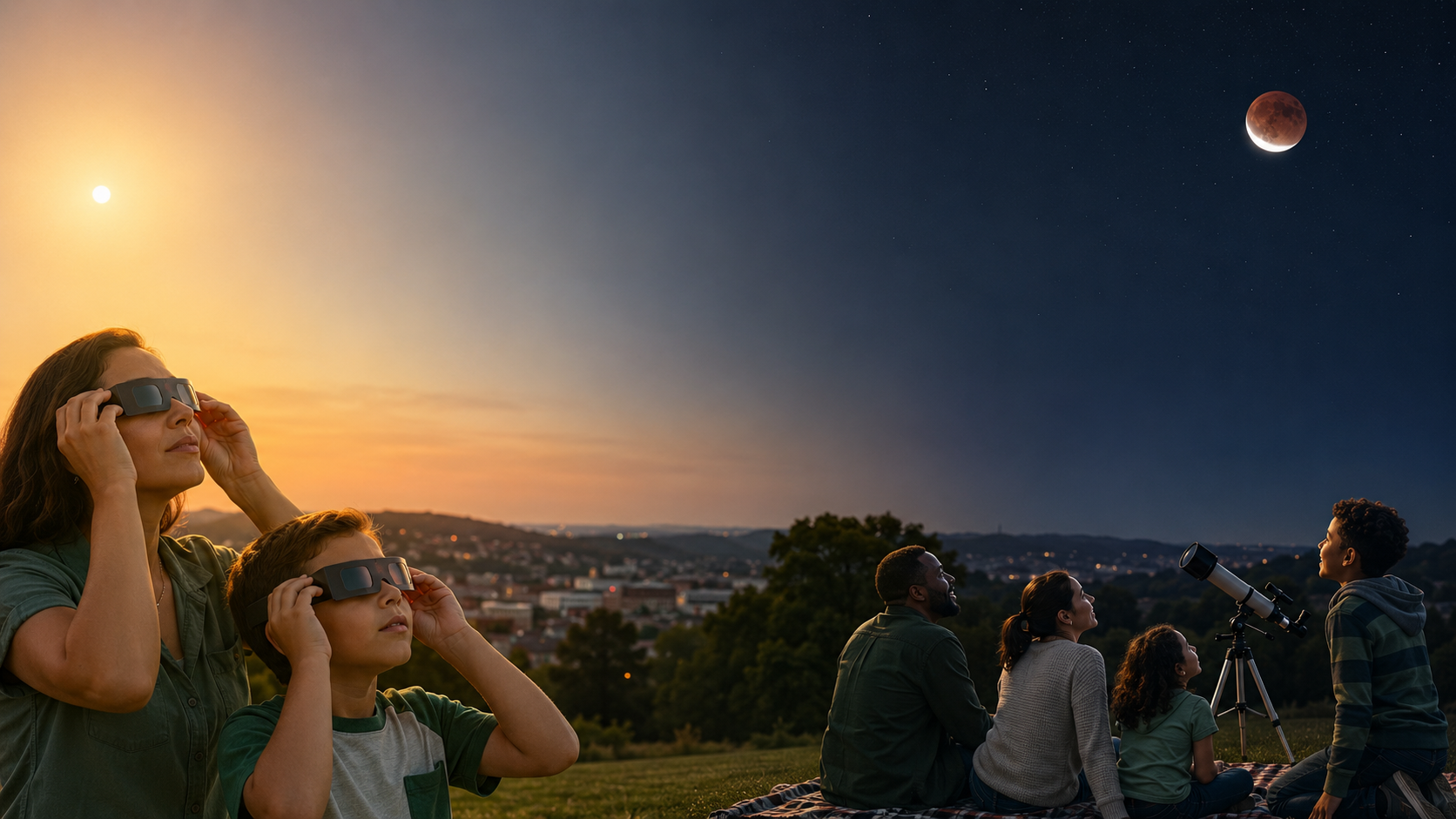
August 2026 has been an unusually busy month for astronomy: a total solar eclipse crossed parts of Europe and the Arctic on August 12, the Perseid meteor shower peaked under dark skies, Venus is bright after sunset, and a deep partial lunar eclipse is coming to Cincinnati on August 27–28.
Those events do not share the same eye-safety rules. Eclipse glasses are for looking at the Sun. They are not needed for a lunar eclipse, a meteor shower or ordinary nighttime stargazing.
Here is a practical Cincinnati family guide to knowing when eye protection is essential—and when it will only make the sky too dark to see.
First, a local correction about the August solar eclipse
The August 12, 2026 total solar eclipse was a remarkable global event, but its path of totality crossed northern Russia, Greenland, Iceland, northern Spain and part of Portugal. Some parts of the United States saw a small partial eclipse; Cincinnati was not a meaningful viewing location for that event.
That makes the remaining local highlight especially helpful for families: Cincinnati can see a deep partial lunar eclipse overnight on August 27–28. A lunar eclipse happens when Earth’s shadow falls on the Moon. Because you are looking at the Moon—not the Sun—it is safe to watch with your unaided eyes.
Cincinnati’s August 27–28 partial lunar eclipse
The local timeline is expected to be:
9:23 p.m. Thursday, August 27: penumbral eclipse begins;
10:33 p.m.: the noticeable partial phase begins;
12:12 a.m. Friday, August 28: maximum eclipse;
1:51 a.m.: partial phase ends; and
3:01 a.m.: penumbral phase ends.
At maximum, most of the Moon’s diameter will be inside Earth’s dark central shadow, so the covered area may look dramatically dim or coppery. Weather and clouds will determine what Cincinnati actually sees. The local timing is available from the Cincinnati eclipse page at Timeanddate.com.
Eye-safety rule: no eclipse glasses are needed for this lunar eclipse. It is safe to look at the Moon directly, and binoculars or a small telescope can provide a closer view.
When eclipse glasses really are required
Any time you intentionally look directly at the Sun—including the partial phases of a solar eclipse—you need a special-purpose solar viewer that conforms to the ISO 12312-2 standard. Ordinary sunglasses, even very dark ones, are not adequate.
The American Astronomical Society’s solar-viewing guidance recommends inspecting viewers for scratches, punctures, tears or other damage and supervising children while they use them.
For safe direct solar viewing:
Put the solar viewer over your eyes before turning toward the Sun.
Look briefly while the viewer stays securely in place.
Turn away from the Sun before removing the viewer.
Follow all instructions printed on the viewer.
Never use a phone screen, tinted plastic, exposed film, smoked glass or multiple pairs of sunglasses as a solar filter.
The most dangerous mistake: binoculars or a telescope
Do not look at the Sun through an unfiltered camera, telescope, binoculars or spotting scope. Do not place eclipse glasses between your eyes and an unfiltered optical device. Magnifying optics concentrate sunlight and can damage the viewer as well as the eye.
Solar filters for optical equipment must be designed for that specific purpose, secured to the front of the optics and used according to expert instructions. A telescope that is perfectly safe for the Moon at night can be dangerous when aimed toward the Sun.
Which August sky events are safe to watch directly?
Lunar eclipses: safe
The Moon reflects sunlight, but it is not bright enough to cause solar retinal injury. A lunar eclipse is safe with the naked eye, binoculars or a properly used telescope.
Meteor showers: safe
Meteor watching is ordinary nighttime viewing. No eclipse glasses are needed. In fact, solar viewers are so dark that they would prevent you from seeing the meteors.
Planets and stars after sunset: safe
Venus is especially prominent low in the western sky shortly after sunset from August 14–16. Looking at a planet or star at night is safe. Wait until the Sun is below the horizon before aiming binoculars or a telescope toward a low object, and make certain the optical path is nowhere near the Sun.
The Sun: protection required
If any bright part of the Sun is visible, use a proper solar viewer for direct viewing. The only exception is the brief total phase of a total solar eclipse while an observer is inside the narrow path of totality. Cincinnati was not in the path of totality for the August 2026 eclipse. During a partial solar eclipse, there is no safe glasses-off moment.
What solar eye injury can feel like
Solar retinopathy is damage to the light-sensitive retina from looking at the Sun. It is often painless, so the absence of pain does not prove the eyes are unharmed. Symptoms can begin hours after exposure and may include:
blurred or reduced central vision;
a central gray, dark or missing spot;
straight lines appearing bent or wavy;
changes in color perception;
light sensitivity; or
unequal vision between the two eyes.
If you or your child develops a new visual symptom after looking at the Sun, stop further viewing and contact an eye-care professional promptly. A home vision check cannot determine whether the retina has been injured.
A simple family skywatching kit
For a comfortable late-summer night outside, bring a blanket or reclining chair, a dim red flashlight, water and insect repellent. For solar events, add solar viewers from a reputable supplier and inspect them before use. Keep children beside an adult, practice putting the viewers on while facing away from the Sun and skip direct solar viewing if a child cannot keep the viewer securely in place.
An indirect pinhole projector can also show the Sun’s shape without direct viewing. The rule is simple: project the image onto a surface and look at the projection—never look through the pinhole at the Sun.
About See Well Eyecare
See Well Eyecare is an independent optometry practice led by Dr. Rawzi Baik in Hyde Park, Cincinnati. We provide comprehensive and urgent eye care with patient education, advanced diagnostic technology and a personal approach for adults and children age four and older.
If vision changes after solar viewing—or if your family is due for a comprehensive eye examination—request an appointment. Sudden severe vision loss or vision changes with neurologic symptoms may require emergency medical care.
Explore Hyde Park & Oakley
Late-summer skywatching can start close to home. Choose an open area with a clear horizon, stay away from traffic and private property, and give your eyes time to adjust after leaving bright storefronts or streetlights. For the lunar eclipse, look generally toward the southeast as the partial phase begins and higher toward the south as the night progresses.
Local event
The Cincinnati Observatory has announced a clear-skies-only partial lunar eclipse viewing event for the August 27–28 event. Check the Observatory’s official page on the day of the event for weather status, admission or registration details before leaving home.
Event times and availability can change. This article provides general eye-safety education and is not a diagnosis or a substitute for individualized medical care.
FAQs for the page
Do I need eclipse glasses for the August 27–28, 2026 lunar eclipse in Cincinnati?
No. A lunar eclipse is safe to watch directly. Eclipse glasses are for looking at the Sun and would make the Moon difficult or impossible to see.
Can I use regular sunglasses to watch a solar eclipse?
No. Ordinary sunglasses do not provide enough protection for direct solar viewing. Use a special-purpose solar viewer that conforms to ISO 12312-2.
Can I look at the Sun through binoculars while wearing eclipse glasses?
No. Unfiltered binoculars or telescopes concentrate sunlight and can damage the viewer and the eye. Optical equipment needs a purpose-built filter secured to the front of the optics and expert guidance.
What should I do if my vision is blurry after looking at the Sun?
Stop solar viewing and contact an eye-care professional promptly, especially for central blur, a missing spot, distortion or color changes. Solar retinal injury can be painless and may not be obvious immediately.
Quick Links
Helpful Articles
All Eye Care Services
Eye care for every stage of life, from routine exams and contact lens fittings to dry eye care, myopia management and medical eye visits. Dr. Baik helps you understand your options and choose care that fits your needs.

Keep In Touch
For non-urgent questions or to learn more about our services, contact us today!

We are an LGBTQ+ friendly clinic that believes all people deserve quality eye care
- 3330 Erie Avenue, Suite 14
Cincinnati, OH 45208 - Phone: (513) 268-8748
- Fax: (513) 268-8758
- Monday 9:00am - 3:00pm
- Tuesday 8:00am - 7:00pm
- Wednesday Closed
- Thursday 8:00am - 5:00pm
- Friday 8:00am - 3:00pm
- Saturday 9:00am - 2:00pm
- Sunday Closed
- Monday
- Tuesday
- Wednesday
- Thursday
- Friday
- Saturday
- Sunday
- Monday
- Tuesday
- Wednesday
- Thursday
- Friday
- Saturday
- Sunday
© 2026 See Well Eyecare. All rights Reserved - Accessibility Statement - Privacy Policy - Terms & Conditions - Sitemap
Managed and Designed by 