
Family History of Macular Degeneration? What Cincinnati Adults Can Do to Protect Their Vision
Family History of Macular Degeneration? What Cincinnati Adults Can Do to Protect Their Vision
If a parent or close relative lost central vision from macular degeneration, it is natural to wonder whether the same future is waiting for you.
The hopeful answer is that family history is a reason to become more intentional about eye health—not a prediction that you will lose vision. The dream outcome is to keep reading, driving, recognizing faces and enjoying the details of daily life for as long as possible. A thoughtful plan begins with understanding your individual risk, establishing an eye-health baseline and knowing which changes deserve attention.
Age-related macular degeneration, often shortened to AMD, affects the macula: the small central area of the retina responsible for sharp, detailed vision. AMD can interfere with reading, driving and recognizing faces, but it usually does not eliminate all peripheral vision.
At See Well Eyecare, Dr. Rawzi Baik provides comprehensive and medical eye care for adults in Hyde Park (45208), Oakley (45209), Mount Lookout, Mariemont and throughout Cincinnati. Depending on a patient’s age, symptoms, family history and examination findings, evaluation may include a retinal examination, Optomap ultra-widefield retinal imaging and dilation when clinically appropriate.
Does Family History Mean You Will Develop AMD?
No. Family history increases concern, but it does not determine the outcome by itself.
AMD is influenced by several factors. Some cannot be changed, including age and genetics. Others—especially smoking—can be addressed. A person with no known family history can still develop AMD, while a person with an affected parent may never develop vision-threatening disease.
What family history should change is the conversation. Tell your eye doctor:
Which relative was affected
Approximately when the condition was diagnosed
Whether one or both eyes were involved
Whether the relative received injections or was told they had “wet” AMD
Whether siblings or several family members have similar disease
Whether you have noticed distortion, a central blur or difficulty seeing faces
Even incomplete family information can be useful.
What Does the Macula Do?
The retina is the light-sensitive tissue lining the back of the eye. The macula sits near its center and provides the detailed vision needed for tasks such as reading fine print, threading a needle, following road signs and recognizing a face across a room.
The National Eye Institute’s guide to age-related macular degeneration explains that AMD can blur central vision because aging damages the macula. Peripheral vision is generally preserved, but loss of central detail can still have a major effect on independence and quality of life.
Dry AMD and Wet AMD
Dry AMD
Most people with AMD begin with the dry form. Changes may include deposits beneath the retina called drusen and alterations in the macular tissues. Progression can be slow, and early AMD may cause no noticeable symptoms.
Wet AMD
Wet AMD occurs when abnormal blood vessels grow and leak beneath the retina. It is less common but can cause more rapid or severe central vision change. Distortion, a new central blur or a dark or missing spot deserves prompt evaluation.
An eye examination is needed to determine whether AMD is present and what stage or type may be involved. Symptoms alone cannot make that distinction.
Symptoms That Should Not Be Ignored
Early AMD may be silent. When symptoms do occur, patients may notice:
Straight lines appearing wavy or bent
A blurry, dim or missing area near the center of vision
Greater difficulty reading small print
Needing brighter light for close work
Reduced contrast or colors appearing less vivid
More difficulty recognizing faces
A noticeable difference between the two eyes
Cover one eye at a time when checking a change. The better eye can mask distortion or blur in the other eye.
A sudden central change, new distortion or a dark spot should be evaluated promptly. New flashes, a sudden increase in floaters, or a curtain or shadow in the vision are different warning signs that may indicate a retinal tear or detachment and also require prompt attention.
How See Well Eyecare Evaluates Retinal and Macular Health
History and Vision Assessment
Dr. Baik reviews family history, smoking history, medications, medical conditions, visual symptoms and previous retinal findings. Vision is measured in each eye, and an Amsler-style grid or other central-vision assessment may be used when appropriate.
Comprehensive Eye Examination
A comprehensive examination evaluates more than the glasses prescription. The front and back of the eyes, pupils, eye pressure, optic nerves, retina and macula are assessed according to the patient’s needs and risk factors.
Optomap Ultra-Widefield Retinal Imaging
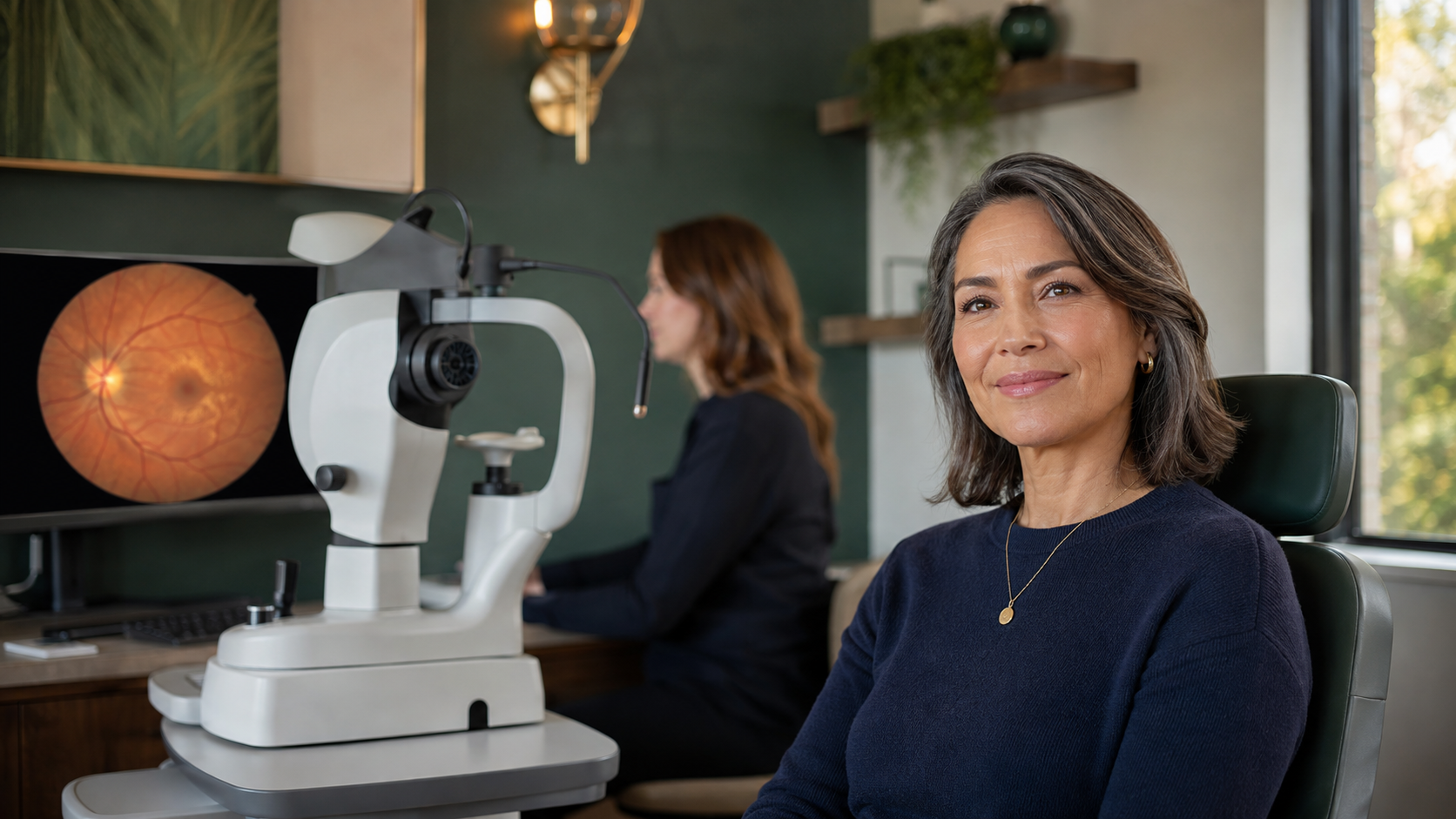
Optomap creates a wide-field digital image of the retina. At See Well Eyecare, it can provide useful baseline documentation and help Dr. Baik compare retinal appearance over time. The image can also make it easier to show and explain findings to the patient.
Optomap is an adjunct to examination. It does not make every diagnosis, and it does not replace dilation when a dilated retinal examination is clinically indicated.
Dilated Retinal Examination and Referral
Dilating drops widen the pupil so the doctor can examine the retina through a larger opening. Dilation may be recommended based on symptoms, age, family history, imaging or examination findings.
When findings suggest AMD or another macular condition that needs advanced imaging or treatment, Dr. Baik can coordinate referral to an ophthalmologist or retina specialist. See Well Eyecare does not present routine imaging as a substitute for specialist care.
What Can You Do to Lower Modifiable Risk?
No lifestyle can guarantee that AMD will be prevented. Still, several habits support overall eye and systemic health.
Do Not Smoke
Smoking is one of the most important modifiable risk factors associated with AMD. If you smoke, ask your primary care clinician about evidence-based help with quitting. Avoiding tobacco is valuable for the eyes, heart, lungs and circulation.
Build a Nutrient-Dense Eating Pattern
Rather than searching for one “magic” eye food, aim for a consistent dietary pattern that includes leafy green vegetables, colorful fruits and vegetables, fish and other nutrient-dense foods appropriate for your overall medical needs.
Lutein and zeaxanthin are concentrated in the macula and are found in foods such as dark leafy greens. Food-first guidance remains important even when a supplement is considered.
Support Cardiovascular Health
Regular physical activity and appropriate management of blood pressure, cholesterol, diabetes and other systemic conditions support long-term health. Your primary care clinician can help personalize those goals.
Use Quality UV Protection
Wear sunglasses that block ultraviolet radiation and consider a brimmed hat during extended outdoor exposure. Polarized lenses can improve comfort by reducing reflected glare, although polarization itself is not a treatment for AMD.
Keep Recommended Eye Examinations
AMD can be present before vision feels different. The appropriate examination interval depends on age, family history, previous findings and other risks. A baseline examination gives future visits something meaningful to compare.
Should Everyone With a Family History Take AREDS2?
No. AREDS2 is not a general multivitamin for everyone with an affected relative.
The National Eye Institute’s AREDS2 guidance explains that the evidence-based formulation may help slow progression for people with intermediate AMD in one or both eyes. It does not prevent early AMD from developing into intermediate AMD, and it is not intended simply because a parent had the condition.
Before starting AREDS2 or another high-dose supplement, have your eyes examined and review the product with the appropriate clinician. Supplements can vary in formulation and may interact with medications or be inappropriate for certain patients.
Some patients ask about MacuHealth or other eye-health supplements. These products should be discussed in the context of the examination findings, diet, medical history and the evidence for the patient’s specific condition. A supplement should never be presented as a replacement for retinal examination, smoking cessation, a nutrient-dense diet or indicated treatment.
What About Home Monitoring?
An Amsler grid may help some patients monitor central distortion between visits. It should be used one eye at a time, with the usual reading correction, according to the clinician’s instructions.
Home monitoring does not replace an eye examination. Contact the office promptly if straight lines become newly wavy, an area looks missing or dim, or central vision changes. Do not wait for the next routine visit to mention a new symptom.
Frequently Asked Questions
At what age should I be checked if my parent had macular degeneration?
There is no single starting age for everyone. The right timing depends on your age, symptoms, prescription, smoking history, medical history and what happened in your family. If you do not have an established eye-care baseline, schedule a comprehensive examination and share the family history.
Can an ordinary vision screening detect AMD?
A screening that measures distance acuity may miss early retinal changes. A comprehensive eye examination evaluates eye health in addition to how clearly you read an eye chart.
Does Optomap replace dilation?
No. Optomap can provide valuable wide-field documentation and support patient education, but dilation may still be needed depending on symptoms, risk factors and examination findings.
Will sunglasses prevent macular degeneration?
No pair of sunglasses can guarantee prevention. Quality UV-blocking eyewear is still sensible protection for outdoor exposure and can improve visual comfort. Choose lenses that block UV; polarization is an additional glare-reducing feature.
Should I take an eye vitamin if AMD runs in my family?
Not automatically. AREDS2 is supported for specific stages of diagnosed AMD, not for every person with family history. Ask your eye doctor whether any supplement is appropriate after your retinal health and medical history have been reviewed.
Where can I have my retina checked near Hyde Park or Oakley?
See Well Eyecare provides comprehensive eye examinations and retinal evaluation at 3330 Erie Avenue, Suite 14, in Cincinnati’s Hyde Park neighborhood, minutes from Oakley and Mount Lookout. Dr. Baik can discuss whether Optomap imaging, dilation, monitoring or referral is appropriate for you.
Schedule a Comprehensive Eye Examination
If macular degeneration runs in your family—or you simply do not know when your retina was last examined—schedule a comprehensive eye examination with Dr. Rawzi Baik at See Well Eyecare. Bring any known family details and a list of supplements or medications you use.
The goal is not to make you worry about a future that may never occur. It is to understand your present eye health, identify meaningful risks and create a sensible plan for protecting your vision.
About See Well Eyecare
See Well Eyecare is an independent optometry and optical practice at 3330 Erie Avenue, Suite 14, Cincinnati, Ohio 45208. Dr. Rawzi Baik provides comprehensive and medical eye care, Optomap ultra-widefield retinal imaging, contact lens services, dry-eye evaluation, pediatric care for ages 4 and older, myopia management and personalized optical care.
We use technology when it adds meaningful information and take time to explain what the findings mean for the individual patient.
Explore Hyde Park & Oakley
See Well Eyecare is located on Erie Avenue between Hyde Park Square and Hyde Park Plaza, close to Oakley, Mount Lookout and the Wasson Way corridor. Patients can combine a scheduled examination with a walk, coffee, lunch or errands in one of Cincinnati’s most connected east-side neighborhoods.
Free patient parking is available behind the building. Our location gives Hyde Park and Oakley residents a nearby independent option for routine monitoring, medical eye concerns and coordinated specialty referral when needed.
Quick Links
Helpful Articles

All Eye Care Services
Eye care for every stage of life, from routine exams and contact lens fittings to dry eye care, myopia management and medical eye visits. Dr. Baik helps you understand your options and choose care that fits your needs.

Keep In Touch
For non-urgent questions or to learn more about our services, contact us today!

We are an LGBTQ+ friendly clinic that believes all people deserve quality eye care
- 3330 Erie Avenue, Suite 14
Cincinnati, OH 45208 - Phone: (513) 268-8748
- Fax: (513) 268-8758
- Monday 9:00am - 3:00pm
- Tuesday 8:00am - 7:00pm
- Wednesday Closed
- Thursday 8:00am - 5:00pm
- Friday 8:00am - 3:00pm
- Saturday 9:00am - 2:00pm
- Sunday Closed
- Monday
- Tuesday
- Wednesday
- Thursday
- Friday
- Saturday
- Sunday
- Monday
- Tuesday
- Wednesday
- Thursday
- Friday
- Saturday
- Sunday
© 2026 See Well Eyecare. All rights Reserved - Accessibility Statement - Privacy Policy - Terms & Conditions - Sitemap
Managed and Designed by 