
Multifocal Contact Lenses After 40: Can You See Distance, Screens and Near Without Readers?
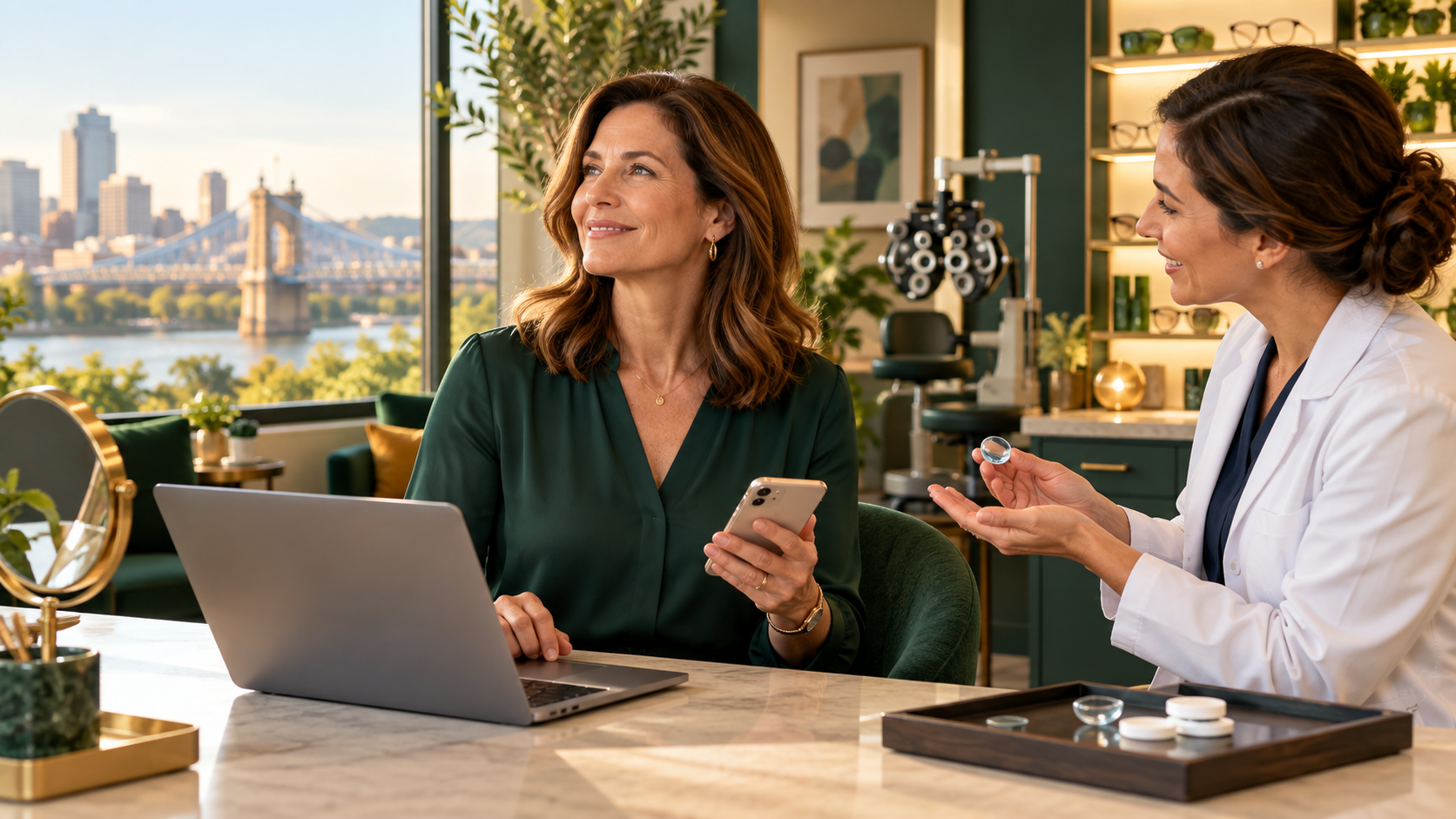
Multifocal Contact Lenses After 40: Can You See Distance, Screens and Near Without Readers?
If your phone has started moving farther away while distance vision remains clear, you may be noticing presbyopia. This normal age-related focusing change usually becomes noticeable in the early-to-mid 40s.
Reading glasses and progressive eyeglasses are excellent solutions, but they are not the only ones. Multifocal contact lenses after 40 may reduce dependence on readers by placing more than one focusing power within each lens.
The goal is not perfect vision at every distance under every condition. It is a practical balance for the tasks that matter most to you.
Presbyopia Is Not the Same as Farsightedness
The National Eye Institute’s presbyopia guide explains that the natural lens inside the eye becomes less flexible with age. This makes near focusing harder even for someone who has never needed glasses.
Presbyopia continues to change for years. A contact-lens design that worked at 43 may need adjustment later as near demand increases.
How Multifocal Contacts Work
Most soft multifocal lenses contain zones or optical profiles for distance, intermediate and near. Both eyes receive blended information, and the visual system learns which details to emphasize for a given task.
That differs from monovision, in which one eye is typically biased toward distance and the other toward near. Some patients prefer multifocals; others prefer monovision or modified combinations. A diagnostic fitting helps compare the experience rather than choosing from a description alone.
See Well’s multifocal contact-lens service begins with the glasses prescription, eye dominance, pupil behavior, corneal health, tear film and real-world priorities.
Set Priorities Before Selecting a Lens
Tell Dr. Baik which situations matter most:
- driving, especially after dark;
- one or more computer monitors;
- phone and menu reading;
- presentations and meetings;
- sports or exercise;
- detailed hobbies; and
- long contact-lens wearing days.
A person who spends eight hours at dual monitors may need a different balance than someone who prioritizes nighttime driving and occasional phone use.
Daily Disposable and Reusable Options
Replacement schedule is part of the clinical decision. Daily disposable multifocals offer a fresh lens each day and eliminate the storage case. Reusable designs may provide different prescription ranges or material choices but require consistent cleaning and replacement.
One current option is MyDay multifocal from CooperVision, a daily disposable multifocal design. It may be considered when the prescription, ocular surface and visual goals fit; the product page does not determine individual candidacy.
Other multifocal designs may also be appropriate. Dr. Baik prescribes the exact brand, base curve, diameter, power and add—not a generic “multifocal” category.
The FDA explains that contact lenses require a valid, lens-specific prescription because they are medical devices worn directly on the eye.
Why Trial Lenses and Follow-Up Matter
A contact-lens examination evaluates more than reading a chart. Dr. Baik checks lens movement, centration, surface wetting, distance and near performance, and the corneal response.
Early impressions are useful, but adaptation may continue outside the exam room. Use the lenses for approved real tasks, then report specifically:
- “The dashboard is clear, but signs blur at night.”
- “The laptop works, but fine print is difficult.”
- “Vision becomes inconsistent after six hours.”
Those details are more actionable than “I do not like them.”
Dry Eye Can Limit Multifocal Performance
A multifocal design depends on stable optics. When the tear film breaks up, vision may fluctuate more than it would through glasses. Dryness, burning, watering or shortened wear time deserves evaluation rather than repeated power changes.
The CDC’s contact-lens care guidance reinforces clean, dry hands, water avoidance and appropriate replacement. Healthy habits matter with every multifocal design.
Ordering Through See Well Keeps the Fit Connected
When patients order their exact prescribed contacts through See Well, the practice can support prescription accuracy, authentic supply, eligible manufacturer rebates, annual-supply convenience and free home shipping for qualifying annual supplies. Temporary diagnostic lenses may be available for purchasing patients when clinically appropriate.
Before ordering elsewhere, ask what is included. Keeping the prescription, product, fitting and follow-up connected gives you a local team that can help when near vision, comfort or the exact product changes.
The FTC Contact Lens Rule protects prescription portability; it does not make every seller responsible for clinical fitting or corneal follow-up.
Keep Glasses in the Plan
Even successful multifocal wearers should have current glasses. You may prefer glasses for late-night driving, eye irritation, illness or days when contacts need to come out. A task-specific computer pair can also complement contacts when sustained screen work exceeds what the lens balance comfortably provides.
Explore Hyde Park & Nearby Neighborhoods
See Well Eyecare provides multifocal contact-lens fittings in Hyde Park (45208), convenient to Oakley (45209), Mount Lookout and Mariemont (45227). Our locally owned practice offers one familiar team for the eye examination, contact-lens fitting, annual supply and troubleshooting.
Local Events & Attractions | Hyde Park Farmers’ Market on October 18
The Cincinnati Parks calendar lists the Hyde Park Farmers’ Market on October 18. A market visit is a useful real-world test of distance signs, intermediate conversation and near labels—but only after the lens has been dispensed for approved trial wear.
Frequently Asked Questions
Will multifocal contacts eliminate reading glasses completely?
Not for everyone. Many patients reduce reader use, while very fine print, dim lighting or prolonged near work may still require additional help.
Are multifocal contacts available for astigmatism?
Options exist, but prescription ranges vary. Some patients need a specialized design or a different strategy.
How long does adaptation take?
Some people adapt quickly; others need several days, targeted adjustments or a different design. Follow the wearing schedule and report task-specific problems.
Can I order a different multifocal brand with the same power?
No. Brand, material, geometry and parameters are part of the prescription. A different product requires professional evaluation.
Are annual-supply rebates guaranteed?
No. Manufacturer programs change and have eligibility rules. See Well can review current options for the exact prescribed product.
Try the Lens in Your Real Life
If readers are interrupting work, exercise or social time, request a multifocal contact-lens evaluation. Bring your current contacts, glasses and approximate screen distances.
About the Author
Dr. Rawzi Baik is the owner and optometrist at See Well Eyecare, an independent Hyde Park practice serving Cincinnati. He earned his Doctor of Optometry degree from The Ohio State University and provides comprehensive, contact-lens, dry-eye and specialty care with clear explanations and individualized follow-up.
Primary keyword: multifocal contact lenses after 40 Cincinnati
Supporting keywords: presbyopia contacts Cincinnati, MyDay multifocal, contact lens exam Hyde Park, multifocal contacts Oakley, contacts instead of readers
Quick Links
Helpful Articles

All Eye Care Services
Eye care for every stage of life, from routine exams and contact lens fittings to dry eye care, myopia management and medical eye visits. Dr. Baik helps you understand your options and choose care that fits your needs.

Keep In Touch
For non-urgent questions or to learn more about our services, contact us today!

We are an LGBTQ+ friendly clinic that believes all people deserve quality eye care
- 3330 Erie Avenue, Suite 14
Cincinnati, OH 45208 - Phone: (513) 268-8748
- Fax: (513) 268-8758
- Monday 9:00am - 3:00pm
- Tuesday 8:00am - 7:00pm
- Wednesday Closed
- Thursday 8:00am - 5:00pm
- Friday 8:00am - 3:00pm
- Saturday 9:00am - 2:00pm
- Sunday Closed
- Monday
- Tuesday
- Wednesday
- Thursday
- Friday
- Saturday
- Sunday
- Monday
- Tuesday
- Wednesday
- Thursday
- Friday
- Saturday
- Sunday
© 2026 See Well Eyecare. All rights Reserved - Accessibility Statement - Privacy Policy - Terms & Conditions - Sitemap
Managed and Designed by 