
Myopia Management in Cincinnati: A Parent’s Guide to Slowing Childhood Nearsightedness

Myopia Management in Cincinnati: A Parent’s Guide to Slowing Childhood Nearsightedness
If your child’s glasses prescription becomes stronger each year, you may wonder whether anything can be done beyond ordering thicker or stronger lenses. In many cases, the answer is yes.
Traditional glasses and contact lenses correct blurry vision, but most conventional designs are not intended to slow the progression of childhood myopia. Myopia management takes a broader approach: it evaluates how quickly a child’s nearsightedness is changing, measures eye growth when appropriate, considers personal risk factors, and recommends treatment designed to reduce progression.
At See Well Eyecare, Dr. Rawzi Baik provides individualized myopia-management care for children and teenagers in Cincinnati. Our goal is not simply to help a child see the board today. We want families to understand what the prescription means, why it may be changing, and which options may support better long-term eye health.
What Is Childhood Myopia?
Myopia, commonly called nearsightedness, causes distant objects to appear blurry while closer objects are usually clearer. It often begins during the school years and may continue to progress as a child grows.
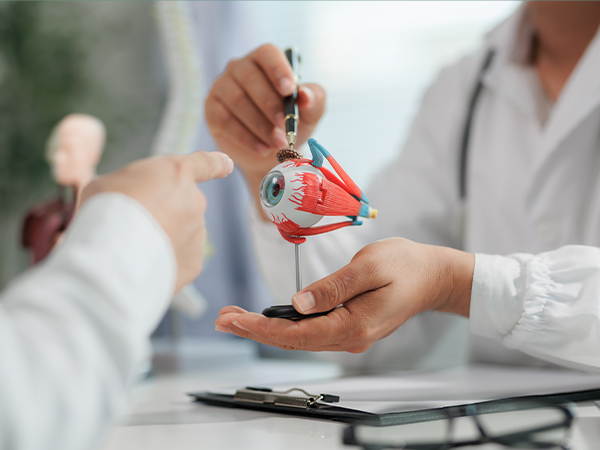
In many myopic eyes, the eye becomes longer from front to back. This causes light to focus in front of the retina instead of directly on it. Glasses or contact lenses move the image back into focus, restoring clear vision while they are worn.
The concern is not that glasses make myopia worse—they do not. The concern is that standard vision correction generally does not address the underlying pattern of excessive eye growth.
Why Does Slowing Myopia Matter?
As the amount of myopia increases, the lifetime risk of certain eye conditions also rises. These can include retinal tears or detachment, myopic macular degeneration, glaucoma, and cataracts.
Myopia management cannot eliminate these risks, reverse existing myopia, or guarantee that a child’s prescription will stop changing. The purpose is to slow progression so the child may finish growing with less myopia than they might otherwise have developed.
From my perspective as an eye doctor, this is a long-term health conversation—not simply a discussion about avoiding stronger glasses. Even a child who functions well in glasses deserves an assessment when the prescription is changing quickly or meaningful risk factors are present.
Why Is Childhood Myopia Increasing?
Myopia develops through a combination of genetics, eye growth, and environmental influences. No single habit explains every case.
A child may be at greater risk when:
Myopia begins at a younger age.
One parent is myopic, with risk generally higher when both parents are myopic.
The prescription has increased between examinations.
The child spends long, uninterrupted periods reading, studying, gaming, or using digital devices at close distances.
Outdoor time is limited.
There is a family history of high myopia, retinal holes, retinal tears, retinal detachment, or myopic degeneration.
Busy Cincinnati families often balance schoolwork, remote work, practices, travel teams, and screen-based learning. The goal is not to blame parents or eliminate every device. We look for practical adjustments: comfortable working distances, regular breaks from prolonged near tasks, appropriate lighting, and more time outdoors when possible.
Outdoor time appears especially useful in reducing the risk that myopia will begin. Once a child is already myopic, healthy visual habits remain worthwhile, but lifestyle recommendations should not be presented as a substitute for clinically appropriate treatment.
Why Updating Glasses May Not Be Enough
A conventional single-vision prescription is important because a child needs clear, comfortable vision for school, sports, and daily life. But clear vision and myopia control are two different goals.
Think of ordinary prescription lenses as correcting the blur created by the eye’s current shape. Myopia-management treatment adds a second objective: influencing future progression or eye growth.
That distinction is why a child whose prescription changes repeatedly may benefit from more than a routine lens update. The next step is not automatically a particular product; it is a careful assessment of progression, risk, eye health, maturity, and family priorities.
What Is Axial Length, and Why Do We Measure It?
Axial length is the distance from the front to the back of the eye. Because childhood myopia is frequently associated with excessive elongation, axial length gives us information that a glasses prescription alone may not fully capture.
Two children can have similar prescriptions but different patterns of eye growth. Establishing a baseline and repeating the measurement over time can help us:
Monitor whether the eye is elongating faster than expected.
Evaluate progression alongside changes in prescription.
Assess how a treatment plan appears to be performing.
Explain eye growth to parents with objective measurements.
Decide whether the current plan should be continued, adjusted, or reconsidered.
Axial length is one important piece of the clinical picture. It is not a stand-alone diagnosis, and a single measurement does not predict a child’s future.
How We Use the Topcon MYAH
See Well Eyecare uses the Topcon MYAH to support myopia assessment and monitoring. This technology can measure axial length and track changes over time. It also provides corneal topography—a detailed map of the front surface of the eye—which is particularly valuable when evaluating and fitting orthokeratology lenses.
Depending on the child and the treatment being considered, MYAH testing may help us evaluate:
Axial length and eye-growth trends.
Corneal shape and symmetry.
Suitability for specialty contact lenses.
Changes in the cornea during Ortho-K treatment.
Pupil measurements and other information relevant to lens selection.
Advanced technology is useful only when it informs thoughtful care. We interpret these findings together with the child’s prescription history, age, eye health, family history, lifestyle, and treatment experience.
What Is the Brien Holden Vision Institute Myopia Calculator?
The Brien Holden Vision Institute Myopia Calculator is an educational tool eye-care professionals can use to illustrate possible patterns of myopia progression and the potential effect of slowing that progression.
It can make an abstract conversation easier for parents to visualize. However, it is not a promise, a diagnosis, or a precise forecast for an individual child. Real outcomes vary, and treatment decisions should never be based on a calculator alone.
We use forecasting tools as part of a larger discussion, not as a replacement for examination findings or clinical judgment.
Comprehensive Eye Exam vs. Dedicated Myopia Management Consultation
A comprehensive eye exam and a myopia-management consultation serve related but different purposes.
Comprehensive eye exam
A comprehensive exam evaluates the child’s overall vision and eye health. It may include visual acuity, prescription testing, eye focusing and teaming, pupil responses, and an internal and external health evaluation.
Dedicated myopia-management consultation
This is a separate, treatment-focused visit designed to determine whether myopia management is appropriate and which approach best fits the child.
Depending on the child’s needs, the consultation may include:
Review of current and previous prescriptions.
Analysis of the age of onset and rate of progression.
Axial-length measurements with the Topcon MYAH.
Corneal topography.
Slit-lamp and ocular-surface evaluation.
Family-history review.
Discussion of schoolwork, screen time, near work, outdoor activity, sports, and daily routines.
Comparison of appropriate treatment options.
An individualized follow-up and monitoring plan.
This dedicated visit gives families time to ask questions and understand the responsibilities, benefits, limitations, and safety considerations of each option.
Myopia-Management Options
There is no single best treatment for every child. The right choice depends on age, prescription, rate of progression, eye shape and health, maturity, lifestyle, treatment eligibility, and family preferences.
Essilor Stellest® eyeglass lenses
Stellest lenses correct a child’s prescription while using a specialized lenslet design to help slow myopia progression and axial elongation. They may appeal to families who prefer an eyeglass-based treatment or whose child is not ready for contact lenses.
In the United States, Stellest lenses have specific FDA-authorized initiation ages and prescription parameters. Eligibility must be confirmed through an examination and dedicated consultation.
Bausch + Lomb CRT® and orthokeratology
Orthokeratology, or Ortho-K, uses specially designed rigid lenses worn during sleep to temporarily reshape the cornea. The lenses are removed in the morning, allowing many wearers to see clearly during the day without glasses or daytime contact lenses.
Ortho-K can be attractive for hockey players, swimmers, dancers, and other active children who value freedom from daytime eyewear. Careful corneal mapping, lens handling, hygiene, parental involvement, and follow-up are essential. In the United States, Ortho-K lenses are cleared for temporary overnight vision correction; the myopia-control discussion is based on evidence for orthokeratology as a treatment category rather than a product-specific FDA myopia-control indication.
Low-dose atropine
Low-dose atropine is a prescription eye drop that may help slow myopia progression in selected children. Its use for myopia management is off-label in the United States, meaning atropine is an approved medication but this particular use does not have an FDA-labeled indication.
Some families value that treatment does not require contact-lens wear. However, concentration, expected benefit, possible light sensitivity or near-vision symptoms, access through an appropriate pharmacy, and the monitoring plan all require an individualized discussion. Atropine may sometimes be considered alongside another treatment when clinically appropriate.
MiSight® 1 day contact lenses
MiSight 1 day is a daily disposable soft contact lens designed to correct vision and slow myopia progression in eligible children. A fresh lens is used each day, so there is no overnight wear or lens-cleaning routine.
The child must be ready to insert and remove lenses safely, avoid water exposure, follow the wearing schedule, and attend follow-up visits. MiSight also has specific FDA-approved initiation ages and prescription parameters that must be confirmed during the evaluation.
How Do We Choose the Right Treatment?
The newest or most familiar option is not automatically the best one. We consider:
The child’s age and age when myopia began.
Current prescription and rate of change.
Axial-length trend, when available.
Corneal shape and eye health.
Family history and expected risk.
Comfort with glasses, drops, soft lenses, or overnight lenses.
Sports and activities.
School demands, screen use, outdoor time, and travel schedule.
The child’s maturity and the caregiver’s ability to supervise treatment.
The family’s preferences and ability to follow the monitoring plan.
For a child moving between school, homework, hockey practice, swim meets, and family commitments, the treatment has to work in real life. An elegant plan that is not followed consistently is unlikely to provide its intended benefit.
What Does Follow-Up Look Like?
Myopia management is an ongoing process rather than a one-time prescription. Follow-up timing depends on the treatment, the child’s age, progression, and clinical findings.
Monitoring may include:
Visual acuity and prescription changes.
Axial-length measurements.
Eye-health and slit-lamp evaluation.
Corneal topography for Ortho-K.
Lens fit, handling, hygiene, and wearing time.
Eyeglass fit and alignment for treatment lenses.
Response to atropine and any side effects.
Review of outdoor time, near-work habits, and adherence.
If progression continues, that does not automatically mean a treatment has failed. No option stops all eye growth in every child. We compare the observed change with the child’s prior pattern, age, adherence, and expected response before deciding whether an adjustment or combination strategy should be considered.
When Should Parents Ask About Myopia Management?
Consider scheduling a dedicated consultation if:
Your child was recently diagnosed with myopia.
The prescription has become stronger since the last examination.
Myopia began at a young age.
One or both parents are nearsighted.
There is a family history of high myopia or retinal disease.
Your child cannot see clearly before the next annual visit.
You want to understand options beyond conventional glasses.
Your family is looking for a treatment that fits an active or screen-heavy routine.
Earlier evaluation matters because younger children generally have more years in which myopia may progress. That does not mean every child needs treatment immediately. It means parents deserve enough information to make the decision thoughtfully.
Frequently Asked Questions
Can myopia be cured or reversed?
Current myopia-management treatments do not cure myopia or reverse the eye’s established growth. They aim to slow future progression while providing clear vision.
Did glasses cause my child’s prescription to worsen?
No. Properly prescribed glasses correct blur; they do not cause the eye to become nearsighted. The prescription often changes because the eye is continuing to grow.
Is screen time the only cause of childhood myopia?
No. Genetics, age, eye growth, outdoor exposure, and patterns of near work all contribute. Rather than blaming one device, we evaluate the child’s overall risk and routine.
How much outdoor time should my child get?
Evidence supports encouraging children to spend roughly two hours outdoors during daylight when practical. This appears most helpful in reducing the chance that myopia begins. Outdoor time is healthy, but it should not replace prescribed treatment for a child with progressive myopia.
Is my child too young for myopia management?
Treatment depends on age, prescription, maturity, eye health, and the specific option. Some therapies have defined starting-age criteria. A dedicated consultation can determine what is appropriate now and whether monitoring alone makes more sense.
Can treatments be combined?
Sometimes. Combination therapy may be considered when progression remains concerning or when the clinical circumstances support it. It should not be automatic; benefits, burdens, evidence, and monitoring requirements should be discussed individually.
Will my child still need regular eye exams?
Yes. Myopia-management follow-ups do not replace comprehensive eye examinations. Children still need routine evaluation of their overall vision and eye health.
About See Well Eyecare
See Well Eyecare is an independent optometry practice led by Dr. Rawzi Baik. We provide comprehensive pediatric eye examinations, advanced myopia measurements, individualized treatment planning, and a full-service optical in a welcoming, relationship-focused setting.
Families value clear explanations, practical recommendations, and a care plan built around the individual child—not a one-size-fits-all product. Our location and free parking also make follow-up easier for busy parents balancing work, school, and activities.
Explore Hyde Park & Nearby Neighborhoods
See Well Eyecare is located at 3330 Erie Avenue, Suite 14, in Hyde Park between Oakley and Mount Lookout. We are also convenient for families traveling from Mariemont, Indian Hill, Madeira, Columbia-Tusculum, and other Cincinnati communities.
Families can combine an appointment with a stop in Hyde Park Square, shopping or dining in Oakley, or time outdoors near Mount Lookout and Ault Park. Our central location offers a personalized alternative for parents seeking advanced pediatric eye care without a high-volume experience.
Local Events & Attractions
Nearby family-friendly destinations include Ault Park, the Cincinnati Observatory, Wasson Way, Hyde Park Farmers’ Market, and community activities around Hyde Park Square and Oakley. These places also make it easier to build outdoor time into family routines. Event schedules vary, so confirm current details with the organizer before visiting.
Schedule a Dedicated Myopia-Management Consultation
If your child’s nearsighted prescription is increasing—or your child was recently diagnosed with myopia—contact See Well Eyecare to schedule a dedicated myopia-management consultation.
We will review progression, measure the eyes when appropriate, discuss Stellest lenses, Ortho-K, low-dose atropine, MiSight 1 day, and other clinically appropriate choices, then build an individualized plan around your child’s vision, eye health, activities, and family routine.
Clear vision today matters. Thoughtful management of how myopia may progress matters for the future.
See Well Eyecare
3330 Erie Avenue, Suite 14
Cincinnati, Ohio 45208
Quick Links
Helpful Articles
All Eye Care Services
Find personalized eye care excellence with our comprehensive services. From eye exams to advanced diagnostics, trust us for all your vision needs.

Keep In Touch
For non-urgent questions or to learn more about our services, contact us today!

We are an LGBTQ+ friendly clinic that believes all people deserve quality eye care
- 3330 Erie Avenue, Suite 14
Cincinnati, OH 45208 - Phone: (513) 268-8748
- Fax: (513) 268-8758
- Monday 9:00am - 3:00pm
- Tuesday 11:00am - 7:00pm
- Wednesday Closed
- Thursday 9:00am - 4:00pm
- Friday 8:00am - 5:00pm
- Saturday 9:00am - 3:00pm
- Sunday Closed
- Monday
- Tuesday
- Wednesday
- Thursday
- Friday
- Saturday
- Sunday
- Monday
- Tuesday
- Wednesday
- Thursday
- Friday
- Saturday
- Sunday
© 2026 See Well Eyecare. All rights Reserved - Accessibility Statement - Privacy Policy - Sitemap
Managed and Designed by 