
Photochromic vs. Polarized Lenses: Which Helps Cincinnati Eyes More?
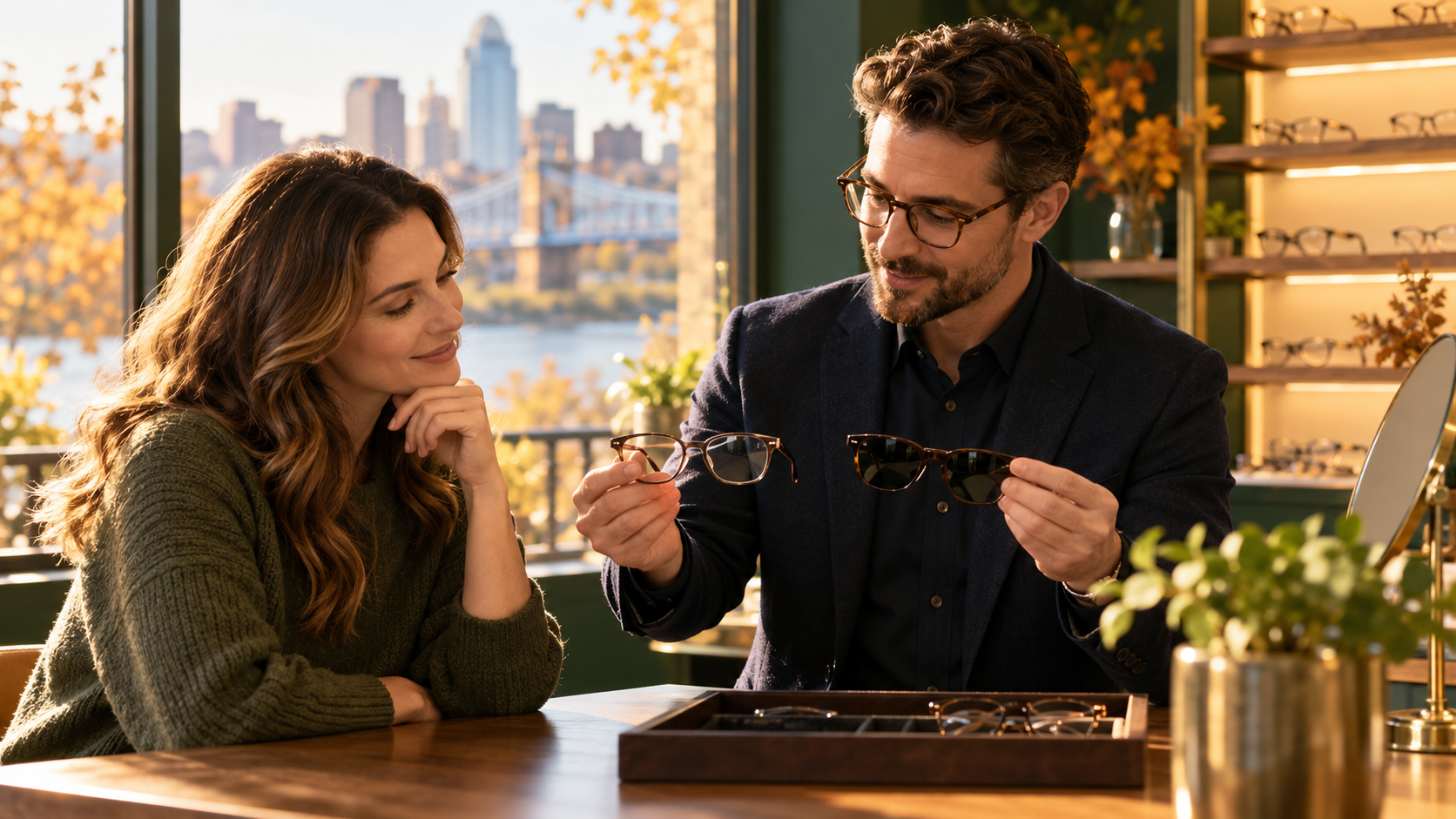
Photochromic vs. Polarized Lenses: Which Helps Cincinnati Eyes More?
Photochromic lenses darken in response to ultraviolet light. Polarized lenses use a filter to reduce reflected glare from surfaces such as roads, water and snow. Both can improve outdoor comfort, but they are not interchangeable.
The right choice starts with your routine: Do you move indoors and outdoors all day? Spend long periods driving? Walk near the river? Need prescription sunglasses for sports or weekend travel? A professional comparison of photochromic vs. polarized lenses in Cincinnati can turn those daily details into a useful lens plan.
What Photochromic Lenses Do Well
Photochromic lenses are clear or nearly clear indoors and darken outdoors when activated by UV exposure. The American Academy of Ophthalmology’s photochromic-lens overview explains that activation can vary with temperature, lens material and UV conditions.
They are especially useful for people who:
- frequently move between indoor and outdoor environments;
- want one primary pair for changing light;
- dislike repeatedly swapping glasses; or
- need UV protection integrated into everyday prescription lenses.
Traditional photochromic lenses may not darken as fully inside a vehicle because the windshield blocks much of the activating UV. Some current designs are engineered for additional visible-light response, but performance differs. Ask for a realistic explanation of what the chosen lens will do in the car.
What Polarized Lenses Do Well
Polarized lenses are designed to reduce intense reflected glare. The AAO’s polarized sunglasses guidance notes their value around water, snow and roads.
They are often the better dedicated choice for:
- daytime driving;
- boating or fishing;
- outdoor sports and long walks;
- glare from wet pavement; or
- patients who remain uncomfortable in ordinary tinted lenses.
Polarization does not automatically mean the lens has the right UV protection, prescription accuracy or impact rating. Those features should be verified separately.
Can One Lens Do Both?
Some products combine photochromic behavior with polarization. Transitions XTRActive Polarized is one manufacturer example, while HOYA’s photochromic portfolio illustrates how activation options vary across lens families. Availability and compatibility depend on prescription, material, frame and the laboratory.
A combination lens may be convenient, but a dedicated polarized sunglass can still provide stronger, more consistent outdoor glare control for some lifestyles.
Why the Frame and Measurements Matter
Lens performance depends on more than the feature name. Prescription, frame wrap, optical center, vertex distance, pantoscopic tilt and lens thickness all influence the finished result.
See Well’s Hyde Park optical uses Optikam frame-specific measurements when appropriate and offers curated premium and budget-conscious options. Our team can explain the complete value—lens design, coating, measurements, fitting, adjustments, troubleshooting and warranty support—before discussing individual components.
For stronger prescriptions, the lens material and frame choice may matter as much as the sun feature. Our guide to high-index lenses in Cincinnati explains that tradeoff.
A Legitimate Second-Pair Decision
An everyday photochromic pair and a dedicated polarized driving sunglass are not duplicates when they solve different problems. One adapts across indoor and outdoor settings; the other is purpose-built for sustained reflected glare.
Before ordering elsewhere, ask what is included. Keeping the prescription, product, fitting and follow-up connected gives you one local team for adjustments if the glasses slide, sit unevenly or do not perform as expected.
Explore Hyde Park & Nearby Neighborhoods
See Well Eyecare’s optical is in Hyde Park (45208), convenient to Oakley (45209), Mount Lookout and Mariemont (45227). Cincinnati’s hills, wet fall roads and changing daylight make real-world glare needs worth discussing—not guessing from a catalog.
Local Events & Attractions | FotoFocus Through October 31
FotoFocus presents exhibitions across Greater Cincinnati through October 31. Moving between galleries, streets and changing fall light is a good reminder that different lenses manage indoor clarity, UV exposure and reflected glare in different ways.
Frequently Asked Questions
Do photochromic lenses replace sunglasses for driving?
Not always. Many photochromic lenses darken less behind a UV-filtering windshield. A dedicated polarized prescription sunglass may better control daytime road glare.
Are all polarized lenses prescription lenses?
No. Polarization can be added to many prescriptions, but accurate fabrication and fitting still matter.
Can polarized lenses make screens look unusual?
Yes. Some digital displays may appear darker or change with head angle because the screen and lens filters interact.
Which option is better for migraines or light sensitivity?
Light sensitivity has different causes. An eye examination should come first when it is new, severe or one-sided. Lens recommendations can then be tailored to the trigger and diagnosis.
Do these lenses block UV?
Many quality options do, but confirm the specific product. The AAO recommends sunglasses that block 99% to 100% of UVA and UVB radiation in its UV eye-protection guidance.
Compare Lens Options With Your Actual Routine
Request an appointment or visit our optical after your examination. Bring the frame you wear most and tell us about driving, work, outdoor time and screen use so the recommendation solves a specific need.
About See Well Eyecare
See Well Eyecare is a locally owned Hyde Park practice led by Dr. Rawzi Baik. Our team connects comprehensive eye care with thoughtful eyewear selection, precise measurements, professional fitting and after-purchase adjustments for Cincinnati families and professionals.
Primary keyword: photochromic vs polarized lenses Cincinnati
Supporting keywords: prescription sunglasses Cincinnati, polarized driving glasses, photochromic lenses Hyde Park, UV protection glasses, optical Oakley
Quick Links
Helpful Articles

All Eye Care Services
Eye care for every stage of life, from routine exams and contact lens fittings to dry eye care, myopia management and medical eye visits. Dr. Baik helps you understand your options and choose care that fits your needs.

Keep In Touch
For non-urgent questions or to learn more about our services, contact us today!

We are an LGBTQ+ friendly clinic that believes all people deserve quality eye care
- 3330 Erie Avenue, Suite 14
Cincinnati, OH 45208 - Phone: (513) 268-8748
- Fax: (513) 268-8758
- Monday 9:00am - 3:00pm
- Tuesday 8:00am - 7:00pm
- Wednesday Closed
- Thursday 8:00am - 5:00pm
- Friday 8:00am - 3:00pm
- Saturday 9:00am - 2:00pm
- Sunday Closed
- Monday
- Tuesday
- Wednesday
- Thursday
- Friday
- Saturday
- Sunday
- Monday
- Tuesday
- Wednesday
- Thursday
- Friday
- Saturday
- Sunday
© 2026 See Well Eyecare. All rights Reserved - Accessibility Statement - Privacy Policy - Terms & Conditions - Sitemap
Managed and Designed by 