
Scleral Lenses for Keratoconus in Cincinnati: What to Expect During the Fitting Process
Scleral Lenses for Keratoconus in Cincinnati: What to Expect During the Fitting Process
Keratoconus can make vision feel unpredictable. Glasses may help at first, but as the cornea becomes more irregular, a standard prescription may no longer provide the crisp, stable vision a patient wants.
That does not mean you have run out of options.
A scleral lens is a large, custom gas-permeable contact lens that vaults over the irregular cornea and rests on the white part of the eye. The space beneath the lens is filled with preservative-free sterile saline, creating a smooth optical surface that can improve functional vision for many people with keratoconus.
The fitting is more involved than a routine soft-contact-lens visit. That extra care is what allows the lens to be designed around the individual eye.
At See Well Eyecare in Hyde Park, Dr. Rawzi Baik welcomes new scleral lens wearers as well as established wearers who need a new Cincinnati provider after moving, changing doctors or losing access to a previous practice.
Scleral Lenses Do Not Cure Keratoconus
Scleral lenses correct vision while they are being worn. They do not reverse keratoconus or stop it from progressing.
If the corneal shape is changing, Dr. Baik may recommend evaluation by a corneal ophthalmologist to discuss treatments such as corneal cross-linking. Specialty contact lenses and medical management have different roles and may be used together.
The Mayo Clinic’s scleral lens overview explains that these lenses vault over the cornea, rest on the sclera and maintain a fluid layer between the lens and the eye. That design can improve vision for irregular corneas such as keratoconus.
Step 1: The Initial Keratoconus and Contact Lens Evaluation
The first visit is about understanding the whole picture—not simply copying numbers from an old lens box.
Please bring:
Your current glasses
Any contact lenses you currently wear
Old lens labels, prescriptions or fitting records if available
Information about prior cross-linking, corneal surgery or eye injury
The solutions, plungers or other products you use
Notes about comfort, wearing time, fogging and vision changes
Dr. Baik will review your goals, eye history and previous lens experience. The examination may include visual acuity, refraction, slit-lamp evaluation of the cornea and eyelids, tear-film assessment and a review of corneal health.
A scleral lens evaluation is a specialty service and is separate from a routine comprehensive eye examination. A current eye-health examination may be needed before or alongside the fitting.
Step 2: Corneal Topography with the Topcon MYAH
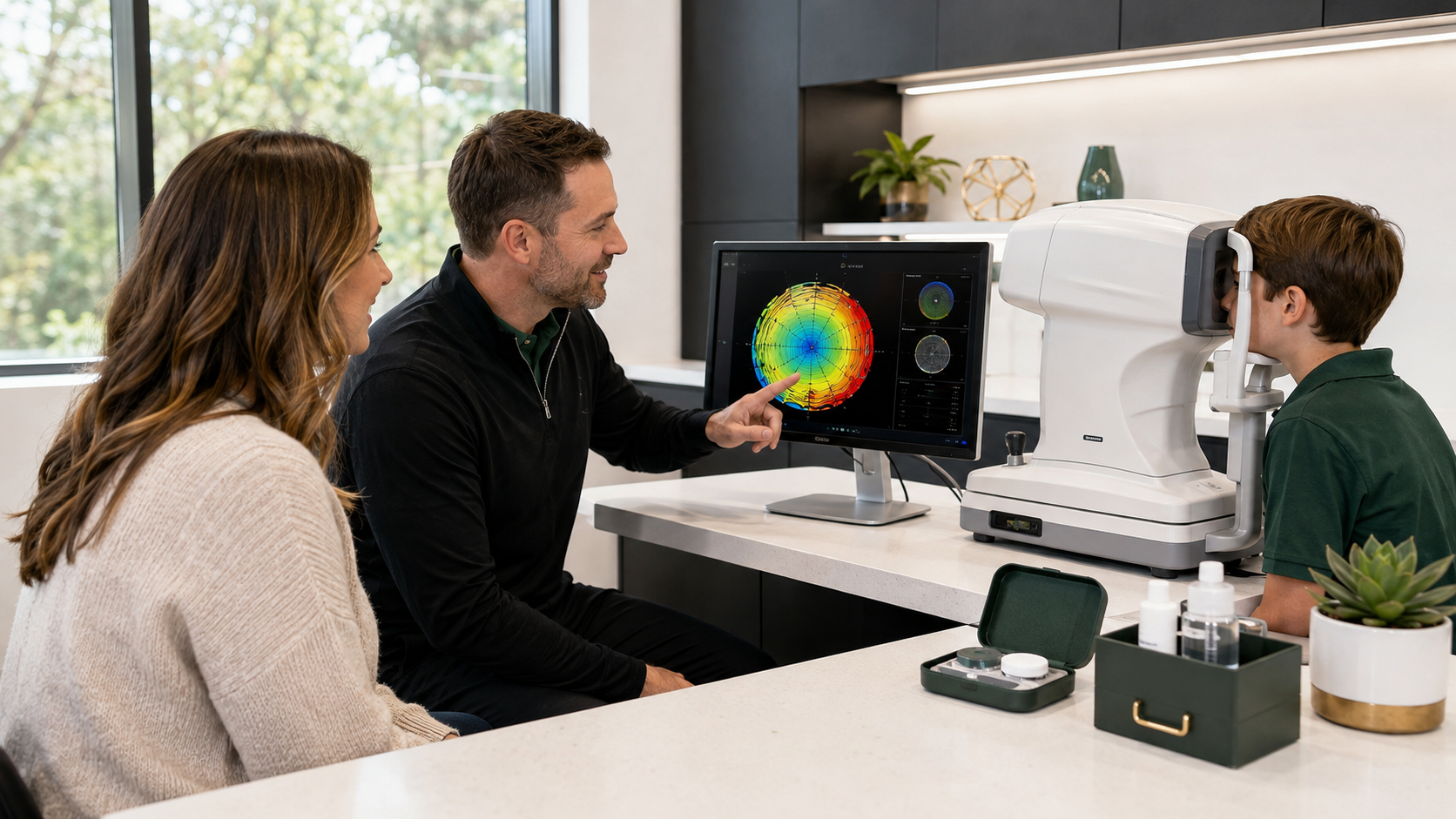
Keratoconus changes the shape of the cornea. Corneal topography creates a detailed color map of its curvature and helps document steepness, asymmetry and changes over time.
At See Well Eyecare, the Topcon MYAH helps us capture and compare this corneal information. The map supports clinical decision-making, provides a useful baseline and helps us understand why glasses or standard contacts may not produce stable vision.
Topography is important, but it is not the entire scleral fit. Because a scleral lens lands beyond the cornea, Dr. Baik must also evaluate how a diagnostic lens vaults the cornea, clears the limbus and rests on the sclera.
Step 3: A Diagnostic Scleral Lens Is Placed on the Eye
A diagnostic lens is selected based on the examination and corneal shape. It is filled completely with the prescribed preservative-free sterile saline and placed on the eye without trapping an air bubble.
The lens is allowed to settle before the fit is judged. During the evaluation, Dr. Baik looks at:
Central clearance over the cornea
Clearance near the limbus, where the cornea meets the white of the eye
How evenly the lens lands on the sclera
Whether an edge lifts, pinches or presses on tissue
Lens centration and stability
The fluid reservoir beneath the lens
Vision through the diagnostic lens
An additional refraction over the lens helps determine the lens power. Measurements and observations are combined to create a custom order.
Step 4: Your Lens Is Custom Designed
The first diagnostic lens is an evaluation tool. It may not be the lens you ultimately take home.
Dr. Baik sends the selected design, prescription and fitting changes to the specialty laboratory. The lens is then manufactured for your eye. Keratoconus is different from person to person—and often different between a patient’s right and left eyes—so the two lenses may require different designs.
The name on the lens box is less important than whether the lens is appropriate for the eye, provides useful vision and meets healthy fitting goals. Our goal is to welcome patients who have worn many scleral brands or lens platforms, not limit care to one manufacturer.
Step 5: The Dispensing and Training Visit
When the ordered lens arrives, it is evaluated on the eye before it is released for regular use. Vision and fit are checked again because the final lens must be judged in person.
You will also learn how to:
Wash and dry your hands correctly
Inspect the lens before use
Fill the lens with the solution prescribed for you
Insert it without trapping a bubble
Remove it safely with the proper tool or technique
Clean, disinfect and store it
Recognize a problem that requires removal and a call to the office
Training is part of the process. Some people feel confident quickly; others need more practice. Bringing a support person can be helpful if you are anxious or have difficulty seeing the steps without your correction.
Step 6: Build Wearing Time as Directed
Your wearing schedule will be individualized. Do not assume that a schedule from an old lens or another wearer is right for you.
General safety principles include:
Never sleep in scleral lenses unless a doctor has specifically prescribed otherwise
Never use tap water to fill, rinse or store a lens
Do not shower or swim while wearing the lenses
Use only the filling and care products recommended for your lenses
Remove the lens if vision suddenly changes or the eye becomes painful, red or unusually light-sensitive
Keep backup glasses available
Some patients notice mild lens awareness at first. Pain is not a normal adaptation goal. If the lens becomes increasingly uncomfortable, develops a bubble or produces significant redness, remove it and contact the office.
Step 7: Return for Follow-Up and Refinement
Follow-up visits are essential. A lens can feel acceptable while still needing a change in clearance, landing, edge alignment, power or surface performance.
At follow-up, Dr. Baik may evaluate:
Vision at the beginning and later in the wearing day
Comfort and average wearing time
Fogging or debris beneath the lens
Redness or blanching where the lens lands
Corneal and conjunctival health after lens removal
Ease of insertion, removal and care
Whether a design or prescription change is needed
Complex eyes may require more than one design adjustment. That is not necessarily a failed fit; refinement is a normal part of creating a custom medical device for an irregular surface.
After the fit is finalized, regular eye-health and lens checks remain important. Keratoconus and the ocular surface can change, and lenses can develop deposits, scratches or other wear over time.
What Results Should You Expect?
Many people with keratoconus gain clearer and more stable functional vision in scleral lenses than they achieve with glasses. However, no ethical fitting can promise perfect vision, instant all-day comfort or a one-visit result.
The outcome depends on corneal shape and scarring, eye health, tear quality, lens tolerance, handling skills and realistic goals. Dr. Baik will explain what the findings suggest for your individual eyes.
Insurance and Medical Necessity
Coverage for scleral lenses varies. Some vision plans may offer benefits when their specific definition of medical necessity is met, while others limit the diagnosis, documentation, prior authorization or lens benefit. In many situations, the specialty evaluation and lenses may not be covered in the way a patient expects.
See Well Eyecare can review available information and explain the office process, but benefit verification is not a guarantee of payment. We do not want coverage questions to replace the clinical conversation about whether scleral lenses are appropriate for your eyes.
About See Well Eyecare
See Well Eyecare provides professional, personalized eye care with advanced diagnostic technology and time for patient education. Dr. Rawzi Baik works with routine and complex contact lens wearers, including people with keratoconus, irregular corneas, corneal scarring and previous specialty-lens experience.
Our patients include people using vision benefits and private-pay patients choosing direct specialty care. Recommendations are based on eye health, visual needs and lifestyle—not on a single lens brand.
Explore Hyde Park & Nearby Neighborhoods
Hyde Park: See Well Eyecare is located at 3330 Erie Avenue, Suite 14, near Hyde Park Square.
Mariemont: Patients from the 45227 area can reach our specialty contact lens office with a straightforward drive through Cincinnati’s east side.
Anderson Township: We welcome established and new scleral lens wearers looking for personalized follow-up closer to home.
Local Events & Attractions
Clear, stable vision can make it easier to enjoy Cincinnati’s architecture, exhibits and performances. New lens wearers should follow their prescribed wearing schedule and carry backup glasses and care supplies when away from home.
Come Together Live at Music Hall: A celebration of the Beatles’ legacy on the Mighty Wurlitzer is scheduled for August 20 at 7 p.m.
1940s Day at Cincinnati Museum Center: Union Terminal hosts its annual 1940s-themed day on August 22 from 10 a.m.–5 p.m.
Big Tent Closing Reception: FotoFocus Center plans its closing reception on August 22 from 5–7 p.m.
Event schedules and admission can change. Check the organizer’s official page before attending.
Frequently Asked Questions
Are scleral lenses hard contact lenses?
They are made from rigid gas-permeable material, but they are larger than small corneal gas-permeable lenses. They vault over the cornea and land on the sclera.
Do scleral lenses touch the keratoconus cone?
A healthy scleral fit is designed to vault the cornea rather than bear on the cone. The fluid-filled space and lens clearance must be evaluated after the lens settles.
Why is corneal topography needed?
Topography maps the corneal shape, documents the pattern of irregularity and provides a baseline for future comparison. It supports—but does not replace—the diagnostic lens assessment.
Will axial length be measured for a keratoconus fitting?
Axial length is useful in myopia management but is not usually the main measurement used to fit a scleral lens for keratoconus. Corneal shape, ocular-surface health, diagnostic lens behavior and vision are more directly relevant.
How many visits does a scleral fitting require?
It usually takes multiple visits for evaluation, dispensing, training and follow-up. The exact number depends on the eye and whether design refinements are needed.
Can I sleep in scleral lenses?
Not unless your eye doctor has specifically prescribed overnight wear. Most scleral lenses are removed before sleep, then cleaned and disinfected.
Can I fill my scleral lens with tap water or multipurpose solution?
No. Use only the preservative-free sterile filling solution prescribed for you. Tap water should never contact a contact lens or lens case.
Why does my scleral lens fog after a few hours?
Fogging can come from debris in the fluid reservoir, tear-film issues, deposits or fitting factors. Bring the lens in after wearing it for the amount of time requested so the cause can be evaluated.
Can I transfer my scleral lens care to See Well Eyecare?
Yes. Bring your current lenses, labels, care products and any fitting records you can obtain. Dr. Baik will still examine your eyes and evaluate the lenses directly rather than assuming the old fit remains healthy.
Do scleral lenses stop keratoconus from progressing?
No. They provide optical correction while worn. Patients with progression may need evaluation by a corneal ophthalmologist for treatments intended to stabilize the cornea.
Schedule a Scleral Lens Consultation in Cincinnati
If glasses or standard contacts are no longer giving you useful vision—or if you need a new provider for existing scleral lenses—learn more about our specialty contact lens care, then request a consultation with See Well Eyecare.
Call (513) 268-8748 and tell our team whether you are new to scleral lenses or currently wearing them. Please bring your lenses and available fitting information to the appointment.
This article provides general education. Candidacy, lens design, wear schedule and follow-up recommendations require an individualized examination.
About the Author
Rawzi Baik, OD, provides comprehensive eye care and specialty contact lens services at See Well Eyecare in Hyde Park, Cincinnati. His approach combines detailed measurements, clinical evaluation and patient education throughout the fitting process.
Quick Links
Helpful Articles

All Eye Care Services
Eye care for every stage of life, from routine exams and contact lens fittings to dry eye care, myopia management and medical eye visits. Dr. Baik helps you understand your options and choose care that fits your needs.

Keep In Touch
For non-urgent questions or to learn more about our services, contact us today!

We are an LGBTQ+ friendly clinic that believes all people deserve quality eye care
- 3330 Erie Avenue, Suite 14
Cincinnati, OH 45208 - Phone: (513) 268-8748
- Fax: (513) 268-8758
- Monday 9:00am - 3:00pm
- Tuesday 8:00am - 7:00pm
- Wednesday Closed
- Thursday 8:00am - 5:00pm
- Friday 8:00am - 3:00pm
- Saturday 9:00am - 2:00pm
- Sunday Closed
- Monday
- Tuesday
- Wednesday
- Thursday
- Friday
- Saturday
- Sunday
- Monday
- Tuesday
- Wednesday
- Thursday
- Friday
- Saturday
- Sunday
© 2026 See Well Eyecare. All rights Reserved - Accessibility Statement - Privacy Policy - Terms & Conditions - Sitemap
Managed and Designed by 