
What to Expect With Ortho-K and CRT Lenses in Cincinnati: From Your First Scan to Follow-Up Care
What to Expect With Ortho-K and CRT Lenses in Cincinnati: From Your First Scan to Follow-Up Care
Choosing overnight vision-correction lenses for yourself or your child can raise very practical questions: How many appointments are involved? What does the scan measure? Will the lenses hurt? How soon should daytime vision improve? What happens if the first design is not perfect?
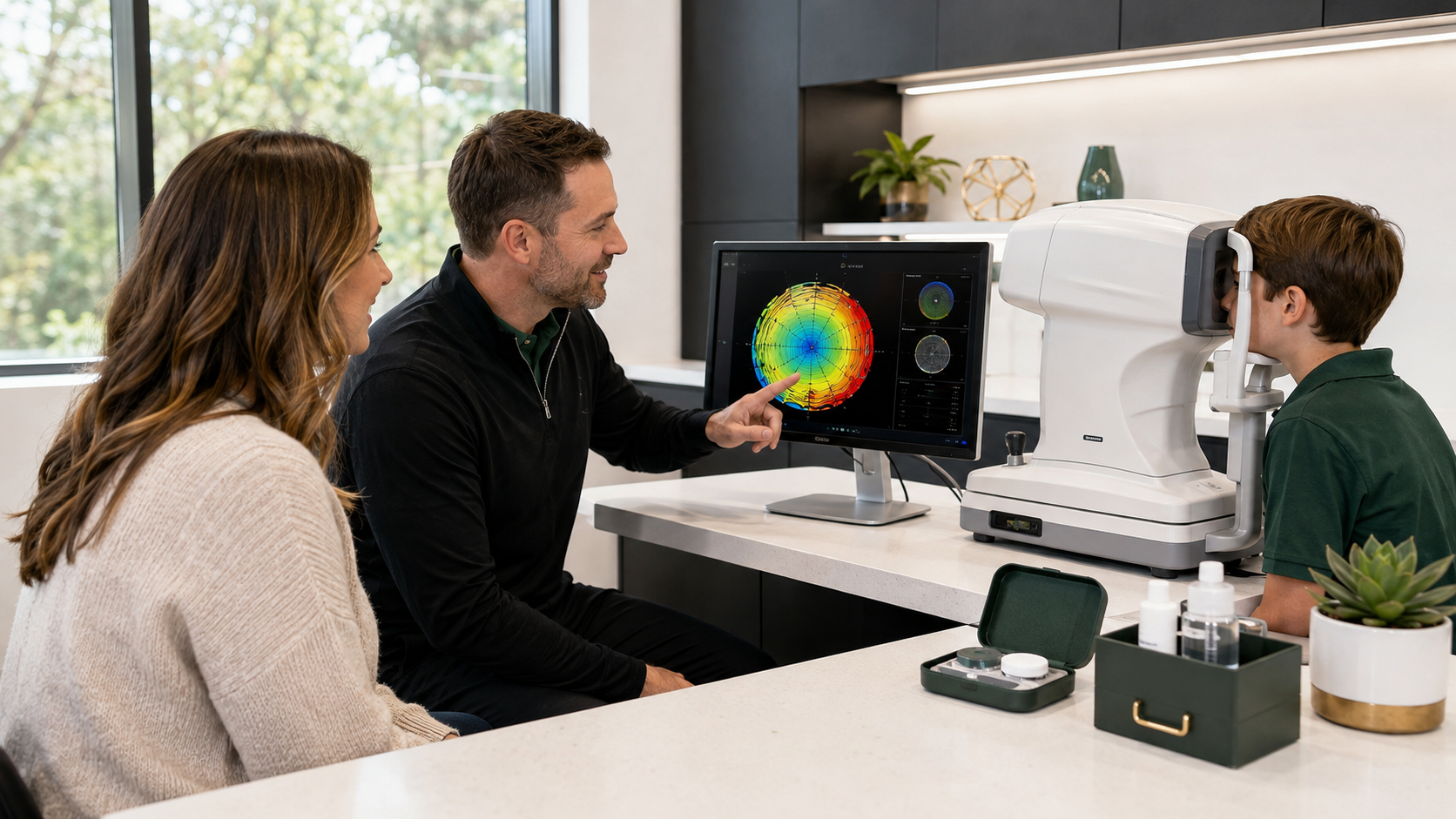
This guide explains the process at See Well Eyecare—from the initial examination and Topcon MYAH measurements to lens training, the first morning and long-term monitoring. It is designed to complement our Ortho-K overview, which explains what orthokeratology is and who may benefit.
Ortho-K is not simply a contact-lens prescription. It is a specialty fitting and ongoing treatment process. The lenses are worn during sleep to temporarily change the shape of the front surface of the eye. They are removed after waking, allowing many wearers to see clearly during the day without ordinary glasses or daytime contacts. The effect is reversible, so consistent wear and follow-up care matter.
At See Well Eyecare in Hyde Park, we welcome Cincinnati families considering Ortho-K as well as established CRT or Ortho-K wearers whose former office closed, who moved to the area or who need a new provider to monitor their treatment.
Ortho-K, CRT and overnight vision-shaping lenses: are they different?
Orthokeratology—usually shortened to Ortho-K—is the broad name for overnight corneal-reshaping treatment. CRT, or corneal refractive therapy, is a commonly recognized name within that category. Different manufacturers use different lens platforms and terminology, but parents and wearers are usually trying to solve the same problem: safe overnight correction, dependable daytime vision and appropriate monitoring.
See Well Eyecare's technology and clinical process allow us to evaluate new and established wearers across a broad range of Ortho-K histories. We do not promise that an existing lens can always be copied or continued unchanged. Corneal shape, prescription, lens condition and available design information must first be evaluated.
The FDA's guide to contact-lens types explains that Ortho-K uses specially designed rigid gas-permeable lenses to temporarily change corneal curvature. Because the effect is temporary, the prescribed maintenance schedule must continue to maintain it.
The process at a glance
| Stage | What we evaluate | Why it matters |
|---|---|---|
| Comprehensive eye exam | Vision, prescription and overall eye health | Confirms that we are not overlooking an eye-health or binocular-vision issue |
| Dedicated Ortho-K/myopia evaluation | Goals, candidacy, corneal health, refraction and lifestyle | Determines whether Ortho-K is a reasonable option and explains alternatives |
| Topcon MYAH baseline | Corneal topography, axial length and other measurements as indicated | Helps design the lens and creates objective data for future comparison |
| Lens dispensing and training | Lens verification, insertion, removal, cleaning and emergency rules | Builds safe habits before the first overnight wear |
| First-night follow-up | Vision, lens position, corneal response and topography | Shows how the eye responded after the first night and whether changes are needed |
| Early stabilization visits | Daytime vision, comfort, centration and corneal health | Refines the fit while the treatment effect stabilizes |
| Six-month myopia monitoring | Axial length, refraction/autorefraction and clinical findings | Tracks eye growth and treatment response over time |
| Annual comprehensive exam | Full eye-health and vision evaluation | Keeps routine preventive care current in addition to specialty monitoring |
Exact timing and testing are individualized. Additional visits or a revised lens design may be needed.
Step 1: Start with a comprehensive eye examination
Before designing a specialty overnight lens, we need an accurate understanding of the person's vision and eye health. A comprehensive eye exam evaluates more than the glasses prescription. It may include visual acuity, refraction, eye coordination, focusing, eye pressure and the health of the cornea, retina and other eye structures.
For a child with changing nearsightedness, the exam also helps us separate a simple prescription update from a broader myopia-management need. Parents who are not sure where to begin can start with a pediatric eye exam and bring prior prescriptions or records if available.
The comprehensive exam and the dedicated Ortho-K fitting are related, but they are not the same service. The specialty process requires additional measurements, lens design, training and follow-up that are not part of a routine glasses examination.
Step 2: The dedicated Ortho-K consultation and candidacy evaluation
At the specialty evaluation, we discuss more than the prescription. We want to understand:
how quickly a child's myopia has changed;
whether the goal is daytime freedom from glasses, myopia management or both;
sports, swimming, sleep routines and travel;
previous contact-lens experience;
allergy, dry-eye or eyelid symptoms;
the child's and parent's readiness to follow a nightly care routine; and
whether another option—such as myopia-control glasses or a daily disposable myopia-management contact lens—may better fit the family.
For children, Ortho-K should be viewed as a strategy intended to slow progression, not a cure and not a guarantee that the prescription will never change. Our Cincinnati kids' myopia guide offers a useful overview of the available treatment categories.
Step 3: Topcon MYAH corneal topography and axial length
The Topcon MYAH lets us collect two kinds of information that answer different questions.
Corneal topography: what shape are we fitting?
Corneal topography creates a detailed map of the front surface of the eye. It shows curvature, symmetry and changes from one visit to another. For Ortho-K, the map helps us design the lens and later evaluate whether the treatment zone is centered and responding as intended.
Topcon describes the MYAH platform as combining corneal topography with visit-to-visit comparison, white-to-white measurements, contact-lens fitting tools and fluorescein simulation. The scan is noncontact, quick and generally easy for children.
Axial length: how is the eye growing?
Axial length is the front-to-back length of the eye. It is not the same as a glasses prescription. Refraction tells us how the eye focuses light; axial length gives us an objective way to monitor physical eye growth.
The International Myopia Institute's clinical guidance includes axial length among the useful measurements for myopia management where the technology is available. The MYAH stores measurements and displays trends so that we can compare visits rather than relying on one isolated number.
Why the refraction, topography and axial length must be interpreted together
No single scan chooses the treatment. We match the measured prescription with the corneal map, visual needs, age, eye health and axial-length trend. In an established wearer, topography may also show the current treatment pattern. The combined picture helps us decide whether to continue, adjust, redesign or discuss another approach.
Step 4: Designing and ordering the lenses
Ortho-K lenses are not pulled from a box like ordinary disposable contacts. The initial design uses the examination findings and corneal measurements. When the lenses arrive, we verify them and schedule a dispensing visit.
A first design is an informed starting point—not a promise that no adjustment will be needed. Small design changes are a normal part of specialty contact-lens care. The number of lenses and visits required varies with the cornea, prescription, treatment goal and response.
If you already wear Ortho-K or CRT lenses, bring:
the current lenses and case;
any boxes, labels or parameter cards;
prior corneal maps and fitting records;
recent glasses and contact-lens prescriptions;
the solutions and products currently used; and
backup glasses.
Our specialty contact-lens service can evaluate the current fit and eye health. If records are incomplete or the existing design is not appropriate, new measurements or lenses may be necessary.
Step 5: Dispensing, insertion-and-removal training and care
At the dispensing visit, the lens is evaluated on the eye and the wearer—or a parent when appropriate—learns how to insert, remove, clean, disinfect and store it. We do not want a family leaving with unanswered questions.
Safe habits include:
wash hands with soap and dry them completely before touching a lens;
use only the care products prescribed for that lens;
never use tap water, bottled water or saliva on the lens or case;
do not “top off” old solution;
rub and rinse the lens when directed;
clean and replace the case on schedule;
keep fingernails and cosmetics away from the lens surface; and
keep current backup glasses available.
The CDC's contact-lens prevention guidance emphasizes dry hands, water-free lens care, fresh solution and routine case replacement. Its separate water-safety guidance explains why lenses should be removed before swimming or showering unless an eye-care professional gives different instructions.
The simplest safety rule is: when in doubt, take the lens out. Pain, increasing redness, light sensitivity, discharge or unusual blur is not a “push through it” situation. Remove the lens, do not reinsert it and contact the office promptly. Contact lenses are medical devices, and the FDA outlines infection and corneal-ulcer risks that deserve timely attention.
Step 6: The first night and first-morning visit
Your written instructions take priority, because every case is individual. Many overnight designs are worn for approximately eight to ten hours. Some manufacturer guidance recommends inserting the lenses about 15 to 20 minutes before sleep so that the wearer can confirm that they feel settled before closing the eyes.
For the first-morning evaluation, we may ask the wearer to arrive within a few hours of waking and with the lenses still in place. This lets us evaluate the lens before removal, then assess daytime vision, corneal health and the new topography pattern afterward. Follow the specific arrival instructions given at dispensing.
The first night is valuable data, not a final verdict. We look for:
lens position and movement;
treatment-zone centration;
corneal staining, swelling or other health changes;
unaided daytime vision;
residual prescription;
comfort and handling; and
whether the lens design or routine should change.
Professional overnight-lens guidance commonly emphasizes an early morning-after evaluation and continued follow-up after stability. The technical schedule is determined by the treating doctor; this is why ordering an overnight lens online without fitting and monitoring is not appropriate.
What should the first week feel like?
Some lens awareness is common when the eyes are open, especially during the first few nights. The lens should not cause significant pain. Because the lens is primarily worn with the eyelids closed, many children adapt well once insertion and removal become familiar.
Vision often improves over the first several nights rather than becoming perfect after one use. Early in the process:
distance vision may fluctuate;
the effect may fade later in the day;
the two eyes may respond at slightly different rates;
halos, glare or ghost images may occur, especially at night; and
temporary daytime correction or backup glasses may still be needed.
Not every wearer reaches completely glasses-free vision, and higher prescriptions may leave some residual correction. We set expectations based on the individual eye rather than promising a particular acuity or timeline.
Early follow-ups and lens refinement
After the first-morning visit, follow-ups are commonly scheduled during the early adaptation period—often around one week and one month, although the exact timing varies. Extra checks may be needed if vision is inconsistent, the lens is difficult to handle, the topography is not centered or the cornea needs closer observation.
These visits may include:
unaided and best-corrected vision;
refraction or autorefraction;
corneal topography comparison;
slit-lamp examination of the cornea and eyelids;
review of lens cleanliness, position and condition; and
a practical review of wear and care.
A revised lens is not necessarily a failed fitting. It may be the appropriate response to objective data from the first days of wear.
The six-month myopia-monitoring visit—and the annual exam
Once a child is stable, See Well Eyecare generally plans a six-month myopia-monitoring visit that may include axial length, refraction/autorefraction, corneal topography and an eye-health assessment. We compare the new measurements with the baseline and previous visits to understand the direction and rate of change.
Clinical myopia-management resources such as Review of Myopia Management discuss regular assessment of treatment safety and effectiveness using refraction and axial length. A child whose prescription or axial length is changing faster than expected—or who has symptoms—may need an earlier visit or a revised plan.
The six-month specialty visit does not replace the yearly comprehensive eye exam. The annual examination evaluates broader visual function and eye health. Keeping both appointments creates a more complete record than either one alone.
How long must the lenses be worn?
Ortho-K results require consistency. Overnight lenses are commonly prescribed for a full night's sleep—often at least eight hours—and many wearers need them nightly. Some stable adults or children may eventually receive a different maintenance schedule, but only the treating doctor should make that change.
If a night is missed, do not double the wear time or improvise. Daytime vision may be less clear as the temporary effect fades. Use the backup correction recommended for that situation and contact us if there is uncertainty.
Fees, insurance and what is separate from the routine exam
An Ortho-K program may involve a comprehensive eye exam, a dedicated consultation, specialized measurements, custom lenses, training and multiple follow-ups. These services may be billed separately, and specialty myopia care may be private-pay even when a family has vision insurance.
Benefits vary by plan and do not guarantee coverage. Before treatment begins, our team can explain the recommended services, what is included in a fitting period, what may incur an additional fee and the available insurance and payment options. Private-pay families receive the same thoughtful explanation and may choose the appropriate services à la carte when applicable.
A practical Cincinnati family checklist
Before the first consultation:
complete the requested patient forms;
gather prior prescriptions, maps and lens information;
list allergy and eye medications;
think honestly about sleep and hygiene routines; and
bring questions about sports, travel, camps and overnight stays.
Before dispensing:
arrange time for insertion-and-removal training;
have backup glasses ready;
obtain only the care products the office recommends; and
keep the first-morning and early follow-up appointments open on the calendar.
About See Well Eyecare
See Well Eyecare provides professional, personalized eye care for families in Hyde Park, Oakley and throughout Cincinnati. Our team combines thorough evaluation, advanced technology and clear education so parents understand not only what we recommend, but why. We accept vision insurance and also welcome private-pay families with transparent options; insurance status does not determine the quality or attention of your care.
If you are considering Ortho-K, already wear CRT lenses or need a new Cincinnati provider to evaluate an established fit, request an appointment or call (513) 268-8748. Please mention whether the visit is for a new fitting or transfer of existing Ortho-K care.
Explore Cincinnati while the family is already out
If a specialty follow-up brings your family across town, consider pairing the trip with a different Cincinnati experience:
The Cincinnati Art Museum's free Art on the Rise program is scheduled for September 5 and October 3, 2026.
Cincinnati Museum Center offers an Ohio Open Doors tour of Union Terminal on September 13, 2026; advance registration is recommended.
The Cincinnati Zoo's HallZOOween is scheduled on select weekends from October 10 through November 1, 2026 and is included with zoo admission or membership.
Event dates, admission and registration can change. Check the official organizer's page before leaving home. Remove or refresh this section after November 1, 2026.
Frequently asked questions
Are Ortho-K and CRT the same thing?
CRT is a commonly recognized type or name within the broader category of orthokeratology. Different manufacturers use different platforms, but all require individualized fitting and monitoring. Learn more on our Ortho-K service page.
Is the Ortho-K fitting included in a routine eye exam?
No. A comprehensive eye exam assesses prescription and eye health. Ortho-K adds specialty measurements, lens design, training and follow-up, so it is a separate service and may carry separate fees.
What is corneal topography?
It is a detailed map of the cornea's curvature. With the Topcon MYAH, we use it to guide lens design and compare the treatment pattern from one visit to another.
Why measure axial length if my child already has a prescription?
The prescription measures how the eye focuses; axial length measures the eye's physical front-to-back length. Tracking both can give a more complete view of myopia progression. See our myopia-management page.
How many hours should Ortho-K lenses be worn?
Many designs are prescribed for approximately eight to ten hours overnight. The correct schedule is individualized. Follow the written instructions from See Well Eyecare and do not change the schedule without asking.
Will vision be perfect after the first night?
Not necessarily. Some people improve quickly; others need several nights, early daytime correction or a refined lens design. Prescription, corneal shape and consistency all influence the response.
What happens if my child misses a night?
The temporary treatment effect may fade and daytime vision may be less clear. Do not double wear time. Use the recommended backup correction and contact the office if you are unsure what to do.
Can See Well Eyecare take over an established Ortho-K or CRT patient?
We can evaluate established wearers, including those whose previous office closed or who moved to Cincinnati. Bring current lenses, cases, parameter information, prior maps and prescriptions. Continuation without a new lens cannot be guaranteed until the eyes and current fit are assessed.
How often are follow-ups needed?
There is usually a first-morning visit, additional early checks while the fit stabilizes, six-month myopia monitoring and a yearly comprehensive exam. The doctor may adjust this schedule based on the wearer’s age, eye health and response.
What symptoms mean the lens should come out?
Remove the lens and do not reinsert it for pain, marked redness, light sensitivity, discharge, injury or unusual persistent blur. Contact an eye-care professional promptly. Severe or rapidly worsening symptoms may require urgent evaluation.
Is Ortho-K permanent?
No. The corneal-reshaping effect is temporary. If wear stops, the cornea and prescription generally move back toward their pretreatment state over time.
This article provides general education and does not diagnose a condition or replace individualized examination, fitting instructions or emergency care.
Quick Links
Helpful Articles

All Eye Care Services
Eye care for every stage of life, from routine exams and contact lens fittings to dry eye care, myopia management and medical eye visits. Dr. Baik helps you understand your options and choose care that fits your needs.

Keep In Touch
For non-urgent questions or to learn more about our services, contact us today!

We are an LGBTQ+ friendly clinic that believes all people deserve quality eye care
- 3330 Erie Avenue, Suite 14
Cincinnati, OH 45208 - Phone: (513) 268-8748
- Fax: (513) 268-8758
- Monday 9:00am - 3:00pm
- Tuesday 8:00am - 7:00pm
- Wednesday Closed
- Thursday 8:00am - 5:00pm
- Friday 8:00am - 3:00pm
- Saturday 9:00am - 2:00pm
- Sunday Closed
- Monday
- Tuesday
- Wednesday
- Thursday
- Friday
- Saturday
- Sunday
- Monday
- Tuesday
- Wednesday
- Thursday
- Friday
- Saturday
- Sunday
© 2026 See Well Eyecare. All rights Reserved - Accessibility Statement - Privacy Policy - Terms & Conditions - Sitemap
Managed and Designed by 