
What to Expect When Your Child Gets Stellest Lenses in Cincinnati
What to Expect When Your Child Gets Stellest Lenses in Cincinnati
When a child's nearsighted prescription changes, parents often hear two different goals in the same conversation: help the child see clearly now and try to slow how quickly the myopia progresses.
Stellest lenses are designed to address both goals in one pair of glasses. But choosing them involves more than sending a prescription to a laboratory. The process includes a comprehensive eye exam, a dedicated myopia evaluation, baseline axial-length measurement, careful frame selection, precise optical measurements, daily wear and planned follow-up.
This guide focuses on what families actually experience at See Well Eyecare. It complements our existing Stellest lens information and our broader myopia-management overview without repeating the basic product introduction.
See Well Eyecare is located in Hyde Park and welcomes families from Oakley, Mount Lookout, Mariemont, Madeira, Anderson Township and throughout Greater Cincinnati.
First, what are Stellest lenses?
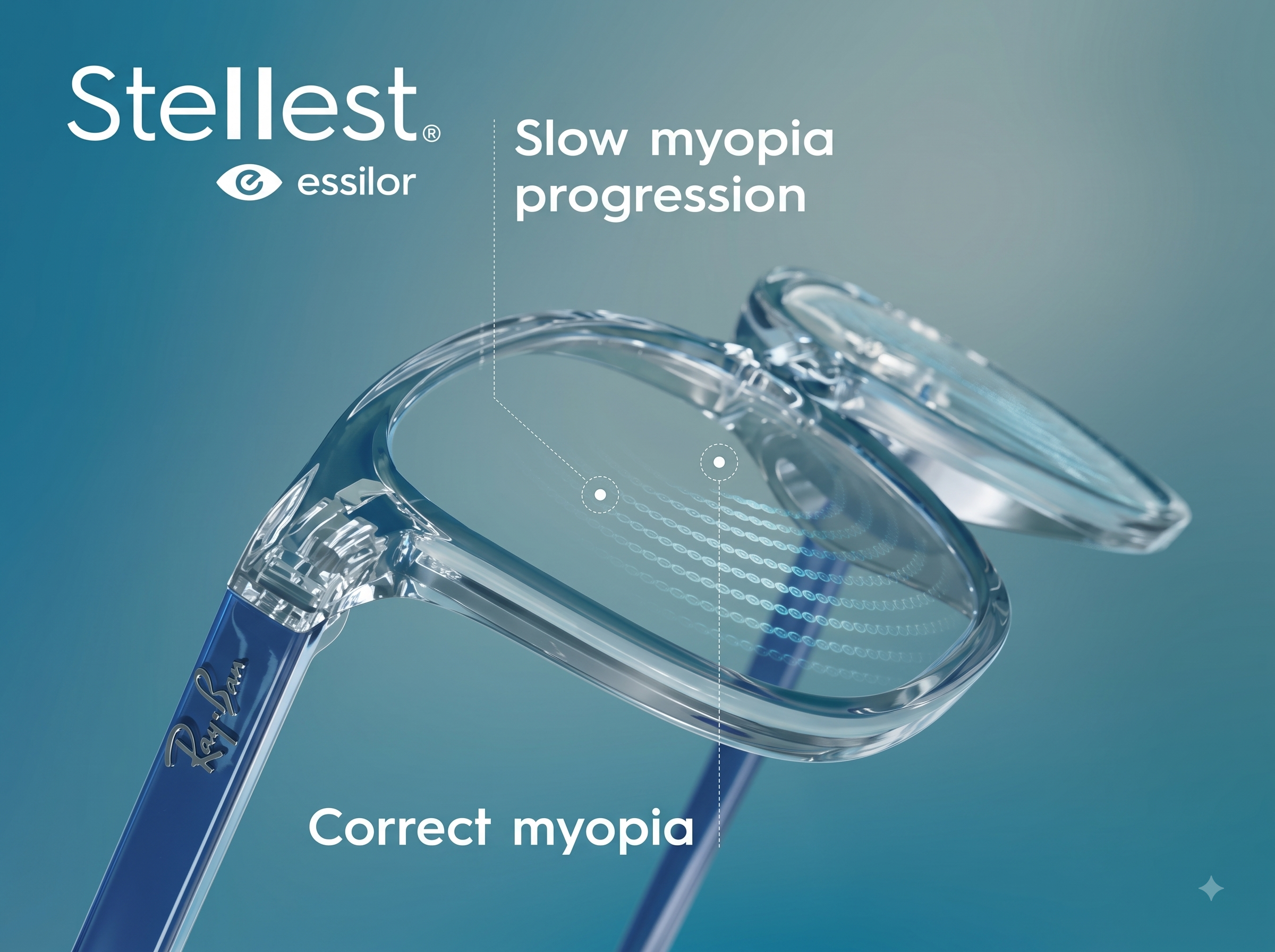
Stellest lenses are prescription eyeglass lenses that correct nearsightedness while using a specialized pattern of tiny peripheral lenslets intended to slow childhood myopia progression. A clear central zone provides the child's distance prescription; the surrounding lenslet design creates a different optical signal across the peripheral retina.
In September 2025, the U.S. Food and Drug Administration authorized marketing of Stellest to correct myopia, with or without astigmatism, and slow progression in children who are 6 through 12 years old when treatment begins. The authorized indication applies to children with non-diseased eyes and specified prescription parameters. The detailed FDA De Novo record is the best source for the current U.S. indication.
That does not mean every child within that age range is automatically a candidate—or that a child outside it has no options. The prescription, eye health, progression history, visual needs, frame fit and ability to wear the glasses consistently all matter. If Stellest is not the right match, we can discuss other myopia-management approaches.
The Stellest process at a glance
| Stage | What happens | Why it matters |
|---|---|---|
| Comprehensive eye exam | Prescription, vision, eye coordination and eye health are assessed | Confirms the child's visual and ocular-health needs |
| Dedicated myopia evaluation | Progression history, risk factors, refraction and treatment choices are reviewed | Separates simple correction from an active myopia plan |
| Topcon MYAH baseline | Axial length and other measurements are collected as indicated | Creates objective starting data for future comparison |
| Frame selection | The optician evaluates stability, size, bridge fit and child-friendly function | Keeps the lens design positioned correctly during daily activity |
| Digital optical measurements | Monocular PD and fitting heights are captured in the adjusted frame | Places the lens design in front of each eye as intended |
| Dispensing and adaptation | Vision, frame fit, cleaning and wear expectations are reviewed | Helps the child start with comfortable, consistent habits |
| Early optical check | Fit, comfort, adaptation and wearing time are reviewed | Allows adjustments before small issues become reasons not to wear the glasses |
| Six-month monitoring | Refraction/autorefraction and axial length are compared with baseline | Shows how the eyes and prescription are changing |
| Annual comprehensive exam | Full visual and eye-health evaluation is repeated | Keeps preventive eye care current alongside myopia monitoring |
The exact tests and timing are individualized. A child may need an earlier visit if vision, comfort, fit or progression raises concern.
Step 1: The comprehensive pediatric eye exam
The first step is a comprehensive eye exam, not simply reading a school vision chart. During a pediatric eye examination, we assess the child's distance and near vision, prescription, eye focusing and coordination, and overall eye health.
Children do not always recognize blur. They may move closer to the board, squint at signs, avoid distance-dependent activities or assume that everyone sees the same way. An exam helps determine whether myopia is present, whether it has progressed and whether another visual or eye-health issue needs attention.
The National Eye Institute's myopia guide explains that nearsightedness commonly begins between ages 6 and 14 and may worsen into the early twenties. Earlier onset can leave more years for progression, which is one reason monitoring matters.
Step 2: A dedicated myopia evaluation—separate from the routine exam
A glasses prescription answers, “What power helps my child see clearly today?” A myopia evaluation asks additional questions:
When did the child first become nearsighted?
How much has the prescription changed and over what period?
Is there a family history of myopia or high myopia?
How much time does the child spend outdoors and doing close work?
Is the child likely to wear glasses consistently?
Would a spectacle, soft-contact-lens or Ortho-K approach fit the child's needs and maturity?
What measurements will we use to judge response over time?
The comprehensive exam and myopia evaluation are connected but distinct services. Myopia management includes additional testing, treatment planning and monitoring that are not automatically part of a routine vision examination.
Families who want an overview before the visit can read our Cincinnati kids' myopia article, which introduces Stellest, MiSight and Ortho-K without assuming that one option is best for every child.
Step 3: Measuring axial length with the Topcon MYAH
One of the most useful baseline measurements in myopia management is axial length—the front-to-back length of the eye. Myopia often progresses as the eye grows longer. Axial length does not replace the prescription; it adds a different, objective measurement to the story.
At See Well Eyecare, the Topcon MYAH provides a quick, noncontact axial-length measurement. Topcon's official MYAH clinical overview describes repeatable optical biometry, axial-length and prescription trend reports, corneal topography and other myopia-management tools.
The child looks at a target while the instrument captures the measurement. Nothing touches the eye. We save the result as a baseline and compare it with future visits.
Why both prescription and axial length?
Refraction and autorefraction measure how the eye focuses. Axial length measures physical eye growth. Either number can fluctuate or tell an incomplete story when viewed alone. Comparing both over time helps us discuss whether the treatment plan appears appropriate or whether another conversation is needed.
The International Myopia Institute reviews treatment efficacy primarily through changes in axial elongation and refractive progression. In practical terms, our goal is not to chase one “perfect” number; it is to create repeatable measurements and understand the child's trend.
Step 4: Choosing the right frame is part of the treatment
Children naturally start with color and style. We want them to like the frame—because a pair left in a backpack cannot do its job—but the optical fit matters just as much.
Our optician looks for a frame that:
sits securely without sliding down;
positions each pupil appropriately within the lens shape;
has enough lens area for the specialized design;
fits the bridge and temples without pinching;
tolerates school, sports and everyday movement;
can be adjusted as the child grows; and
works with the prescription and laboratory requirements.
The most expensive frame is not automatically the best frame. See Well Eyecare carries a range of styles and price points, including budget-conscious options. The goal is a stable, comfortable frame that the child will wear and that supports accurate lens placement.
Ordering online from a frame photo cannot reproduce this full process. The frame must first be adjusted on the child's actual face, then measured in the position in which it will be worn. Our team remains accountable for checking the finished glasses, adjusting them and helping if the fit changes.
Step 5: Precision measurements with Optikam
Stellest lenses require more than a single total pupillary-distance number. We measure each eye separately and determine the fitting height in the selected, pre-adjusted frame.
See Well Eyecare uses the Optikam digital measurement platform when appropriate. Optikam's official system description explains that its tablet-based process can capture pupillary distance, fitting height and position-of-wear data in natural posture, with measurements stored electronically.
Digital measurement helps us create a consistent, trackable record and transmit the information to the laboratory. It also lets the optician review the frame and measurements together. A traditional PD ruler still has a valid role in certain cases and as a verification method; the technology supports professional judgment rather than replacing it.
Why measurement matters with Stellest
The clear central zone and surrounding lenslet area must be positioned as designed. Precise monocular PDs and fitting heights help align the optical center with each eye. If a frame constantly slides, becomes crooked or is measured before it is properly adjusted, the child may not look through the lens as intended.
This is why the fitting appointment is part of the clinical pathway—not merely a fashion stop after the exam.
Step 6: Ordering, laboratory work and the final inspection
Once the prescription, frame and measurements are confirmed, the order goes to the laboratory. Turnaround varies with lens availability, prescription, frame and lab volume, so our team will give an estimate rather than promising a universal delivery date.
When the glasses return, we inspect the lenses and frame before dispensing. At pickup, the optician checks:
that the frame is level and stable;
pupil alignment and fitting position;
vision at distance and near;
comfort behind the ears and across the bridge;
how to clean and store the lenses; and
the recommended daily wearing schedule.
Bring the child to the dispensing appointment whenever possible. A parent can pick up ordinary backup glasses in some situations, but a specialized myopia-control pair should be checked on the child's face.
What should the first week feel like?
Many children adapt quickly, but Stellest is not optically identical to an ordinary single-vision lens. The FDA's authorization materials note that some study participants reported visual symptoms such as blur or halos. A child may need several days to learn to look through the new design naturally.
During the first week, parents can ask simple questions:
Is the board clear at school?
Is reading comfortable?
Do the glasses stay up without frequent pushing?
Is the child wearing them for the prescribed schedule?
Is there persistent blur, dizziness, headache or a new visual complaint?
A little early awareness does not automatically mean the lens is wrong. Persistent or significant symptoms deserve a fit and vision check. Often the solution is a frame adjustment; sometimes the prescription or measurements need to be reviewed.
Daily wear: consistency is part of treatment
Stellest is designed to be worn as the child's primary pair—not only for the classroom or when the board looks blurry. Current manufacturer practitioner instructions recommend at least 10 hours per day on at least 6 days per week, while clinical research has also associated longer, full-time wear with greater treatment benefit. Follow the schedule Dr. Baik gives your family because the child's needs and the current U.S. labeling take priority over general internet advice.
The randomized clinical research on highly aspherical lenslet designs reported that wearing time matters; the two-year Stellest study summarized by the International Myopia Institute found greater effect among children who wore the lenses full time. No myopia treatment stops every child's progression, so consistent use supports the intended benefit without guaranteeing a specific result.
Parents can build wear into the morning routine:
Put the glasses on after getting dressed.
Use the hard case when the glasses are off.
Keep ordinary backup glasses available.
Tell teachers or caregivers that these are the child's primary treatment glasses.
Return for an adjustment if the frame slips or becomes crooked.
Cleaning and caring for the glasses
Children's lenses collect fingerprints, sunscreen and dust quickly. For routine care:
rinse grit away with cool or lukewarm water before wiping;
use the cleaner and microfiber cloth recommended by the optical team;
avoid hot water and harsh household chemicals;
hold the bridge with two hands when putting the glasses on or taking them off;
store the pair in its case when not worn; and
bring loose screws, bent temples or a sliding frame to the office for adjustment.
Do not try to reshape the frame at home. A small bend can change lens position and comfort.
The early fit-and-adaptation check
We commonly want an early optical check after dispensing—often around two weeks—to ask about adaptation and daily wear and to confirm that the frame remains positioned correctly. The exact appointment depends on the child and current fitting guidance.
This visit may include:
distance and near vision;
frame and lens-position check;
review of wearing time;
adjustment of the bridge or temples; and
answers to the child's and parent's questions.
Do not wait for the scheduled visit if the glasses are painful, visibly crooked, constantly sliding, damaged or causing persistent visual symptoms. The sooner we correct a fit problem, the less likely the child is to stop wearing the pair.
Six-month myopia monitoring
See Well Eyecare generally plans a dedicated myopia follow-up at about six months. Depending on the child, it may include:
distance and near visual acuity;
objective autorefraction and clinical refraction;
axial-length measurement on the Topcon MYAH;
comparison with the baseline and previous trends;
review of daily wearing time;
inspection of the glasses and frame fit; and
discussion of whether the current plan should continue or change.
Professional guidance discussed by Review of Myopia Management supports regular assessment of safety and efficacy with refraction and axial length. If progression appears faster than expected, we do not assume the family failed. We first confirm wear, measurements, fit and other risk factors, then discuss the available options.
The yearly comprehensive exam is still necessary
The six-month myopia check does not replace the annual comprehensive exam. The yearly visit evaluates the child's broader eye health, focusing and coordination, prescription and retinal health. Some testing—such as a dilated or cycloplegic examination—may be recommended based on age, prescription and findings.
Think of the schedule as two connected loops:
Myopia loop: baseline → treatment → six-month measurement → adjust or continue.
Eye-health loop: yearly comprehensive exam → preventive assessment → updated long-term plan.
Together, they tell a stronger story than simply replacing lenses whenever a child says the board is blurry.
What if the prescription changes?
Some change can occur even with effective myopia management. The goal is to slow progression, not promise that the prescription or axial length will remain frozen.
If a meaningful prescription change occurs, the child may need new lenses. Manufacturer and office warranty or protection programs can have eligibility rules, deadlines, documentation requirements and exclusions. Our optician will explain the current terms available for the selected frame and Stellest lenses before purchase. Keep receipts and attend the recommended follow-ups, because documentation may be important.
Do not publish a blanket promise such as “free replacement if the prescription changes” unless the exact current U.S. program has been verified for that order.
Fees, insurance and private-pay options
The pediatric comprehensive exam, dedicated myopia evaluation, Topcon MYAH measurements, Stellest lenses, frame and follow-up services are related but may be separate charges. Vision benefits may contribute toward the exam, frame or lenses depending on the plan, but coverage and eligibility vary.
Our team can verify available benefits and explain the expected costs before ordering. Families without applicable coverage are welcome and will receive the same careful attention. You can use private-pay options and choose services à la carte when appropriate. Review our insurance and payment information or ask the team for a personalized estimate.
A parent checklist for the appointment
Bring:
the child's current and previous glasses;
recent prescriptions and eye records;
a list of medications and allergies;
vision-plan information if you want benefits checked;
notes about school, sports and screen use; and
questions about wear, warranties and follow-up fees.
Before ordering:
let the optician adjust the final frame before measurements;
confirm that the child likes and will wear the frame;
ask what is included in the purchase and fitting process;
request the current written warranty terms; and
schedule the early fit check and six-month monitoring visit.
About See Well Eyecare
See Well Eyecare provides professional, personalized care for children and families in Hyde Park, Oakley and throughout Cincinnati. Our process connects a thorough examination, Topcon MYAH technology, professional optician-guided frame fitting, Optikam digital measurements, clear payment choices and continued support after the glasses are dispensed.
We accept vision insurance, and private-pay families are never treated as secondary. Whether benefits apply or services are paid directly, our goal is to explain the plan clearly and help each family make a confident decision.
If your child's nearsightedness is changing—or you want to know whether Stellest may be appropriate—request an appointment or call (513) 268-8748. When scheduling, mention that you are interested in a pediatric myopia or Stellest evaluation so the team can reserve the appropriate visit.
Explore Cincinnati after the appointment
Families coming from across Cincinnati can pair a visit with a seasonal activity that is different from the events featured in our other recent guides:
Western & Southern/WEBN Riverfest is scheduled for September 6, 2026 at Sawyer Point and Yeatman's Cove.
The Cincinnati Art Museum lists Art After Dark on August 28, September 25 and October 30, 2026.
BLINK 2026 is scheduled for October 8–11 across Cincinnati and Northern Kentucky.
The free FotoFocus 2026 Biennial runs from September 30 through October 31 at dozens of regional venues.
Event times, locations, admission and registration can change. Check the official organizer before leaving home. Refresh or remove this section after October 31, 2026.
Frequently asked questions
Are Stellest lenses just regular glasses?
They correct the child's prescription like glasses, but they also contain a specialized peripheral lenslet design intended to slow myopia progression. See our Stellest lens page for the overview.
What ages are Stellest lenses authorized for in the United States?
The FDA authorization applies to eligible children who are 6 through 12 years old when treatment begins, within the specified prescription and eye-health criteria. An examination is needed to determine candidacy.
Is a Stellest evaluation included in a regular eye exam?
Not automatically. The comprehensive exam evaluates vision and eye health. Active myopia management adds baseline measurements, treatment planning and scheduled monitoring, which may be separate services and fees.
Why does See Well Eyecare measure axial length?
Axial length measures the eye's physical front-to-back growth, while refraction measures focusing power. Tracking both helps us interpret progression more completely. Learn more about our myopia-management approach.
Does my child need corneal topography for Stellest glasses?
Axial length and refraction are the central monitoring measurements for most spectacle-based myopia care. The MYAH also provides corneal topography, which may be used when clinically indicated or when comparing other treatment options such as Ortho-K.
Why can't I use one total PD from an online order?
Stellest fitting uses monocular measurements—each eye separately—and fitting heights taken in the child's adjusted frame. Our Optikam system creates a trackable digital record, and the optician verifies the frame on the child's face.
How many hours should my child wear Stellest lenses?
Current practitioner instructions recommend at least 10 hours per day on at least 6 days per week, and many children are advised to wear them full time. Follow the schedule Dr. Baik gives your child.
How long does adaptation take?
Many children adapt within several days, but individual experiences vary. Contact us for persistent blur, headaches, dizziness, halos that interfere with activities or a frame that slips out of position.
Will Stellest stop my child's myopia completely?
No treatment can guarantee that myopia will stop. Stellest is intended to slow progression. We monitor refraction and axial length to understand the child's response and adjust the plan when appropriate.
What happens at the six-month visit?
We typically review vision and daily wear, measure refraction/autorefraction and axial length, compare trends and inspect the frame fit. This specialty visit is separate from the annual pediatric comprehensive exam.
What if the glasses break or the prescription changes?
Contact the office rather than ordering a replacement without checking the fit and prescription. Warranty terms depend on the current manufacturer, frame, laboratory and office program. We review the applicable terms at purchase and help document eligible concerns.
Can my child still have backup glasses?
Yes. A current backup pair is important for damage, loss or repair. Ask which prescription and lens type are appropriate for backup use.
This article provides general education and does not diagnose a condition, guarantee treatment results or replace an individualized eye examination and myopia-management plan.
Quick Links
Helpful Articles
All Eye Care Services
Eye care for every stage of life, from routine exams and contact lens fittings to dry eye care, myopia management and medical eye visits. Dr. Baik helps you understand your options and choose care that fits your needs.

Keep In Touch
For non-urgent questions or to learn more about our services, contact us today!

We are an LGBTQ+ friendly clinic that believes all people deserve quality eye care
- 3330 Erie Avenue, Suite 14
Cincinnati, OH 45208 - Phone: (513) 268-8748
- Fax: (513) 268-8758
- Monday 9:00am - 3:00pm
- Tuesday 8:00am - 7:00pm
- Wednesday Closed
- Thursday 8:00am - 5:00pm
- Friday 8:00am - 3:00pm
- Saturday 9:00am - 2:00pm
- Sunday Closed
- Monday
- Tuesday
- Wednesday
- Thursday
- Friday
- Saturday
- Sunday
- Monday
- Tuesday
- Wednesday
- Thursday
- Friday
- Saturday
- Sunday
© 2026 See Well Eyecare. All rights Reserved - Accessibility Statement - Privacy Policy - Terms & Conditions - Sitemap
Managed and Designed by 