A Farsighted Child May Still Pass the Eye Chart: What Cincinnati Parents Should Know
A Farsighted Child May Still Pass the Eye Chart: What Cincinnati Parents Should Know
Children can sometimes use their powerful focusing system to overcome farsightedness—also called hyperopia—long enough to read a distance chart. That effort can hide the prescription during a simple screening while contributing to headaches, eye strain, avoidance of near work or an eye that turns inward.
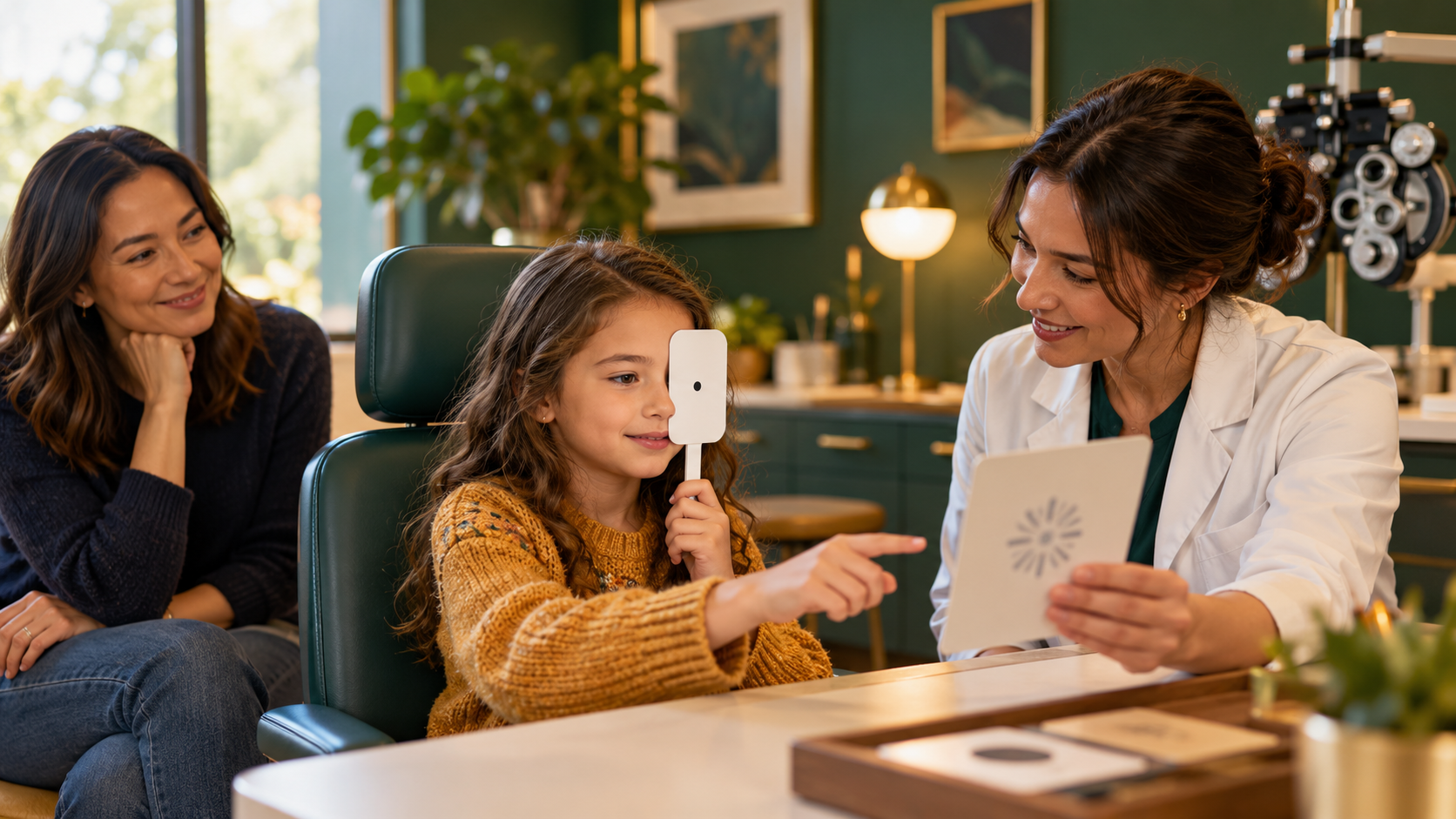
A farsighted child eye exam in Cincinnati looks beyond the letters a child can identify. It considers symptoms, focusing, eye teaming, alignment and the prescription that appears when focusing is appropriately relaxed.
What Is Hyperopia?
The National Eye Institute’s hyperopia guide explains that farsightedness occurs when light would focus behind the retina because of the eye’s shape. Near objects may be blurry, although children can sometimes compensate.
AAPOS guidance on refractive errors in children notes that small amounts of hyperopia are common in young children and may not require glasses. Higher amounts, blurred vision or crossed eyes may need plus-powered lenses.
Why “20/20” Does Not Tell the Whole Story
A distance chart measures what the child can identify under that test condition. It does not fully measure how hard the child is focusing, how the eyes work together at near or whether one eye is being suppressed.
Possible clues include:
- headaches or tired eyes after reading;
- rubbing the eyes or avoiding close work;
- holding material unusually far away;
- intermittent crossing of one eye;
- losing place or short attention for near tasks;
- blur that appears later in the day; or
- different vision between the two eyes.
These symptoms are not specific to hyperopia, and not every reading difficulty is an eye problem. A complete examination helps separate visual findings from other learning or attention needs.
What a Pediatric Eye Exam Adds
A pediatric eye examination may assess distance and near acuity, eye alignment, tracking, focusing, depth perception and ocular health. When indicated, dilating or cycloplegic drops temporarily relax focusing so the underlying prescription can be measured more accurately.
The NEI hyperopia fact sheet explains that a comprehensive dilated examination can diagnose hyperopia and other refractive errors.
Why Early Detection Matters
If one eye is more blurred or an eye turns, the developing brain may favor the clearer eye. That can contribute to amblyopia. AAPOS describes amblyopia as reduced vision caused by abnormal visual development, with treatment tailored to the cause.
NEI-supported research also found an association between uncorrected moderate hyperopia and lower early-literacy performance in preschoolers. That does not mean glasses treat a learning disorder; it means clinically meaningful blur and visual effort should not be ignored.
If Glasses Are Recommended
The prescription depends on age, amount of hyperopia, symptoms, alignment and visual development. Some children wear glasses full time; others may be observed or given a different plan.
See Well’s optical offers curated children’s frames, careful measurements and after-purchase adjustments. A child’s glasses need to stay positioned, feel comfortable and fit the intended use. Choosing the same local team for the exam and eyewear keeps prescription, product, fitting and follow-up connected.
This Is Different From Myopia Management
Hyperopia is farsightedness; myopia is nearsightedness. Treatments such as Stellest, MiSight 1 day, Ortho-K/CRT and low-dose atropine are discussed for progressing childhood myopia, not as interchangeable options for farsightedness. See Well’s myopia-management guide explains those distinctions.
Explore Hyde Park & Nearby Neighborhoods
See Well Eyecare welcomes children from Hyde Park (45208), Oakley (45209), Mariemont (45227), Mount Lookout and across Cincinnati. Bring school screening results, current glasses and notes about when symptoms occur.
Local Events & Attractions | Nature Tots on October 27
The Cincinnati Parks calendar lists Nature Tots on October 27. Young children use vision across play, books and movement; observations from home and preschool can add useful context to the exam.
Frequently Asked Questions
Can a farsighted child see far away clearly?
Yes. A child may compensate enough to see clearly at distance, but the effort can still affect comfort, near work or eye alignment.
Does every farsighted child need glasses?
No. The decision depends on age, prescription, symptoms, alignment and whether vision is developing equally.
Why use dilating drops?
They can relax the child’s focusing system and allow a more accurate measurement of hidden hyperopia while also helping the doctor examine eye health.
Will glasses make the eyes dependent?
No. Glasses provide the focus the child needs; they do not weaken the eyes.
Is a school screening enough?
Screening is valuable, but it is not a complete eye examination. Refer after a failed screening or when symptoms, alignment concerns or family history warrant evaluation.
Schedule a Children’s Eye Examination
If your child has headaches, near-work fatigue, crossing, a failed screening or a family history of significant refractive error, request an appointment.
About See Well Eyecare
See Well Eyecare is an independent Hyde Park practice led by Dr. Rawzi Baik. We provide pediatric eye examinations, children’s eyewear and evidence-based myopia management with clear explanations for Cincinnati families.
Primary keyword: farsighted child eye exam Cincinnati
Supporting keywords: hyperopia children Cincinnati, pediatric eye exam Hyde Park, child passes eye chart, children’s glasses Oakley, cycloplegic refraction
Quick Links
Helpful Articles
All Eye Care Services
Eye care for every stage of life, from routine exams and contact lens fittings to dry eye care, myopia management and medical eye visits. Dr. Baik helps you understand your options and choose care that fits your needs.

Keep In Touch
For non-urgent questions or to learn more about our services, contact us today!

We are an LGBTQ+ friendly clinic that believes all people deserve quality eye care
- 3330 Erie Avenue, Suite 14
Cincinnati, OH 45208 - Phone: (513) 268-8748
- Fax: (513) 268-8758
- Monday 9:00am - 3:00pm
- Tuesday 8:00am - 7:00pm
- Wednesday Closed
- Thursday 8:00am - 5:00pm
- Friday 7:00am - 3:00pm
- Saturday 8:00am - 2:00pm
- Sunday Closed
- Monday
- Tuesday
- Wednesday
- Thursday
- Friday
- Saturday
- Sunday
- Monday
- Tuesday
- Wednesday
- Thursday
- Friday
- Saturday
- Sunday
© 2026 See Well Eyecare. All rights Reserved - Accessibility Statement - Privacy Policy - Terms & Conditions - Sitemap
Managed and Designed by 