
High Prescription or High Astigmatism? A More Comfortable Eye Exam in Cincinnati
High Prescription or High Astigmatism? A More Comfortable Eye Exam in Cincinnati
If you have a very strong glasses prescription or significant astigmatism, you may remember eye exams that required loose lenses, a trial frame or repeated equipment changes just to reach your prescription. Those methods can still be clinically useful, but they may feel slow, awkward or less natural than viewing through a standard refractor.
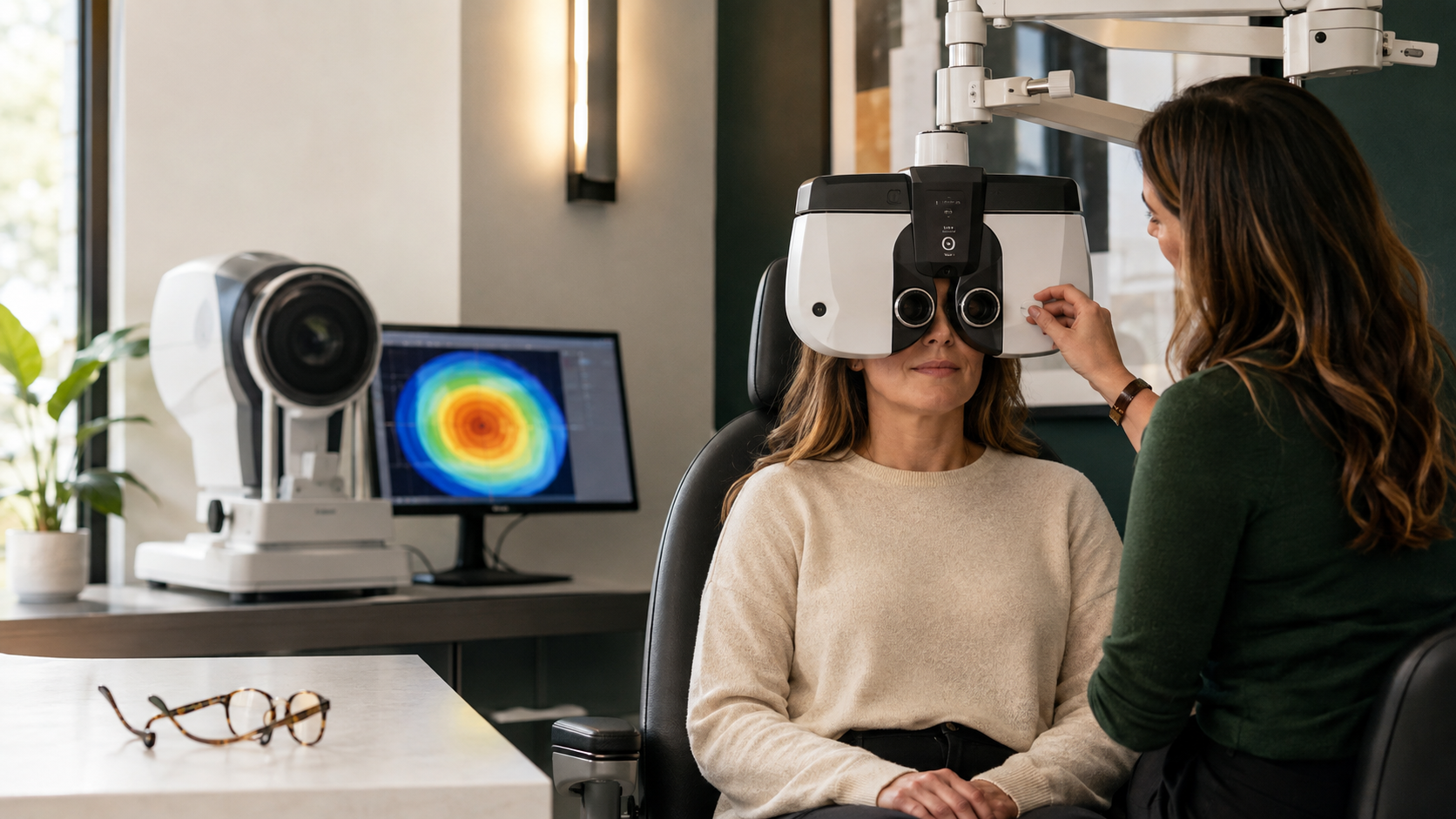
At See Well Eyecare, we want patients with high myopia, high hyperopia and high astigmatism to know that they are not “too complicated” for a comfortable eye exam. Our Hyde Park office combines experience with modern refraction and corneal-mapping technology to make the process more efficient while still giving Dr. Rawzi Baik the flexibility to slow down, verify the result and explain what it means.
We serve patients from Hyde Park, Oakley, Mariemont, Mount Lookout, Columbia-Tusculum, Madeira, Anderson Township and throughout greater Cincinnati.
Why Strong Prescriptions Can Make Refraction More Challenging
A refraction is the part of an eye exam that helps determine the lens power needed for your clearest vision. Patients often recognize it as the “Which is better—one or two?” portion of the visit.
With a high prescription, small changes in lens power, lens position and viewing distance can have a noticeable effect. High astigmatism also requires careful refinement of both cylinder power and axis. The National Eye Institute’s explanation of refractive errors describes how the length of the eye and the shape of the cornea or lens influence where light focuses. Its astigmatism guide explains that an uneven corneal or lenticular shape can cause blurred or distorted vision at different distances.
Traditional trial-frame refraction is not wrong or outdated; in selected cases, it remains a valuable way to confirm how a prescription feels outside the instrument. The difference is that patients should not have to begin with an awkward workaround simply because their prescription is unusually strong.
A Digital Refractor With an Unusually Wide Prescription Range
See Well Eyecare uses a Marco digital refraction system with a much wider range than many patients expect from a standard phoropter-style examination.
Marco’s published specifications for both the TRS-5100 Total Refraction System and TRS-6100 Total Refraction System list these measurement ranges:
Sphere: −29.00 to +26.75 diopters
Cylinder for astigmatism: up to ±8.75 diopters
Axis: 0 to 180 degrees
That means many patients with very high nearsightedness, farsightedness or astigmatism can remain behind the digital refractor during the standard comparison process rather than immediately switching to a trial frame and stacks of loose lenses.
The technology also allows us to compare your current correction with the refined prescription more efficiently. Equipment does not replace clinical judgment, however. Dr. Baik may still use retinoscopy, trial framing, dilation, cycloplegic testing or other verification methods when they would improve reliability—particularly when responses are inconsistent, vision does not sharpen as expected or the prescription differs significantly from prior records.
If you are looking for a comprehensive eye exam in Cincinnati, bring your current glasses, contact-lens information and any older prescriptions available. Seeing how your prescription has changed over time can be as important as the final number measured today.
High Astigmatism Deserves More Than a Stronger Cylinder Number
Astigmatism is common and often reflects a regular difference in curvature across the cornea or lens. The American Optometric Association’s astigmatism overview notes that astigmatism may cause blur, eyestrain, squinting and difficulty seeing at night.
High, irregular or rapidly changing astigmatism may sometimes warrant a closer look at the corneal surface. Reasons to consider additional evaluation can include:
Increasing astigmatism or frequent prescription changes
Vision that remains distorted despite an apparently accurate glasses prescription
Ghosting, halos or multiple images around lights
One eye seeing substantially worse than the other
A family history of keratoconus
Significant eye rubbing or a history of corneal disease, trauma or surgery
Difficulty achieving stable vision with ordinary soft contact lenses
These findings do not automatically mean that someone has keratoconus. They simply provide reasons to investigate further rather than repeatedly changing the glasses prescription without understanding why the vision is unstable.
You can also review our patient guide to astigmatism.
Corneal Topography Can Reveal the Shape Behind the Prescription
See Well Eyecare uses the Topcon MYAH for corneal topography. Corneal topography creates a detailed map of the cornea’s curvature. It can help us screen for irregular astigmatism, asymmetry and patterns that may raise concern for keratoconus or another corneal condition.
The American Optometric Association’s keratoconus resource and the American Academy of Ophthalmology’s discussion of keratoconus diagnosis and management describe corneal mapping as an important part of evaluating corneal shape. The AAO-supported EyeWiki keratoconus review and the National Library of Medicine’s clinical review of keratoconus provide additional detail about how topographic or tomographic patterns contribute to evaluation.
Topography is not a stand-alone diagnosis, and not every patient with high astigmatism needs it. We interpret the map alongside the refraction, best-corrected vision, slit-lamp examination, prescription history and symptoms. If the findings suggest ectasia or another condition requiring services beyond our office, we can discuss further testing or referral.
Learn more about keratoconus and treatment options available to Cincinnati patients.
High Prescriptions Require Thoughtful Eyeglass Design
An accurate prescription is only the first step. With high-powered lenses, frame size, lens material, optical-center placement, vertex distance and how the frame sits on the face can meaningfully affect thickness, appearance, field of view and visual comfort.
Our optical team can help patients compare:
Smaller, well-centered frames that may reduce edge thickness in high myopia
Appropriate high-index lens materials
Aspheric or digitally surfaced lens designs when suitable
Anti-reflective treatments
Frame shapes and constructions that support the prescription
Precise, frame-specific measurements using Optikam technology
Final verification, fitting, adjustments and troubleshooting
This is one reason buying glasses through the same practice that performed the exam can be particularly valuable for a high prescription. The doctor, optician, measurements, laboratory order and follow-up remain connected. We can help solve the whole visual problem rather than simply sending a large prescription number into an online order form.
Contact Lenses May Offer Another Option
Some patients with high prescriptions or high astigmatism appreciate contact lenses because the lenses move with the eyes and sit much closer to the cornea than glasses. Depending on the individual, this may provide a wider usable field of view or reduce some of the image-size and peripheral effects experienced with strong spectacle lenses.
A contact-lens prescription requires its own evaluation and cannot be calculated safely from the glasses prescription alone. The U.S. Food and Drug Administration explains that a contact-lens prescription includes lens-specific information and requires professional fitting. The Centers for Disease Control and Prevention also emphasizes that contact lenses are medical devices that require appropriate wear and care.
Depending on the corneal shape and visual needs, options may include:
Custom soft toric lenses for higher astigmatism
Rigid gas-permeable lenses
Hybrid lenses
Scleral lenses that vault the corneal surface
Other specialty designs for irregular corneas or unusually high powers
See Well Eyecare provides contact-lens examinations and specialty contact-lens evaluations. Patients with keratoconus or irregular corneas can also learn about our scleral-lens services.
Could VSP or EyeMed Consider Contacts Medically Necessary?
Possibly—but a high prescription or high astigmatism does not automatically guarantee medically necessary contact-lens coverage.
Some VSP and EyeMed benefit plans provide a separate benefit when contact lenses meet the plan’s definition of visually or medically necessary. Criteria may involve high ametropia, a significant prescription difference between the eyes, keratoconus, irregular corneal conditions, aphakia or a documented improvement in vision compared with glasses. The exact rules, documentation requirements, copayments, covered lens types and authorization process depend on the patient’s specific plan.
For example, VSP-connected Eyefinity guidance identifies high ametropia of at least 10.00 diopters in either eye and anisometropia of at least 3.00 diopters as examples of qualifying conditions, while directing providers to current VSP requirements for the complete criteria. VSP has also published updates to its visually necessary contact-lens criteria, which is why benefits must be checked against current plan rules rather than assumed from an old threshold.
EyeMed’s medical-necessity information similarly illustrates that coverage decisions depend on clinical requirements and the applicable policy. An EyeMed plan may use different criteria or procedures from VSP, and employer-specific plans can differ even within the same network.
If you have VSP or EyeMed, See Well Eyecare can:
Verify the benefits available under your specific plan.
Document the glasses prescription, contact-lens findings, corneal condition and corrected visual acuity.
Determine whether the clinical findings appear to meet the current criteria.
Request authorization or submit supporting documentation when appropriate.
Explain expected patient costs before ordering whenever reliable benefit information is available.
Coverage is determined by the plan, not by our office, and benefit verification is not a guarantee of payment. However, we can help you investigate the benefit and present the relevant clinical information instead of making you navigate the process alone. Visit our payment and insurance page for general information about plans accepted by See Well Eyecare.
High Myopia Also Requires Ongoing Eye-Health Monitoring
A high prescription is not only an optical challenge. The National Eye Institute notes that high myopia is associated with a longer eye and increased risk of retinal holes, tears, detachment and other vision-threatening changes. Patients with high myopia may need comprehensive dilated examinations more frequently based on their age, history, symptoms and clinical findings.
Seek prompt eye care for a sudden increase in floaters, flashes of light, a curtain or shadow in the vision, sudden distortion or unexplained loss of vision. These symptoms should not wait for a routine glasses appointment.
What to Bring to a High-Prescription Eye Exam
To help us understand your visual history, bring:
Your current and backup glasses
Current contact-lens boxes or parameters
Previous prescriptions, if available
Information about prior corneal surgery, injury or disease
Your VSP or EyeMed information plus your medical-insurance card
Notes about ghosting, glare, night-driving problems or recent changes
If you have been told that your prescription is outside a standard phoropter’s range, that your astigmatism is unusually high or that ordinary glasses or soft contacts do not give you satisfactory vision, tell our team when scheduling. This helps us reserve the appropriate type of visit and prepare for any testing that may be useful.
Schedule a High-Prescription Eye Exam in Cincinnati
See Well Eyecare is located at 3330 Erie Avenue, Suite 14, in Cincinnati’s Hyde Park neighborhood, with free parking behind the building. We welcome patients from Hyde Park, Oakley, Mariemont, Mount Lookout, Columbia-Tusculum, Madeira, Anderson Township and nearby communities.
Our goal is straightforward: make a complicated prescription feel manageable. We combine wide-range digital refraction, corneal topography, careful clinical judgment, specialty contact-lens options and professional optical measurements to help you understand your eyes and choose the correction that works best for your life.
Request an appointment with See Well Eyecare and let us know that you have a high prescription, high astigmatism or a history of difficult refractions.
Frequently Asked Questions
How high can See Well Eyecare’s digital refractor measure?
The published Marco range is −29.00 to +26.75 diopters of spherical power and up to ±8.75 diopters of cylinder for astigmatism. Your final prescription still depends on clinical testing and verification, not the equipment limit alone.
Will I definitely avoid a trial frame?
The wide digital range means many strong prescriptions can be tested through the standard refractor. A trial frame may still be used when it helps confirm real-world comfort, lens position or an unusual prescription.
Does high astigmatism mean I have keratoconus?
No. Many people have regular astigmatism without corneal disease. High, irregular or changing astigmatism may be a reason to examine the corneal shape more closely, but diagnosis requires interpretation of multiple clinical findings.
Can corneal topography diagnose keratoconus by itself?
No. Topography provides a detailed map that can reveal suspicious patterns, but it must be interpreted with the prescription, visual acuity, slit-lamp examination, history and sometimes additional testing.
Do VSP and EyeMed cover medically necessary contact lenses?
Some plans do when current clinical and documentation requirements are met. Eligibility varies by plan and diagnosis. See Well Eyecare can verify benefits and submit documentation when appropriate, but cannot guarantee authorization or payment.
Are specialty contact lenses included in a routine contact-lens evaluation?
Not necessarily. Scleral, rigid, hybrid and other custom designs require additional measurements, fitting time and follow-up. We will explain the recommended evaluation and expected fees before proceeding.
About the Author
Rawzi Baik, OD, is the founder of See Well Eyecare, an independent optometry and optical practice in Cincinnati’s Hyde Park neighborhood. His clinical interests include comprehensive eye care, high and complex prescriptions, contact lenses, myopia management, dry eye, specialty contact lenses and medical eye care.
Primary keyword: high-prescription eye exam Cincinnati
Supporting keywords: high astigmatism eye doctor Cincinnati, strong glasses prescription Cincinnati, digital refraction Cincinnati, Marco phoropter high prescription, corneal topography Cincinnati, keratoconus screening Cincinnati, medically necessary contact lenses VSP, medically necessary contact lenses EyeMed, scleral lenses Cincinnati, specialty contact lenses Cincinnati
Quick Links
Helpful Articles

All Eye Care Services
Find personalized eye care excellence with our comprehensive services. From eye exams to advanced diagnostics, trust us for all your vision needs.

Keep In Touch
For non-urgent questions or to learn more about our services, contact us today!

We are an LGBTQ+ friendly clinic that believes all people deserve quality eye care
- 3330 Erie Avenue, Suite 14
Cincinnati, OH 45208 - Phone: (513) 268-8748
- Fax: (513) 268-8758
- Monday 9:00am - 3:00pm
- Tuesday 11:00am - 7:00pm
- Wednesday Closed
- Thursday 9:00am - 4:00pm
- Friday 8:00am - 5:00pm
- Saturday 9:00am - 3:00pm
- Sunday Closed
- Monday
- Tuesday
- Wednesday
- Thursday
- Friday
- Saturday
- Sunday
- Monday
- Tuesday
- Wednesday
- Thursday
- Friday
- Saturday
- Sunday
© 2026 See Well Eyecare. All rights Reserved - Accessibility Statement - Privacy Policy - Sitemap
Managed and Designed by 