Are Daily, Two-Week and Monthly Contact Lenses Bad for the Environment?
Are Daily, Two-Week and Monthly Contact Lenses Bad for the Environment?
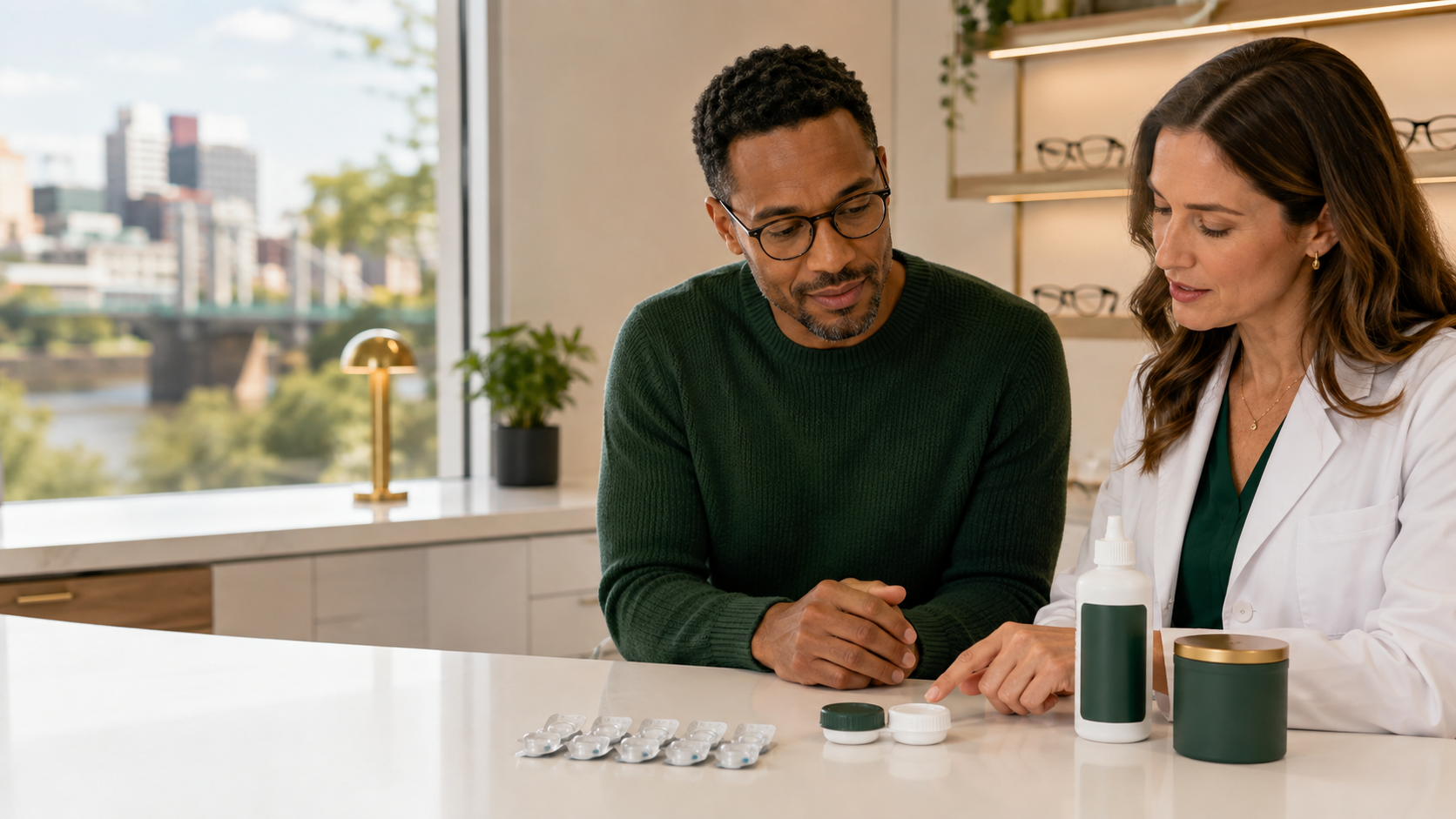
Daily disposable contact lenses create a lens, blister pack and foil top for every day of wear. Two-week and monthly soft lenses use fewer lenses and blister packs, but they also require disinfecting solution, bottles and regularly replaced storage cases. So which option is actually worse for the environment?
The honest answer is that no soft contact-lens system is waste-free, and package count alone does not tell the entire story. Eye health must come first. When a patient's prescription, corneal shape and tear film allow, See Well Eyecare often recommends daily disposables because a fresh lens removes several cleaning and storage steps that can go wrong. We then help our purchasing patients handle the resulting small materials more responsibly through complimentary in-office recycling.
Our collection uses the Bausch + Lomb ONE by ONE Recycling Program, operated with TerraCycle. The goal is not to pretend that daily lenses have no environmental cost. It is to recommend the lens that best supports safe, comfortable wear—and make proper disposal easier.
Daily versus two-week versus monthly: what gets discarded?
| Replacement schedule | What is discarded | Eye-health and care considerations |
|---|---|---|
| Daily disposable | One lens, blister cup and foil top after each day of wear | A fresh lens each day; no storage case or disinfecting solution; must never be reused |
| Two-week reusable | A lens and its original packaging every two weeks, plus solution bottles and storage cases | Requires cleaning, rubbing, rinsing and storing after every wear; the two-week schedule must not be stretched |
| Monthly reusable | A lens and its original packaging each month, plus solution bottles and storage cases | Fewer lenses and blisters, but the same daily cleaning responsibility; deposits and care errors can accumulate over time |
A peer-reviewed analysis comparing representative full-time daily-disposable and monthly-replacement systems estimated 1.06 kilograms of annual dry waste for the daily system and 0.83 kilograms for the monthly system—about 27% more by mass for the daily system. The monthly calculation included solution bottles and cases, not just lenses. The researchers also estimated that the daily system represented roughly 0.26% of one person's annual household waste in their United Kingdom model. These figures are product- and location-specific estimates, not a Cincinnati carbon-footprint study, but they show why a fair comparison must include the complete system. Read the peer-reviewed waste and recycling analysis.
In other words, daily contacts are not automatically the lowest-waste option. Two-week and monthly lenses are not automatically the more responsible choice either if they are over-worn, rinsed with water, poorly disinfected or replaced with extra emergency supplies after a problem. Environmental impact and healthy wear are related questions, but they are not the same question.
First: are contact lenses harmful to your eyes?
Contact lenses are medical devices. When they are professionally fitted and worn correctly, they can be a safe, comfortable and effective way to correct vision. They are not risk-free, however. The most important health risks come from behaviors such as sleeping in lenses without specific approval, exposing lenses to tap water or pool water, reusing a daily disposable lens, extending the replacement schedule, or continuing to wear a lens when the eye is red or painful.
The CDC's healthy contact-lens guidance recommends washing and completely drying your hands before handling lenses, keeping contacts away from water, following the prescribed replacement schedule and having regular professional follow-up. The FDA also advises patients to remove their lenses and contact their eye doctor for redness, pain, vision changes, itching or excessive tearing.
If you develop a red, painful or light-sensitive eye while wearing contacts, remove the lens and follow our Cincinnati contact-lens red-eye guide. Do not put the lens back in simply because the eye feels a little better.
Why we may recommend moving from reusable lenses to dailies
No single contact lens is best for every eye. Prescription range, corneal shape, tear-film quality, allergies, work demands and visual goals all matter. For many children, teens, busy professionals, athletes, occasional wearers and patients who dislike lens-care routines, daily disposables offer meaningful health and convenience advantages:
A fresh lens is opened for each day of wear.
There is no storage case, a common source of contamination when reusable lenses are not cared for correctly.
There is no cleaning solution to misuse, top off or forget while traveling.
Deposits and allergens have less time to accumulate on the lens.
The replacement schedule is easy to understand: one day means one lens.
A large case-control study published in Ophthalmology found that reusable soft-lens wear was associated with higher odds of Acanthamoeba keratitis than daily disposables in that study population. The researchers also emphasized that daily lenses still must not be reused, slept in or exposed to water. You can review the study abstract through the National Library of Medicine.
That is why our message is not “daily contacts make every risk disappear.” It is: a fresh daily lens can remove several avoidable care steps, but safe behavior and professional follow-up still matter. Our contact lens examination and fitting process helps determine whether a daily disposable, reusable soft lens or specialty design is the right match for your eyes.
We especially discuss a transition to dailies with patients who tend to stretch a two-week or monthly schedule, travel frequently, wear contacts only on selected days, struggle with solution and case care, or notice deposit- or allergy-related discomfort. Not every prescription is available in every daily design, and some patients do very well in properly maintained reusable lenses. The recommendation should follow an examination—not an environmental slogan or a one-size-fits-all sales pitch.
Are dailies better for your eyes but worse for the planet?
That question is too simple. Dailies generally create more individual packages, while reusable systems add solution bottles, cases, cleaning and replacement supplies. The waste study above measured dry material by weight; it did not establish the complete carbon footprint of every lens brand, manufacturing process, shipping method or patient routine.
At See Well, we make the clinical recommendation first. If a daily disposable is the most appropriate option, we do not advise a patient to accept unhealthy reuse or a more complicated care system merely to discard fewer blister packs. Instead, we help reduce avoidable waste: order thoughtfully, avoid flushing lenses, recycle accepted components through the proper specialty stream and use curbside recycling for the outer paperboard boxes.
What about microplastics?
Contact lenses and their blister packaging are small enough to escape many conventional recycling streams. Research has also raised valid questions about lenses that are flushed into wastewater and about microplastic shedding under laboratory conditions.
The practical response should be measured, not frightening. A study reported by the American Chemical Society found that some contact-lens users disposed of lenses down a sink or toilet and that wastewater processing could fragment lens material. The clear action for patients is to never flush contacts. Read the American Chemical Society overview of flushed contact lenses.
Another small laboratory study exposed reusable lenses to simulated sunlight and water and detected microplastic shedding under those test conditions. The investigators stated that the effect on human health was unknown. That early finding does not establish that routine contact-lens wear is poisoning the eye, and it should not encourage patients to over-wear a lens or abandon an otherwise healthy prescription without discussing alternatives. The ACS summary of that pilot study explains those limitations.
Do not put used contacts down the sink or toilet
Once a contact lens is removed, use one of these two routes:
Save it for an approved specialty-recycling program.
If specialty recycling is not available, place it in household trash—not a sink, toilet or curbside recycling cart.
Do not place loose contact lenses or tiny blister packs in Cincinnati curbside recycling. Their size and materials make them difficult for ordinary sorting equipment to capture. The City of Cincinnati recycling FAQ advises residents to recycle only accepted shapes and materials; when in doubt, leave an item out of the curbside cart.
Free contact-lens recycling for our purchasing patients
See Well Eyecare has partnered with TerraCycle through the Bausch + Lomb ONE by ONE program. We provide complimentary in-office collection for established patients who purchase their contact-lens supply through See Well Eyecare.
The program accepts the following items from any contact-lens brand, not only Bausch + Lomb:
Used soft contact lenses
Empty contact-lens blister packs
Separated blister-pack foil tops
Bring the materials empty and dry. You do not need to scrub the packaging, but remove remaining liquid and let the items dry before storing or dropping them off. Outer cardboard contact-lens boxes should go into your normal curbside recycling instead of the specialty collection.
Accepted items can change, so review the current official Bausch + Lomb ONE by ONE accepted-materials list or ask our team before bringing an unfamiliar item. The program states that qualifying collections also support Optometry Giving Sight.
An easy home collection routine
Recycling works best when it is simple enough to become a habit.
Keep a small, dry container near the place where you normally remove your lenses.
Peel the foil completely away from each empty blister pack.
Let the lens, plastic cup and foil dry.
Store the accepted pieces together.
Bring the collection to See Well Eyecare during your next visit or contact-lens pickup.
Keep this container away from children and pets. Do not add liquids, tissues, food packaging, cardboard boxes or other household recycling.
Why order your contact lenses through See Well Eyecare?
Buying contacts from your eye doctor's office is not simply a box transaction. It connects the product to the professional responsible for its fit, prescription and effect on your eye health.
When you order through See Well Eyecare, our team can:
Confirm that the exact prescribed brand, material, curve, diameter and power are ordered
Help you understand current manufacturer rebate requirements when an eligible offer is available
Review vision-plan benefits and annual-supply options
Provide free standard shipping to the patient's home with an annual-supply purchase
Arrange standard home shipping for a fee on smaller-than-annual orders, or two-day shipping for an additional fee when available
Reduce the chance that running out of lenses leads to unsafe reuse or extended wear
Provide appropriate trial lenses, when available, to patients who purchase through our office if they need a short bridge while their ordered supply is in transit
Provide local support if comfort, vision or prescription needs change
Keep your examination, fitting, follow-up and supply connected in one place
Offer complimentary contact-lens and packaging recycling to patients who purchase from our office
Trial availability depends on the exact prescription and current inventory. Trials are not a substitute for ordering on time, and they should never be used beyond the replacement schedule provided by Dr. Baik.
The FDA cautions that contact-lens brands are not automatically interchangeable because designs and materials differ. If any seller proposes a substitute, check with your prescribing doctor before wearing it. Our contact-lens FAQ and patient guidance also explains how manufacturer rebates and in-office recycling work.
Why choose our office instead of a large retailer?
Costco, Warby Parker, 1-800 Contacts and other legitimate retailers can fill a valid contact-lens prescription. The difference at See Well Eyecare is not that a box ordered elsewhere becomes unsafe simply because it came from a larger company. The difference is the support surrounding the box.
At our office, the same local team that evaluated the cornea, tear film, lens movement, comfort and vision can help when something changes. We can review the exact prescribed product, assist with qualifying rebate documentation, arrange shipping choices, provide eligible trial-lens support while an order is in transit and address clinical concerns without sending the patient between unrelated companies.
Purchasing locally also supports the staff, technology and patient services maintained by a Cincinnati neighborhood practice. We live here, shop here and use other local businesses and professional services ourselves. We appreciate when patients choose See Well, and we try to return that support through responsive care and community-minded programs such as contact-lens recycling.
An annual supply can support healthier habits
For an established wearer with a finalized prescription, an annual supply means the prescribed lenses are available before the last box runs out. That matters because “just one more day” in a used daily lens is not a harmless way to stretch a supply. See Well provides free standard shipping to the patient's home with an annual-supply purchase. Smaller orders can also be shipped for a fee, and two-day shipping may be arranged for an additional fee when available.
Manufacturer rebates are often available for newer lens designs or qualifying supply quantities, although the manufacturer determines eligibility, documentation and payment. Our team can review the current offer for your prescribed product and help you prepare the submission. Current office offers, when available, are listed on our patient promotions page.
If a purchasing patient is waiting for an ordered supply and is at risk of running out, contact us before reusing or over-wearing lenses. When the exact appropriate trials are available, we may be able to provide a short bridge. Trial lenses remain prescription medical devices and must be worn and replaced exactly as directed.
Explore Hyde Park and nearby neighborhoods
See Well Eyecare is located in Hyde Park at 3330 Erie Avenue, convenient to contact-lens wearers in Hyde Park, Oakley and Mariemont. Patients visit us for personalized contact-lens evaluations, daily disposable options, multifocal and astigmatism designs, dry-eye assessment and specialty lenses when standard contacts are not enough.
If lenses feel dry or become uncomfortable before the end of the day, do not assume you must tolerate it. A lens material change may help, but the tear film and eyelid glands may also need attention. Our advanced dry-eye evaluation and treatment page explains how we investigate the reason behind symptoms.
This article begins our contact-lens sustainability series. Continue with what contact-lens wearers should know about microplastics and our practical guide to the contact-lens carbon footprint after those companion articles are published.
Local events & attractions
Small sustainable habits fit naturally into a neighborhood routine:
Visit the Hyde Park Farmers' Market on Sundays from 9:30 a.m. to 1 p.m. on Hyde Park Square through October, and bring your own market bag.
Use the Hamilton County Recycling and Reuse Search Tool to find responsible outlets for household items that do not belong in a curbside cart.
Review the City of Cincinnati's accepted curbside materials before recycling cardboard contact-lens boxes or other household packaging.
Event hours and program details can change. Check the linked organizer page before leaving home.
Frequently asked questions
Do daily disposable contacts create more waste than monthly contacts?
They usually create more individual lens packages. In one representative full-time-use model, the daily-disposable system produced about 27% more annual dry waste by mass than the monthly system, even after solution bottles and cases were included for the monthly lenses. That result does not measure every brand or the full carbon footprint. It also does not outweigh the clinical reasons a daily lens may be recommended.
Are two-week or monthly contacts better for the environment?
They may produce less annual dry waste in some comparisons because fewer lenses and blister packs are used. However, the complete system includes disinfecting solution, bottles and storage cases. Reusable lenses also must be cleaned and replaced exactly as prescribed. Never stretch a lens schedule or compromise eye health to reduce packaging.
Should I switch from two-week or monthly contacts to daily disposables?
Possibly. Dailies can be especially useful for patients who struggle with lens care, over-wear reusable lenses, travel, have seasonal allergies or wear contacts only occasionally. Prescription availability, corneal health, tear-film quality, comfort and daily routine all affect the decision. A contact-lens evaluation is the right place to compare options.
Are daily disposable contacts the healthiest type of contact lens?
They are often the healthiest and simplest option for many wearers because each day starts with a fresh lens and there is no storage case or cleaning routine. They are not automatically best for every prescription or eye, and they remain medical devices with real risks if reused, slept in or exposed to water. A contact-lens examination is needed to select and evaluate the right design.
Can I recycle contact lenses from any brand at See Well Eyecare?
Yes. Through the Bausch + Lomb ONE by ONE program, our collection can accept used contact lenses, blister packs and foil tops from any brand. See Well provides this complimentary service for patients who purchase their contact-lens supply through our office. Items must be empty and dry.
Can contact lenses go in Cincinnati curbside recycling?
No. Loose lenses and tiny blister-pack components are generally too small for ordinary municipal sorting systems. Use our specialty collection if eligible; otherwise put the lens in household trash. Outer paperboard boxes can usually go into curbside recycling when prepared according to Cincinnati's rules.
Can I flush a contact lens down the toilet or sink?
No. A lens placed down the drain enters the wastewater system and may fragment into smaller plastic material. Save it for specialty recycling or place it in household trash.
Do I need to wash used lenses and blister packs before bringing them in?
No scrubbing is required. Remove remaining liquid and make sure every item is empty and dry before collecting it. Do not bring a container filled with contact-lens solution or water.
Should I switch to reusable lenses just to create less packaging?
Not without discussing it with your eye doctor. Replacement schedule is only one part of a lens decision. Your eye health, hygiene habits, allergies, dryness, prescription and lifestyle all matter. Never extend wear or reuse a daily lens to reduce waste.
Can I receive a manufacturer rebate when I order contacts from the office?
It depends on the manufacturer, available promotion, prescribed lens and quantity purchased. Many manufacturers provide rebates for newer releases or qualifying supply purchases completed after a contact-lens examination. Our team can review the current offer and required documentation, but the manufacturer determines final eligibility and payment.
Do you ship contact lenses to my home?
Yes. Standard home shipping is complimentary with an annual-supply purchase. We can ship smaller-than-annual orders for a fee, and two-day shipping may be available for an additional fee. Timing and expedited availability depend on the product, distributor inventory and destination.
What if I am about to run out while my contact-lens order is on the way?
Patients who purchase their lenses through See Well Eyecare should contact us before reusing a daily lens or wearing any lens beyond its prescribed replacement schedule. If the exact appropriate trial lenses are available, we may be able to provide a limited bridge while the purchased supply is in transit. Trials are not guaranteed and must be used exactly as directed.
Is ordering from See Well safer than ordering from Costco, Warby Parker or 1-800 Contacts?
Any seller should dispense only the exact, valid contact-lens prescription. The advantage of ordering from See Well is clinical continuity: the team that examined the eyes and finalized the lens can also answer product questions, help with qualifying rebates, arrange shipping, offer eligible trial support and evaluate redness, pain, blur or comfort changes. Regardless of where lenses are purchased, never accept an unapproved substitution, reuse a daily disposable, expose lenses to water or extend the replacement schedule.
What symptoms mean I should stop wearing contacts?
Remove the lens and seek prompt eye-care advice for increasing redness, pain, light sensitivity, sudden blur, discharge or excessive tearing. A painful or light-sensitive red eye in a contact-lens wearer can require urgent evaluation.
Choose the healthier lens first—then handle its waste responsibly
Environmental responsibility should not require a patient to compromise safe lens wear. If daily disposables are the best fit for your eyes, use a fresh lens exactly as prescribed, keep it away from water, never reuse it and place eligible materials into the correct specialty-recycling stream. If a two-week or monthly lens is appropriate, follow its cleaning and replacement instructions without shortcuts.
If you are due for a contact-lens exam—or want to know whether a healthier, more convenient daily lens is available for your prescription—request an appointment with See Well Eyecare. Established patients purchasing their contact-lens supply through our office can also ask our team how to begin using the complimentary recycling collection.
About See Well Eyecare
See Well Eyecare is a modern Cincinnati optometry practice led by Dr. Rawzi Baik in Hyde Park. Our professional team provides comprehensive eye examinations, personalized contact-lens fittings, advanced dry-eye care, myopia management, specialty lenses and carefully selected eyewear. We welcome patients who use vision insurance as well as patients who prefer direct-pay options, with the same emphasis on thorough care, clear explanations and long-term support.
About the author
Dr. Rawzi Baik is a Cincinnati optometrist and the founder of See Well Eyecare. He helps children and adults find contact-lens options that fit their eye health, prescription and daily life, with an emphasis on safe wear, patient education and practical follow-up.
This article provides general education and does not replace an individualized eye examination or medical advice. Contact-lens products, rebates and recycling-program eligibility may change.
SEO keyword guidance
Primary keyword: contact lens environmental impact Cincinnati
Supporting keywords: daily vs monthly contact lenses; biweekly contact lenses; daily disposable contact lenses Cincinnati; contact lens recycling Cincinnati; contact lens exam Hyde Park; contact lenses Oakley Cincinnati; recycle contact lenses near me; TerraCycle contact lens recycling; Bausch + Lomb ONE by ONE; annual supply contact lenses; contact lens doctor Cincinnati
Quick Links
Helpful Articles
All Eye Care Services
Find personalized eye care excellence with our comprehensive services. From eye exams to advanced diagnostics, trust us for all your vision needs.

Keep In Touch
For non-urgent questions or to learn more about our services, contact us today!

We are an LGBTQ+ friendly clinic that believes all people deserve quality eye care
- 3330 Erie Avenue, Suite 14
Cincinnati, OH 45208 - Phone: (513) 268-8748
- Fax: (513) 268-8758
- Monday 9:00am - 3:00pm
- Tuesday 11:00am - 7:00pm
- Wednesday Closed
- Thursday 9:00am - 4:00pm
- Friday 8:00am - 5:00pm
- Saturday 9:00am - 3:00pm
- Sunday Closed
- Monday
- Tuesday
- Wednesday
- Thursday
- Friday
- Saturday
- Sunday
- Monday
- Tuesday
- Wednesday
- Thursday
- Friday
- Saturday
- Sunday
© 2026 See Well Eyecare. All rights Reserved - Accessibility Statement - Privacy Policy - Sitemap
Managed and Designed by 