
Eye Rubbing, Changing Astigmatism and Keratoconus: When Cincinnati Patients Need Corneal Mapping
Eye Rubbing, Changing Astigmatism and Keratoconus: When Cincinnati Patients Need Corneal Mapping
Rubbing an itchy or tired eye can feel harmless. The concern is not one brief touch—it is repeated, forceful rubbing, especially when it occurs alongside changing astigmatism, ghosted vision or glasses that never seem quite sharp.
Those findings do not automatically mean keratoconus. Many people have regular astigmatism and never develop corneal disease. Still, the American Academy of Ophthalmology advises patients with keratoconus not to rub their eyes, and current evidence-based guidance identifies eye rubbing as an important modifiable concern when clinicians assess keratoconus risk.
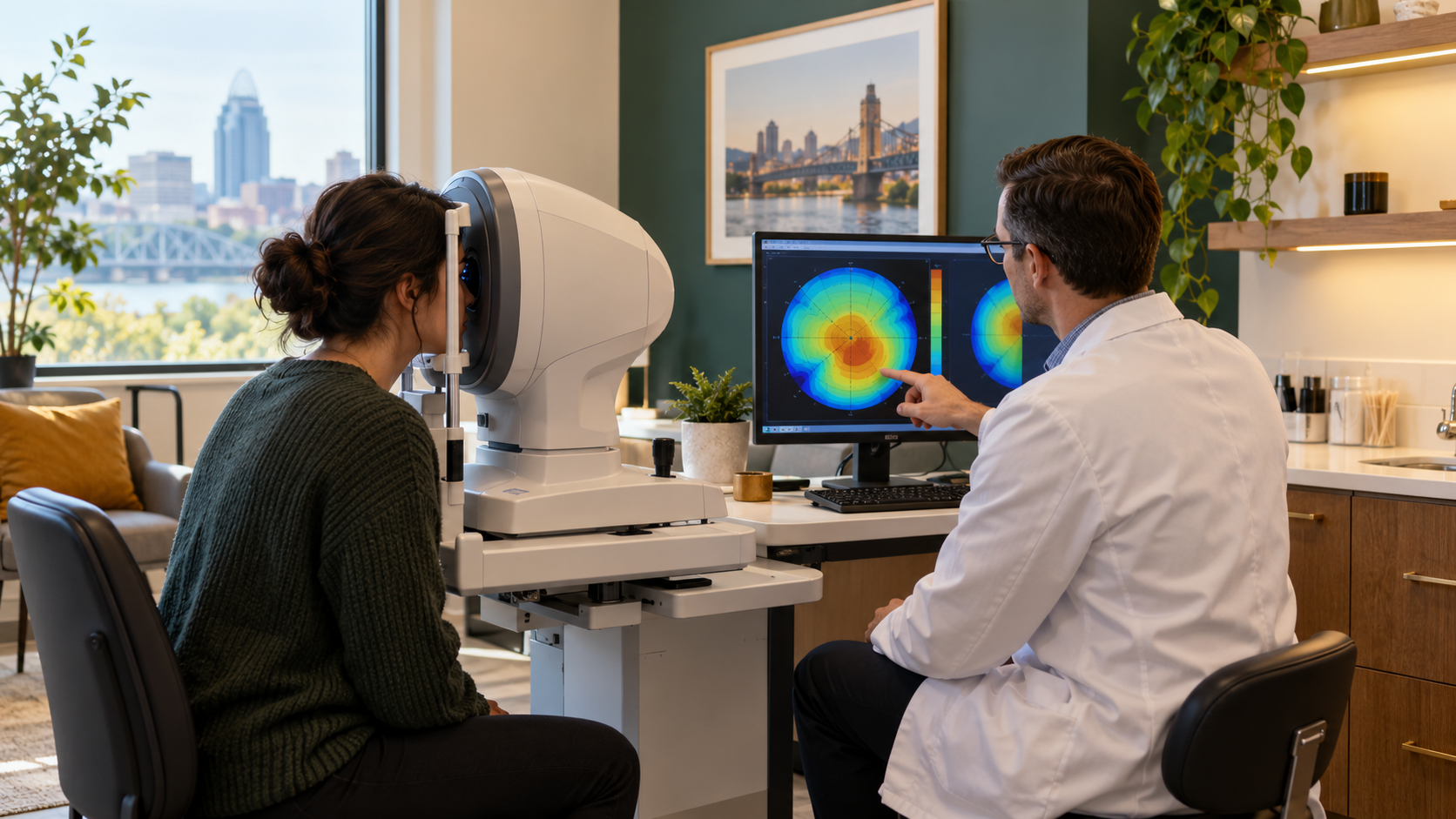
At See Well Eyecare in Hyde Park, Dr. Rawzi Baik can examine the cornea and use Topcon MYAH corneal topography when the history, prescription or vision quality suggests that a standard refraction may not tell the whole story.
What Keratoconus Changes
The cornea is the clear front surface of the eye. In keratoconus, it becomes thinner and develops an increasingly irregular shape. That irregularity can produce:
- increasing or irregular astigmatism;
- blurred, doubled or ghosted images;
- glare and halos, especially at night;
- frequent prescription changes;
- reduced clarity even through updated glasses; and
- difficulty obtaining stable vision with ordinary soft contact lenses.
The AAO’s keratoconus overview explains that the condition may be detected during an eye examination. A detailed history still matters: age, family history, allergies, habitual rubbing and changes in the prescription help determine whether additional testing is appropriate.
Read See Well’s guide to the early signs of keratoconus in Cincinnati for a broader overview of symptoms, referral and specialty-lens care.
Eye Rubbing Is a Clue—not a Diagnosis
Research does not mean that everyone who rubs their eyes will develop keratoconus. Genetics, corneal structure and other factors also matter. However, a recent evidence-based keratoconus clinical guideline identified eye rubbing as the modifiable factor most strongly associated with the condition in the evidence it reviewed. A separate review of eye rubbing and keratoconus describes both the observed association and the mechanical stress rubbing can place on the cornea.
The practical message is simple: do not panic over an occasional touch, but do not ignore a pattern of forceful rubbing. Treat the reason the eyes itch or burn instead of repeatedly pressing on them.
Common reasons people rub include seasonal allergies, eyelid inflammation, dry eye, fatigue and irritation. A dry-eye evaluation in Cincinnati may help identify an ocular-surface cause. Avoid starting medicated drops solely from an online symptom list; allergy, infection, dry eye and eyelid disease can look similar but require different plans.
Why Changing Astigmatism Deserves Context
Astigmatism simply describes how the eye focuses light when its optical surfaces are not perfectly symmetrical. Most astigmatism is regular and is corrected successfully with glasses or contact lenses.
Concern increases when the astigmatism:
- changes more quickly than expected;
- becomes increasingly irregular;
- differs markedly between the two eyes;
- produces reduced best-corrected vision; or
- comes with ghosting, glare or distorted images.
See Well’s article about a high-prescription or high-astigmatism eye exam explains why strong cylinder power alone does not diagnose keratoconus. The pattern of change and the shape of the cornea are more informative than one number on a prescription.
What Corneal Topography Adds
The AAO describes corneal topography as a mapping technique that measures the surface curvature of the cornea. It can help identify astigmatism, detect patterns suspicious for early keratoconus and monitor change.
At See Well, the Topcon MYAH creates a color-coded map of corneal shape. Dr. Baik interprets that map with the prescription, visual acuity, slit-lamp examination, symptoms and history. Topography is not a diagnosis by itself. Tear-film disruption, poor fixation, contact-lens warpage or image-quality problems can affect a map, which is why the test may need to be repeated or supplemented.
The AAO EyeWiki keratoconus review supports using topography or tomography when increasing myopia or astigmatism, reduced corrected vision, family history, chronic rubbing or allergic eye disease raises suspicion.
If Keratoconus Is Suspected
The next step depends on the findings. It may include repeat mapping, monitoring for progression, temporary discontinuation of certain contact lenses before retesting or referral to a corneal specialist.
If keratoconus is confirmed and progressing, a corneal specialist may discuss treatments intended to stabilize the cornea. Glasses do not reshape or strengthen the cornea; they correct the blur that can be corrected optically. When glasses or standard soft lenses no longer provide useful clarity, specialty contact lenses—including selected rigid, hybrid or scleral designs—may improve vision by creating a smoother optical surface. They require a dedicated fitting and ongoing corneal-health follow-up.
Explore Hyde Park & Nearby Neighborhoods
See Well Eyecare is located on Erie Avenue in Hyde Park (45208), convenient to Oakley (45209), Mount Lookout and Columbia-Tusculum. Patients from Mariemont and across Cincinnati can access corneal topography, comprehensive eye care and specialty-contact-lens evaluation in one independent practice.
Local Events & Attractions: Enjoy Cincinnati Without Ignoring Itchy Eyes
Outdoor time at Ault Park, the Cincinnati Nature Center or the Cincinnati Zoo & Botanical Garden can expose sensitive eyes to wind, pollen and dust. Sunglasses, clean hands and clinician-recommended allergy or dry-eye care are safer responses than forceful rubbing. If itching becomes persistent, schedule an evaluation rather than assuming every episode is “just allergies.”
Frequently Asked Questions
Does eye rubbing cause keratoconus?
Eye rubbing is associated with keratoconus and may contribute to progression, but it is not the only factor and does not prove that a person has the condition. Persistent forceful rubbing plus changing vision deserves evaluation.
Does high astigmatism always mean keratoconus?
No. Many people have stable, regular astigmatism. Rapid change, irregularity, ghosting or reduced corrected vision may justify corneal mapping.
Can a routine eye exam find keratoconus?
An examination may reveal suspicious prescription, vision or corneal findings. Corneal topography or tomography can provide more detailed shape information when appropriate.
Can glasses treat keratoconus?
Glasses can correct vision in some early or mild cases, but they do not stop progression. More irregular corneas may require specialty contacts, while documented progression may warrant referral for medical treatment.
Should I stop rubbing immediately if my eyes itch?
Yes—avoid forceful rubbing and identify the cause. Cool compresses, allergy care, eyelid treatment or dry-eye therapy may be appropriate after an examination, depending on the diagnosis.
Schedule a Corneal Evaluation in Cincinnati
If your astigmatism keeps changing, glasses remain blurry, or frequent rubbing has become a habit, request an appointment with See Well Eyecare. Bring previous prescriptions and current glasses or contact-lens information so Dr. Baik can evaluate the pattern over time.
About the Author
See Well Eyecare is an independent optometry practice in Hyde Park, Cincinnati, led by Rawzi Baik, OD. The practice provides comprehensive and medical eye care, corneal topography, dry-eye evaluation, myopia management and specialty contact-lens services for adults and children age four and older.
This article provides general education and does not replace an individual examination, diagnosis or urgent care.
Primary keyword: keratoconus screening Cincinnati
Supporting keywords: eye rubbing and keratoconus, changing astigmatism, corneal topography Cincinnati, irregular astigmatism, Hyde Park eye doctor
Quick Links
Helpful Articles

All Eye Care Services
Eye care for every stage of life, from routine exams and contact lens fittings to dry eye care, myopia management and medical eye visits. Dr. Baik helps you understand your options and choose care that fits your needs.

Keep In Touch
For non-urgent questions or to learn more about our services, contact us today!

We are an LGBTQ+ friendly clinic that believes all people deserve quality eye care
- 3330 Erie Avenue, Suite 14
Cincinnati, OH 45208 - Phone: (513) 268-8748
- Fax: (513) 268-8758
- Monday 9:00am - 3:00pm
- Tuesday 8:00am - 7:00pm
- Wednesday Closed
- Thursday 8:00am - 5:00pm
- Friday 7:00am - 3:00pm
- Saturday 8:00am - 2:00pm
- Sunday Closed
- Monday
- Tuesday
- Wednesday
- Thursday
- Friday
- Saturday
- Sunday
- Monday
- Tuesday
- Wednesday
- Thursday
- Friday
- Saturday
- Sunday
© 2026 See Well Eyecare. All rights Reserved - Accessibility Statement - Privacy Policy - Terms & Conditions - Sitemap
Managed and Designed by 