
Why Your PD Is Not the Whole Eyeglass Measurement: Frame Fit and Optikam in Cincinnati
Why Your PD Is Not the Whole Eyeglass Measurement: Frame Fit and Optikam in Cincinnati
“What is my PD?” is a reasonable question. Pupillary distance helps position the lenses in relation to your eyes—but it is not the only measurement that can matter.
Your eyeglass prescription tells the laboratory the lens powers needed to correct your vision. Professional dispensing measurements show how those lenses should be positioned inside the specific frame you selected and how that frame sits on your face.
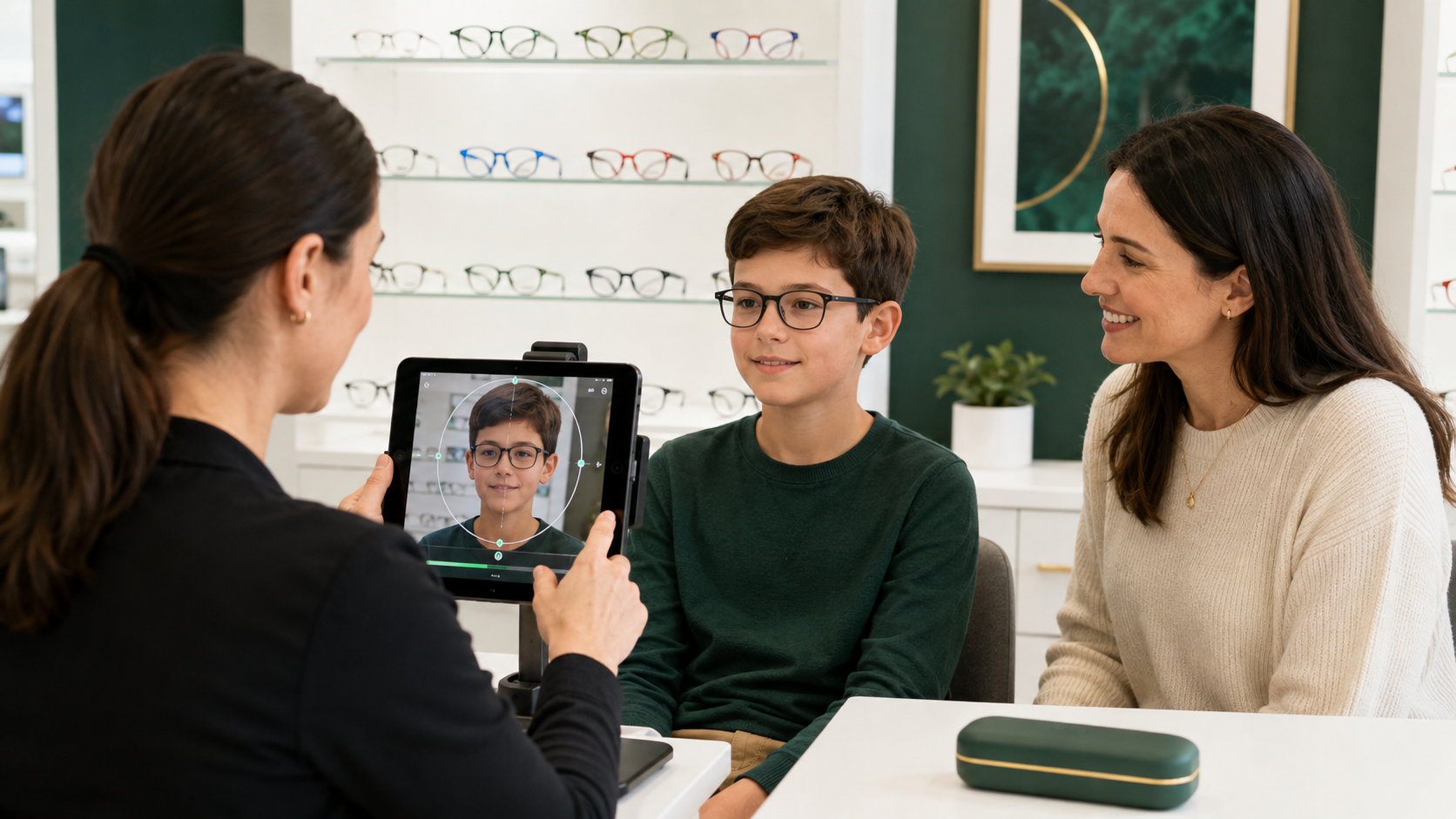
At See Well Eyecare, our optical team uses professional frame fitting and Optikam digital measurements when appropriate. For patients searching for eyeglass measurements in Cincinnati, the goal is not technology for its own sake. It is to connect the prescription, frame, lens design and real wearing position as accurately as possible.
What Is Pupillary Distance?
Pupillary distance, or PD, is the horizontal distance between the centers of the pupils. It may be recorded as one binocular number or as separate right and left monocular measurements.
PD helps the laboratory place the optical reference points of the lenses in front of the eyes. A monocular PD can be especially useful when the face or eyes are not perfectly symmetrical—which is common and normal.
The Federal Trade Commission’s Eyeglass Rule requires prescribers to provide patients with a copy of the eyeglass prescription after a refractive examination. The prescription and the measurements used to fabricate lenses in a chosen frame are related, but they are not always the same set of information.
Why the Selected Frame Changes the Measurement
The same patient can try two frames that sit differently. One may rest higher on the bridge, wrap more around the face or position the lenses farther from the eyes. The vertical location of the pupils within each frame can also change.
That is why the frame should be selected and adjusted before final dispensing measurements. Essilor’s professional fitting guidance says the frame should be adjusted for comfort and accuracy before measurements and identifies monocular PD and fitting height as key steps for progressive lenses.
An attractive frame is only the beginning. It should also sit securely, align appropriately, provide adequate lens depth for the design and work with the prescription.
Measurements Beyond PD
Depending on the prescription, frame and lens design, useful measurements may include:
- Monocular pupillary distance: the horizontal position of each pupil;
- Fitting height: the vertical position of the pupil or design reference point within the chosen frame;
- Back vertex distance: the distance from the back surface of the lens to the eye;
- Pantoscopic tilt: the vertical angle of the frame as it sits on the face;
- Frame wrap or face-form angle: how much the frame curves around the face; and
- Frame dimensions: the lens shape and usable space available for the prescribed design.
Essilor’s overview of frame-fitting parameters explains that pantoscopic angle, frame wrap and back vertex distance are measured with the patient wearing the chosen frame. ZEISS similarly describes how individualized lens calculations may consider pupil distance, frame position and preferred reading distance.
Not every lens requires every parameter, and more measurements do not automatically guarantee perfect adaptation. The measurements need to match the selected lens design and be taken consistently.
What Optikam Adds to the Process
Optikam is a digital eyewear-measurement system. Its official product information explains that as-worn measurements can include vertex distance, pantoscopic tilt, frame wrap and monocular PD. The system captures how the adjusted frame sits on the individual patient rather than relying only on generic assumptions.
At See Well, the sequence matters:
1. We help narrow the frame choices around fit, prescription, style and use. 2. The selected frame is adjusted to sit properly. 3. Measurements are taken while the patient wears that frame naturally. 4. The lens design and options are reviewed in relation to work, driving, reading, screens, sun or safety needs. 5. The finished glasses are verified, fitted and adjusted at pickup.
The Optikam reference guide likewise states that the frame and nose pads should be fit and adjusted before measurement. A digital device supports the process; it does not replace an optician’s judgment or a final fitting.
Who May Benefit Most From Frame-Specific Measurements?
Careful measurements can matter for any prescription, but they become particularly important for:
- progressive lenses;
- stronger prescriptions;
- high astigmatism;
- larger, smaller or wrapped frames;
- occupational or computer lens designs;
- patients whose right and left PDs differ; and
- people who have struggled to adapt to previous glasses.
A peer-reviewed theoretical study in *Ophthalmic and Physiological Optics* examined how errors in individual parameters can affect the optical performance of progressive addition lenses. The practical lesson is not that every progressive must use the most complex design. It is that measurements and design choices should be appropriate and internally consistent.
Patients with very strong prescriptions or high astigmatism can also read our guide to high-prescription eye exams and eyewear in Cincinnati.
Progressive Lenses Need More Than a Good Prescription
A progressive lens blends distance, intermediate and near zones. The location of those zones must relate to the patient’s pupils, frame height, reading posture and intended use.
ZEISS notes that precise fitting measurements are necessary for progressive lenses, with the pupil aligned appropriately to the lens design. A patient who works across multiple monitors may also need a different solution from someone whose main concern is driving and occasional reading.
Our article comparing progressive lenses with dedicated computer glasses explains why one pair cannot always maximize every viewing distance. A legitimate second pair should solve a defined problem—not be presented as an unexplained extra.
Why Professional Frame Selection Matters
Frame choice affects more than appearance. A professional optician considers:
- how the bridge and temples distribute weight;
- whether the eyes sit well within the lens shape;
- whether the frame is appropriate for the prescription;
- the depth needed for the lens design;
- lash, brow and cheek clearance;
- stability during normal movement; and
- whether the frame can be adjusted and supported over time.
At See Well, optician and assistant manager Victoria helps patients compare a curated selection of premium and budget-conscious choices. The goal is to make the decision manageable: sell anything, not everything. We would rather explain a complete, useful eyewear plan than overwhelm you with components.
Keep the Prescription, Product, Fitting and Follow-Up Connected
Purchasing glasses through the same practice that performed the examination can simplify communication between the doctor, optician and laboratory. It allows the team to connect the prescription with the frame, measurements, lens design, verification, adjustments and eligible warranty concerns.
You are entitled to your prescription and may purchase glasses wherever you choose. The FTC’s consumer guidance explains that prescribers must provide it after the refractive examination. Before ordering elsewhere, ask what measurements, fitting, verification, remake policies, adjustments and follow-up are included.
Choosing the same local team for care and products also helps See Well employ professional staff, invest in technology and specialty services, and remain available to Cincinnati families. That invitation should never feel like pressure; care is not conditional on a purchase.
Explore Hyde Park & Nearby Neighborhoods
See Well Eyecare’s optical is located in Hyde Park (45208), convenient to Oakley (45209), Mariemont (45227) and Mount Lookout. Patients can select frames, complete measurements and return for professional dispensing and adjustments with one neighborhood team. Free parking is available behind the building.
Local Events & Attractions | Glasses Made for Real Cincinnati Life
Your eyewear should match what you actually do. That may mean clear intermediate vision for working at the Cincinnati & Hamilton County Public Library, comfortable distance vision for performances at Cincinnati Music Hall or prescription sun protection for time in Cincinnati Parks. Tell us where your current pair falls short so the recommendation has a purpose.
Frequently Asked Questions
Is PD part of my eyeglass prescription?
An eyeglass prescription records the lens powers determined during refraction. PD is a dispensing measurement used to position lenses. Requirements and record practices can vary, but the FTC requires the prescription itself to be released after the refractive examination.
Is one PD number enough?
It may be for some basic applications. Separate monocular PDs can better represent each eye’s position, especially when facial symmetry differs or the lens design benefits from individual centration.
Why must I choose the frame before final measurements?
Fitting height, vertex distance, tilt and wrap depend on how the specific adjusted frame sits on your face. Changing the frame can change those measurements.
Does Optikam guarantee that I will adapt to my glasses?
No measurement system can guarantee adaptation. Accurate measurements, an appropriate lens design, careful fabrication, final fitting and reasonable adaptation expectations all contribute.
Are digital measurements useful for single-vision lenses?
They can be, particularly with stronger prescriptions, high astigmatism, wrapped frames or individualized lens designs. The useful measurement set depends on the patient and product.
Can See Well adjust glasses after pickup?
Yes. Our optical provides professional dispensing and after-purchase adjustments. Warranty and remake coverage depend on the products and policies explained with the order.
Choose Glasses Around Your Prescription and Your Life
If you need new eyewear, visit See Well’s Cincinnati optical and bring your current glasses. We can review what works, what does not and whether the selected frame and lens plan match your real needs. You can also review our eyewear and insurance FAQs or request an appointment.
About See Well Eyecare
See Well Eyecare is a locally owned independent optometry and optical practice in Hyde Park, Cincinnati. Dr. Rawzi Baik and the optical team connect comprehensive eye care with curated eyewear, professional fitting, Optikam measurements, prescription verification and continued local support. Our goal is to make each recommendation understandable and useful for the way the patient works, drives, reads, uses screens and lives.
Quick Links
Helpful Articles

All Eye Care Services
Eye care for every stage of life, from routine exams and contact lens fittings to dry eye care, myopia management and medical eye visits. Dr. Baik helps you understand your options and choose care that fits your needs.

Keep In Touch
For non-urgent questions or to learn more about our services, contact us today!

We are an LGBTQ+ friendly clinic that believes all people deserve quality eye care
- 3330 Erie Avenue, Suite 14
Cincinnati, OH 45208 - Phone: (513) 268-8748
- Fax: (513) 268-8758
- Monday 9:00am - 3:00pm
- Tuesday 8:00am - 7:00pm
- Wednesday Closed
- Thursday 8:00am - 5:00pm
- Friday 8:00am - 3:00pm
- Saturday 9:00am - 2:00pm
- Sunday Closed
- Monday
- Tuesday
- Wednesday
- Thursday
- Friday
- Saturday
- Sunday
- Monday
- Tuesday
- Wednesday
- Thursday
- Friday
- Saturday
- Sunday
© 2026 See Well Eyecare. All rights Reserved - Accessibility Statement - Privacy Policy - Terms & Conditions - Sitemap
Managed and Designed by 