
Pickleball Vision in Cincinnati: Why a Routine Eye Exam Can Help You See the Ball Earlier
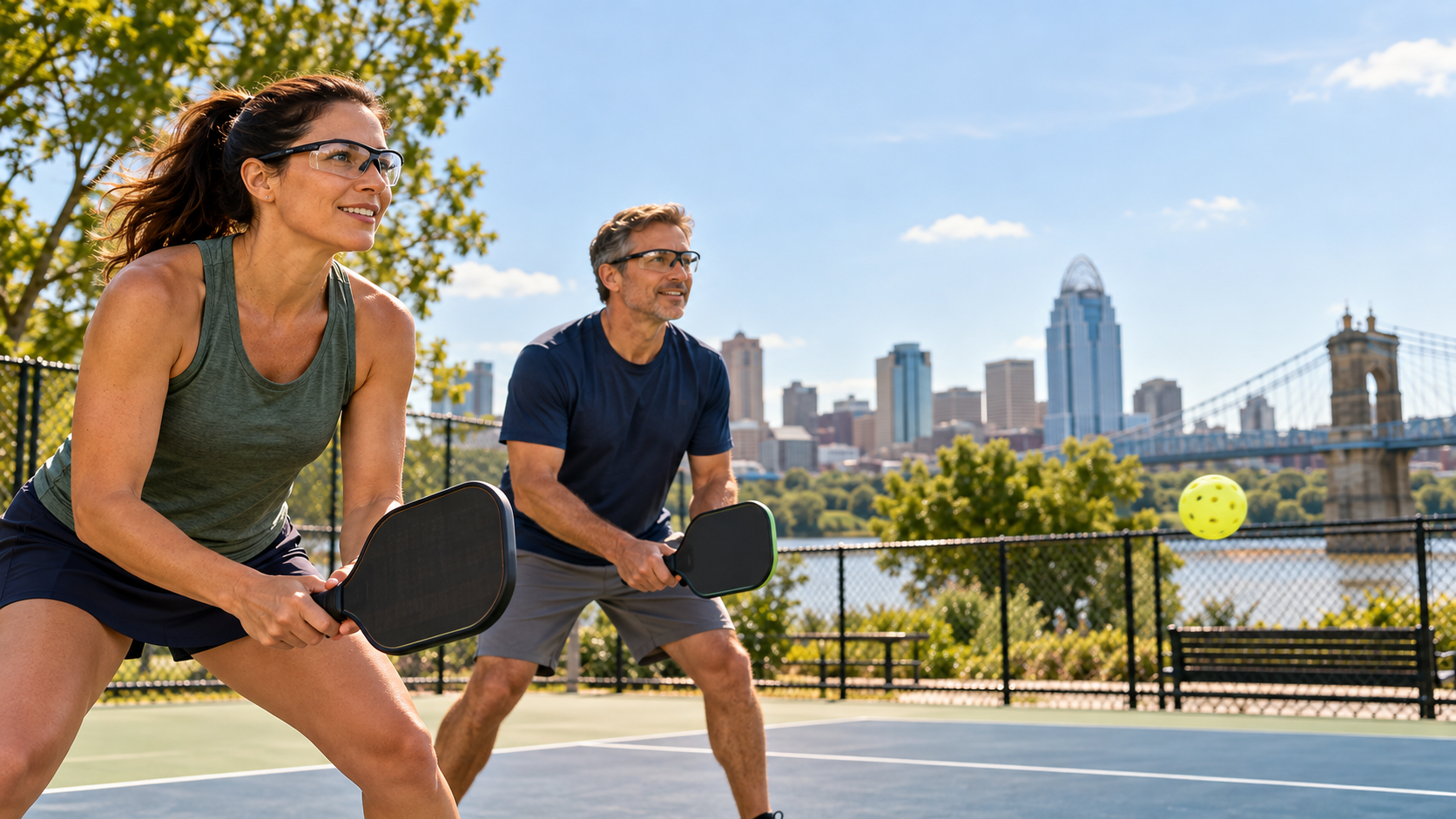
Pickleball Vision in Cincinnati: Why a Routine Eye Exam Can Help You See the Ball Earlier
Pickleball asks the visual system to switch quickly between the opponent, the paddle, the kitchen line and a perforated ball moving through changing backgrounds. A player may read an eye chart well and still struggle with glare, depth judgment, contact-lens dryness or an outdated prescription on court.
That is why a pickleball eye exam in Cincinnati should start with everyday eye health and then connect the findings to real playing conditions. The goal is not to promise better performance from one lens. It is to remove avoidable visual obstacles and help players choose sensible eye protection.
Pickleball Uses More Than Distance Acuity
Useful on-court visual skills include:
- clear distance and intermediate vision;
- depth perception and binocular coordination;
- peripheral awareness;
- contrast against bright sky, fencing and shaded backgrounds;
- comfortable tracking across the court; and
- rapid adjustment between near and far targets.
The American Optometric Association’s sports-vision guidance describes the optometrist’s role in evaluating visual function, protective eyewear and eye injuries. A comprehensive examination remains the starting point because cataract, dry eye, prescription imbalance and other conditions can reduce visual quality even when a player compensates well.
At See Well’s comprehensive eye examination, Dr. Baik can assess prescription, eye coordination and ocular health, then discuss the distances and lighting that matter on court.
Small Prescription Changes Can Matter Against a Fast Background
Mild uncorrected astigmatism or unequal prescriptions may be easy to ignore indoors but more noticeable when following a small moving ball. Players over 40 may also find that progressive lenses designed for daily life are not ideal in an athletic stance because different parts of the lens carry different powers.
That does not mean every player needs a separate pair. It means the eyewear conversation should begin with a legitimate use case. Ask:
- Do you play indoors, outdoors or both?
- Is your biggest problem sun, blur, fogging or protection?
- Do you look through the intended zone of your current lenses while in ready position?
- Would contact lenses plus protective eyewear solve the task better?
- Do you need clear lenses for indoor courts and sun lenses for outdoor play?
See Well’s optical team can explain the complete recommendation before individual components are selected. Optikam measurements help place a prescription accurately in the chosen frame, while professional fitting and later adjustments help keep the frame stable during movement.
Regular Glasses Are Not Sports Protection
Everyday eyeglasses, sunglasses and contact lenses can improve vision, but they are not automatically protective sports equipment. Prevent Blindness specifically advises that ordinary prescription glasses and sunglasses do not provide adequate sports-eye protection.
Pickleball injury risk is easy to underestimate because the sport is non-contact. Players can still be struck by a ball, paddle or partner—particularly during fast exchanges near the net. A peer-reviewed review of pickleball eye injuries and protection recommendations describes the need to consider ocular protection as participation grows.
Ask the eye doctor or optician whether the proposed protector and lens are designed and labeled for the relevant sport and impact standard. The current ASTM F803 standard covers eye protectors for selected sports, while racket-sport standards and product labeling may apply differently. Do not assume a frame is protective because it looks athletic.
Players with useful vision in only one eye, significant myopia, prior eye surgery or prior eye injury deserve an especially careful conversation about protection. The current Prevent Blindness sports-eye safety campaign also highlights pickleball and higher-risk groups.
Sun, Glare and Ball Contrast
Outdoor courts can shift from open sun to shade, and a yellow or green ball may blend into foliage, fencing or bright sky. Lens color is personal: the tint that increases comfort for one player may reduce brightness too much for another.
Consider:
- UV protection for outdoor play;
- lens material and impact design;
- polarization only after considering how it affects the player’s visual experience;
- anti-fog strategies and ventilation;
- a secure, comfortable frame fit; and
- separate indoor and outdoor needs when one pair cannot do both well.
The second-pair discussion should be practical. A clear indoor sports pair and a sun-managed outdoor pair can be legitimate separate tools—not an unexplained “extra pair.” Before ordering elsewhere, ask what is included in the lens design, measurements, fitting, warranty and follow-up.
Contact Lenses Can Expand the Field of View—but Need Oversight
Contact lenses may provide a wide field of view without a spectacle frame edge, and they can be worn beneath appropriate nonprescription sports protection. But lenses may dry on windy outdoor courts, and sweat or hand contact can create hygiene problems.
A contact-lens examination assesses the exact lens on the eye, prescription, movement, corneal response and wearing schedule. Daily disposable or reusable options may be considered according to the patient—not simply because one schedule sounds more athletic.
When prescribed lenses are purchased through See Well, the exact product, authentic supply channel, manufacturer rebate when available, annual-supply shipping and follow-up stay connected. Never rinse lenses or a case with tap water, and wash and dry hands before handling lenses.
Dry Eye Can Change Play Late in a Match
Reduced blinking, wind, sun and prolonged concentration can destabilize the tear film. If the ball looks intermittently smeared and clears after blinking, dry eye may be part of the problem. The National Eye Institute lists blurry vision among dry-eye symptoms.
Repeated symptoms deserve evaluation. A random redness-relief drop may not address meibomian-gland dysfunction, allergy or contact-lens interaction.
If a Ball or Paddle Hits the Eye
Stop playing. Seek prompt eye care for pain, reduced vision, double vision, light sensitivity, flashes, new floaters, bleeding, an irregular pupil or significant swelling. Do not press on the eye. A serious injury can exist without dramatic external bruising.
See Well evaluates many non-life-threatening urgent problems through our emergency eye-care service. Suspected open-eye injury, severe vision loss, major trauma or neurologic symptoms may require emergency-department care.
Explore Hyde Park & Nearby Neighborhoods
Players from Hyde Park (45208), Oakley (45209), Mariemont (45227) and Walnut Hills (45207) can visit See Well for comprehensive eye exams, contact lenses and professionally fitted eyewear. Bring your current sports glasses or contacts so the team can evaluate what is and is not working.
Local Events & Attractions | Where Cincinnati Plays Pickleball
Sawyer Point and Yeatman’s Cove includes dedicated lighted pickleball courts with riverfront views. Players can also review Cincinnati-area options through Visit Cincy’s pickleball guide and consult the USA Pickleball health and safety hub before play.
Frequently Asked Questions
Can an eye exam make me a better pickleball player?
An exam cannot promise athletic improvement, but it can identify prescription blur, eye-teaming concerns, dry eye and ocular-health problems that interfere with seeing comfortably and consistently.
Are my regular prescription glasses safe for pickleball?
They correct vision but are not automatically sports protectors. Ask whether a product is designed, tested and labeled for the relevant impact use.
Should I use progressive lenses while playing?
Some people adapt well; others dislike looking through changing powers while moving. Bring your playing posture and visual priorities into the optical discussion.
Are polarized sunglasses best for outdoor pickleball?
Polarization can reduce reflected glare, but lens choice depends on court lighting, contrast preferences, prescription and protection needs. It is not automatically best for every player.
Can I wear contact lenses under sports eyewear?
Often, yes, when the lenses are properly prescribed and the protective eyewear fits correctly. Contact lenses themselves do not protect against impact.
Where can I schedule a pickleball-focused eye exam in Cincinnati?
Use See Well’s appointment-request page and mention whether you play indoors or outdoors, use glasses or contacts and have concerns about glare, blur or protection.
About See Well Eyecare
See Well Eyecare is an independent optometry and optical practice in Hyde Park, Cincinnati. The team provides comprehensive eye examinations, contact-lens care and professionally fitted eyewear for patients who want recommendations connected to their work, driving, recreation and everyday lives.
Bring Your Court Needs to the Exam
Tell us where you play, what the ball looks like in sun and shade and what your current eyewear fails to do. We can help separate prescription, comfort and protection needs and build a focused solution instead of an overwhelming catalog.
Primary keyword: pickleball eye exam Cincinnati Supporting keywords: pickleball eyewear Cincinnati, sports vision eye exam, pickleball eye protection, prescription sports glasses, contact lenses for pickleball, Sawyer Point pickleball
Quick Links
Helpful Articles

All Eye Care Services
Eye care for every stage of life, from routine exams and contact lens fittings to dry eye care, myopia management and medical eye visits. Dr. Baik helps you understand your options and choose care that fits your needs.

Keep In Touch
For non-urgent questions or to learn more about our services, contact us today!

We are an LGBTQ+ friendly clinic that believes all people deserve quality eye care
- 3330 Erie Avenue, Suite 14
Cincinnati, OH 45208 - Phone: (513) 268-8748
- Fax: (513) 268-8758
- Monday 9:00am - 3:00pm
- Tuesday 8:00am - 7:00pm
- Wednesday Closed
- Thursday 8:00am - 5:00pm
- Friday 8:00am - 3:00pm
- Saturday 9:00am - 2:00pm
- Sunday Closed
- Monday
- Tuesday
- Wednesday
- Thursday
- Friday
- Saturday
- Sunday
- Monday
- Tuesday
- Wednesday
- Thursday
- Friday
- Saturday
- Sunday
© 2026 See Well Eyecare. All rights Reserved - Accessibility Statement - Privacy Policy - Terms & Conditions - Sitemap
Managed and Designed by 