Darker Sunglasses Are Not Always Safer: How Cincinnati Patients Can Choose Real UV Protection
Darker Sunglasses Are Not Always Safer: How Cincinnati Patients Can Choose Real UV Protection
A nearly black lens can look protective and still tell you very little about ultraviolet filtering. Lens darkness controls visible light. UV protection depends on the lens material and treatment, not simply the color.
The American Academy of Ophthalmology’s current sunglasses guide says the key feature is 100% UV protection and specifically cautions that darker lenses are not automatically more protective.
Start With the UV Label
Look for lenses labeled to block 99% to 100% of both UVA and UVB radiation, often written as “UV400” or “100% UV protection.” The National Eye Institute recommends sunglasses that block 99% to 100% of UVA and UVB.
Very dark lenses without effective UV filtration are not a smart substitute. Darkness can make the pupil enlarge, while the lens still may not provide the UV protection the wearer expects. Buy from a reliable source and ask what the label actually certifies.
Why UV Protection Matters in Every Season
Ultraviolet exposure is not limited to hot summer days. UV is present on bright, cool and partly cloudy days, and reflective surfaces can increase glare. The NEI’s guide to UV and eye protection explains the different types of UV radiation and the value of protective eyewear.
Long-term exposure contributes to eye-surface damage and cataract risk. The AAO’s updated article on sun, UV light and the eyes explains that UV can affect the ocular surface, cornea and lens. A brimmed hat adds coverage but does not replace appropriate sunglasses.
Prescription Sunglasses Are More Than a Dark Version of Your Glasses
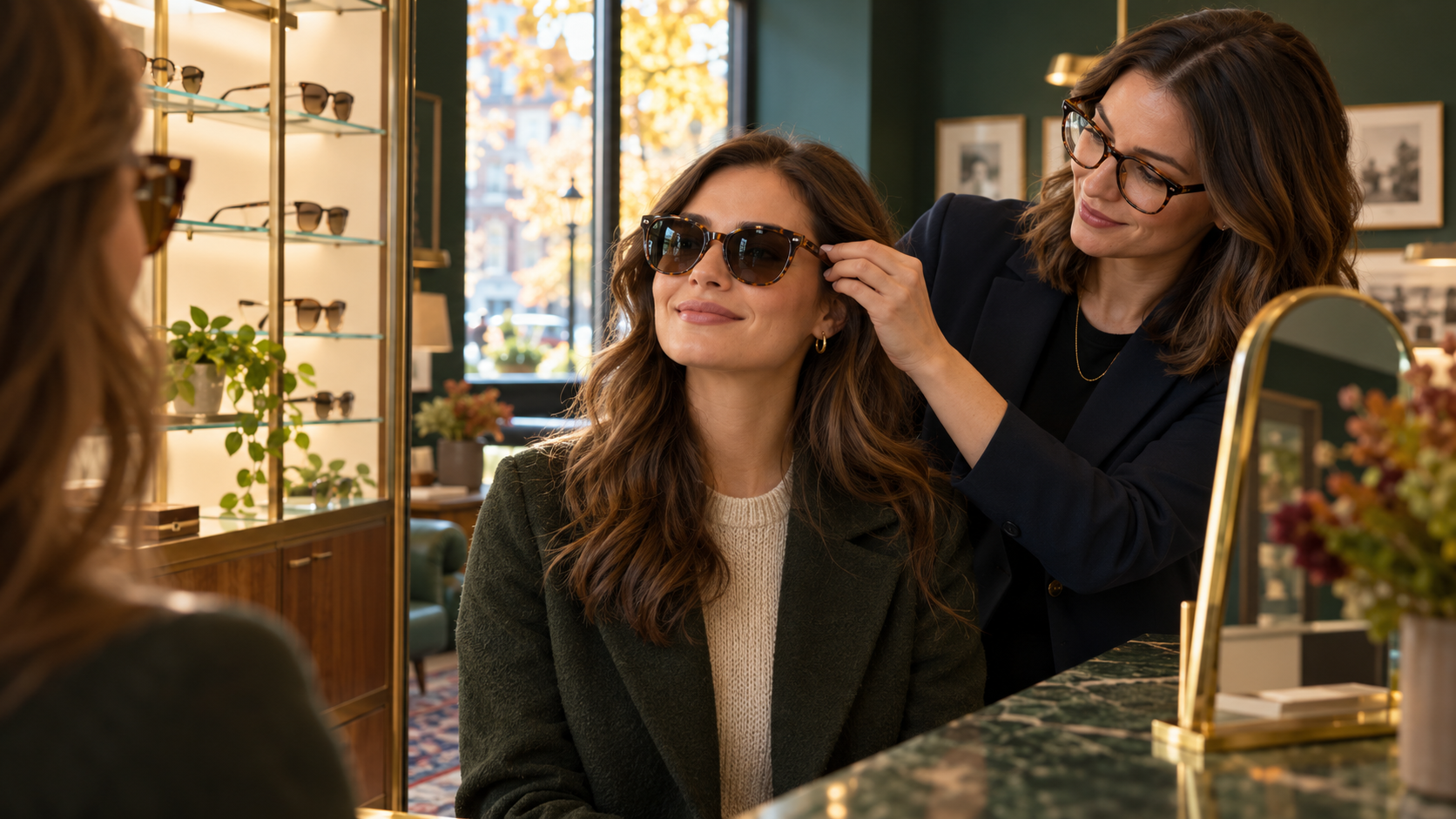
The AAO notes that sunglasses can be made in nearly any prescription. A strong or complex prescription still requires thoughtful frame and lens selection. Frame size, wrap, vertex distance, pupil position and lens material can change thickness, weight and peripheral optics.
At See Well Eyecare, the optical team can connect the sunwear plan to the patient’s real needs:
- polarized glare control for driving or time near water;
- accurate distance vision for road signs;
- dashboard and near vision when a multifocal design is needed;
- impact-resistant options for active use;
- coverage for light entering around the frame; and
- a legitimate backup pair when primary glasses are damaged or unavailable.
See Well’s Hyde Park optical uses professional fitting and Optikam frame-specific measurements to help position prescription lenses accurately. Current collections include Ray-Ban, Gucci, Saint Laurent, Persol, Etnia Barcelona and DB4K children’s frames; exact sunwear availability can vary, so the team can review what is in the office at the time of the visit.
Polarization and UV Protection Solve Different Problems
Polarization reduces reflected glare from horizontal surfaces such as roads and water. It can improve comfort, but polarization by itself is not the UV specification. A lens should still have verified UV protection.
Photochromic lenses respond to changing light and can be convenient, but many designs do not become as dark inside a vehicle because the windshield filters much of the activating UV. See Well’s comparison of photochromic and polarized lenses helps patients identify which feature fits their priorities.
The best answer may be one everyday clear pair plus task-specific sunwear, not one lens expected to do everything equally well.
Clear Prescription Lenses Can Also Block UV
A lens does not need to be tinted to provide UV filtration. The AAO explains that clear prescription lenses can offer UV protection depending on the material or treatment. Clear lenses still do not reduce bright visible light and glare the way sunglasses do.
Before ordering elsewhere, ask what is included: verified UV protection, prescription verification, optical measurements, adjustments, troubleshooting and warranty support. Buying where your eye care lives keeps the prescription, product, fitting and follow-up connected while supporting a neighborhood eye-care resource.
Children Need Protection and Fit
Children spend meaningful time outdoors and need sunglasses that block UV, fit securely and are appropriate for their activities. A lens that is protective but constantly slides down will not provide consistent coverage. Impact resistance and comfort are especially important.
A pediatric eye examination at See Well can identify whether a child needs prescription sunwear. The optical team can then help families choose age-appropriate frames rather than buying oversized glasses for a child to “grow into.”
Explore Hyde Park & Nearby Neighborhoods
See Well Eyecare is located in Hyde Park (45208), close to Oakley (45209), Mount Lookout and Mariemont. Cincinnati patients can combine an eye examination, prescription review and professional sunwear fitting in one locally owned practice.
Local Events & Attractions: Cincinnati Glare Is Year-Round
Walking at Ault Park, visiting Smale Riverfront Park or driving past low autumn and winter sun can create significant glare. Choose lenses around the activity: road use, water, walking, sports and everyday errands do not create identical visual demands.
Frequently Asked Questions
Do darker sunglasses block more UV?
Not necessarily. Darkness controls visible light. Look for a label showing 99% to 100% UVA and UVB protection or UV400 coverage.
Is polarization the same as UV protection?
No. Polarization reduces reflected glare. UV filtering protects against ultraviolet radiation. A quality sun lens may include both.
Can I get sunglasses with a strong prescription?
Often, yes. Frame shape, size, wrap and lens material may need adjustment to keep the result practical and optically appropriate.
Do I still need sunglasses if my clear lenses block UV?
Clear UV-blocking lenses protect against UV but do not reduce brightness and glare like sunglasses. Many patients benefit from both.
Why buy prescription sunglasses through the eye-care office?
Professional selection connects the prescription with frame fit, measurements, lens design, adjustments, troubleshooting and warranty support. It also gives you one accountable team if the vision or comfort needs refinement.
Schedule an Eye Exam and Sunwear Review
Bring your current glasses and sunglasses to a See Well comprehensive eye exam. When you are ready to compare prescription or nonprescription sunwear, request an appointment and let the team know whether driving, outdoor activities, strong prescriptions or children’s fit are the main priority.
About See Well Eyecare
See Well Eyecare is a locally owned optical and optometry practice in Hyde Park, Cincinnati. Dr. Rawzi Baik and the team pair medical eye care with curated eyewear, frame-specific Optikam measurements, lens education and after-purchase adjustments for families and professionals throughout Hyde Park, Oakley and nearby neighborhoods.
Primary keyword: UV protection sunglasses Cincinnati
Supporting keywords: prescription sunglasses Hyde Park, sunglasses Oakley Ohio, UV400 lenses, polarized sunglasses Cincinnati, optical near Hyde Park
Quick Links
Helpful Articles
All Eye Care Services
Eye care for every stage of life, from routine exams and contact lens fittings to dry eye care, myopia management and medical eye visits. Dr. Baik helps you understand your options and choose care that fits your needs.

Keep In Touch
For non-urgent questions or to learn more about our services, contact us today!

We are an LGBTQ+ friendly clinic that believes all people deserve quality eye care
- 3330 Erie Avenue, Suite 14
Cincinnati, OH 45208 - Phone: (513) 268-8748
- Fax: (513) 268-8758
- Monday 9:00am - 3:00pm
- Tuesday 8:00am - 7:00pm
- Wednesday Closed
- Thursday 8:00am - 5:00pm
- Friday 7:00am - 3:00pm
- Saturday 8:00am - 2:00pm
- Sunday Closed
- Monday
- Tuesday
- Wednesday
- Thursday
- Friday
- Saturday
- Sunday
- Monday
- Tuesday
- Wednesday
- Thursday
- Friday
- Saturday
- Sunday
© 2026 See Well Eyecare. All rights Reserved - Accessibility Statement - Privacy Policy - Terms & Conditions - Sitemap
Managed and Designed by 