Do Contact Lenses Create Microplastics? What Cincinnati Wearers Should Know
Do Contact Lenses Create Microplastics? What Cincinnati Wearers Should Know
Contact lenses are small, flexible medical devices that help millions of people see clearly. Their size also creates an unusual disposal problem: a used lens can disappear down a sink or toilet in seconds, but it does not simply disappear from the environment.
Research has identified contact lenses as one potential source of plastic and microplastic pollution when they are flushed into wastewater. That finding deserves attention—but it should not be turned into an alarming claim that normal contact-lens wear has been proven to poison the eye or body. The evidence supports a much more practical message:
Wear the lens selected for your eye health, never flush it, and use an appropriate specialty-recycling program when one is available.
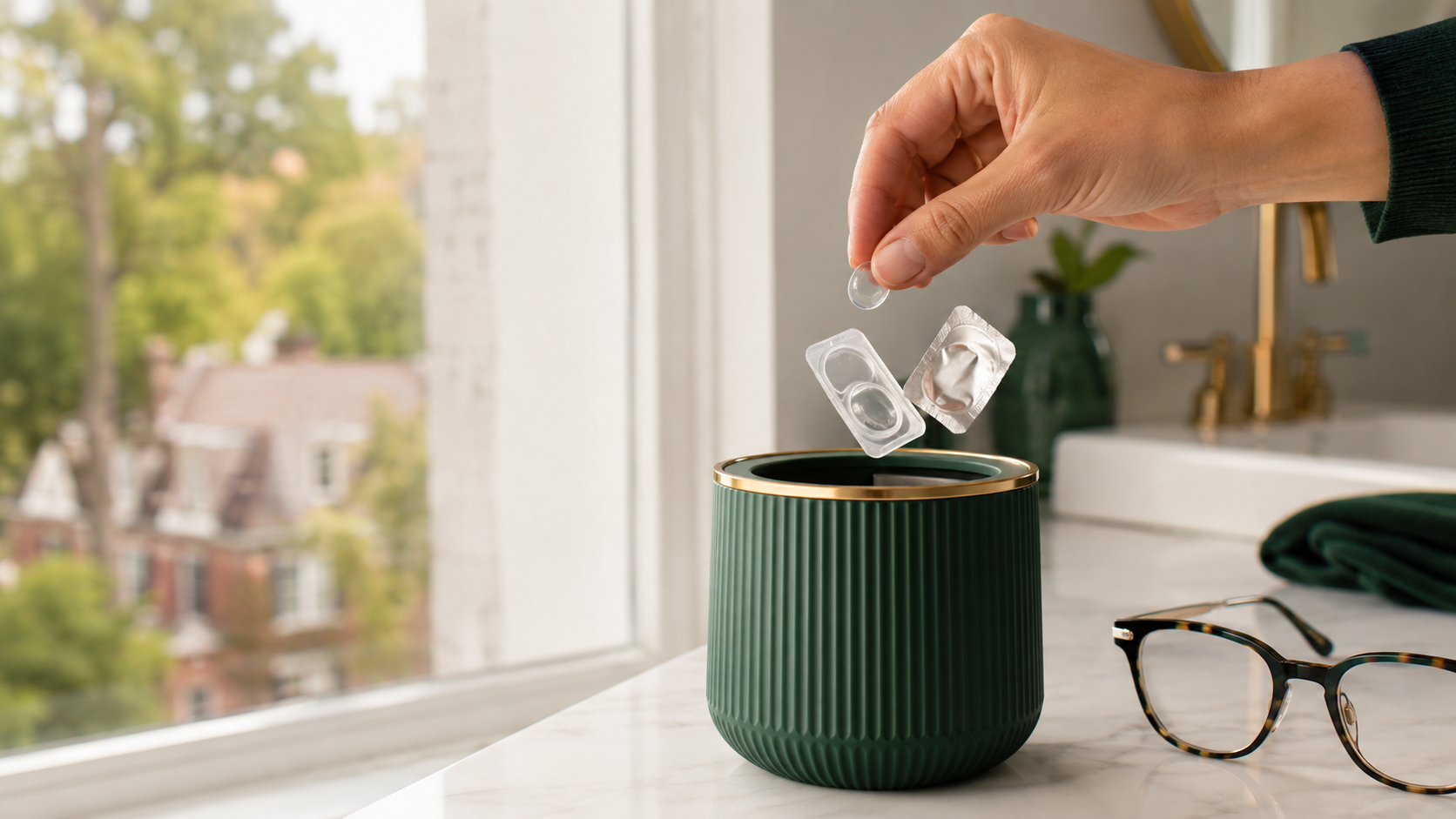
At See Well Eyecare in Hyde Park, patients who purchase their contact-lens supply through our office can bring eligible used lenses and packaging to our complimentary Bausch + Lomb ONE by ONE Recycling Program collection, operated with TerraCycle.
What is a microplastic?
Microplastics are generally described as very small plastic particles. Some are manufactured at a small size; others form when larger plastic materials fragment through physical, chemical or environmental processes.
Soft contact lenses are made from water-containing polymer materials. Their flexibility makes them comfortable enough to rest on the eye, but it does not make them biodegradable or appropriate for a drain. Once a lens enters wastewater, treatment processes may change or fragment the material rather than making it vanish.
That distinction matters. The main patient action supported by current research is not to panic about wearing a prescribed lens. It is to keep used lenses out of wastewater.
What the wastewater research found
A peer-reviewed study published in Environmental Science & Technology combined a survey of 416 U.S. contact-lens wearers with laboratory and wastewater-treatment observations. The researchers estimated that approximately 21% of surveyed wearers flushed lenses down a sink or toilet. They found that wastewater treatment did not measurably eliminate the lens material and that fragments could accumulate in sewage sludge.
The Arizona State University research summary provides the study abstract and a link to the published paper.
The study does not mean every discarded contact lens travels directly into the Ohio River, nor does it prove that wearing a contact lens creates a specific disease in the wearer. It establishes that flushing lenses creates an avoidable pathway into wastewater and that treatment may leave plastic material behind.
Does wearing a contact lens release microplastics into the eye?
This is where online headlines often move faster than the science.
A small laboratory study reported by the American Chemical Society exposed reusable contact lenses to simulated sunlight and water, then measured particles released under those experimental conditions. The researchers described the work as preliminary and did not establish a human-health effect from ordinary prescribed wear. The ACS summary of the laboratory study explains the setup and its limitations.
It would be inaccurate to turn that experiment into a claim that all contact lenses release a known number of particles during normal use or that those particles have been proven to damage the eye. Lens material, age, care, ultraviolet exposure and study methods all matter.
If you are comfortable and seeing well in a professionally fitted lens, do not stop wearing it because of a frightening social-media post. Bring your questions to a contact-lens examination, where we can evaluate your cornea, tear film, prescription, lens fit and replacement routine.
The disposal rule is simple: never use the sink or toilet
When you remove a contact lens:
Save it for an approved specialty-recycling collection, or
Place it in household trash when specialty recycling is unavailable.
Do not flush the lens. Do not wash it down the sink. Do not leave it loose in a Cincinnati curbside recycling cart. Contact lenses and individual blister components are too small for ordinary municipal sorting equipment and require a specialty stream.
The outer paperboard box is different. When it is empty and clean, it can generally be prepared according to the City of Cincinnati’s curbside recycling guidance.
What See Well Eyecare can recycle
See Well Eyecare provides complimentary in-office collection for established patients who purchase their contact-lens supply through our office. The Bausch + Lomb ONE by ONE program currently accepts contact-lens waste from any brand, including:
Used soft contact lenses
Empty blister packs
Fully separated blister-pack foil tops
Items must be empty and dry. Unopened blister packs, outer contact-lens boxes and blister packs with the foil still attached are not accepted in this particular collection. Put eligible paperboard boxes into the appropriate curbside stream instead.
Because program rules can change, review the current official Bausch + Lomb recycling page before preparing a large collection.
A five-step routine that takes almost no extra time
Place a small dry container where you normally remove your lenses.
Separate the foil completely from each empty blister cup.
Allow the lens, foil and blister cup to dry.
Keep liquids, tissues and cardboard out of the container.
Bring the accepted materials to See Well Eyecare during a visit or order pickup.
This works for daily disposable wearers as well as patients replacing reusable soft lenses. The best routine is the one simple enough to repeat.
Does this mean daily disposable contacts are environmentally irresponsible?
Daily contacts use more individual blister packs than two-week or monthly lenses. Reusable lenses use fewer blisters, but they require solution bottles, storage cases and a consistent cleaning system. Our companion guide, Are Daily, Two-Week and Monthly Contact Lenses Bad for the Environment?, compares those systems without pretending that either is waste-free.
At See Well, clinical suitability comes first. Daily disposable lenses are often a strong choice for patients who over-wear reusable lenses, struggle with case care, travel frequently, have allergies or prefer a fresh lens each day. They are not appropriate for every prescription and are not risk-free.
The environmentally responsible answer is never to reuse a daily lens or stretch a reusable lens beyond its prescribed schedule. Unsafe wear can cause a much larger problem than one additional blister pack.
Why purchasing through See Well supports the complete system
Ordering through the office that examined your eyes keeps the prescription, professional fitting, product supply and follow-up connected. Our team can:
Confirm the exact prescribed brand, material, curve, diameter and power
Review current manufacturer-rebate requirements for eligible purchases
Provide free standard home shipping with an annual-supply purchase
Arrange smaller-order or two-day shipping for a fee when available
Offer appropriate trial lenses, when available, as a short bridge for purchasing patients waiting for an order
Help promptly when vision, comfort or eye health changes
Accept eligible used lenses and packaging through our complimentary collection
The FDA’s contact-lens consumer guidance cautions that contact-lens brands are not automatically interchangeable. A lower price or familiar website does not make a different lens an equivalent medical device.
Large retailers such as Costco, Warby Parker and 1-800 Contacts can fill a valid prescription. See Well’s difference is the professional support surrounding the box. The team evaluating the cornea, tear film, lens movement and vision is also available for product questions, rebate documentation, shipping coordination, recycling and clinical concerns. Our contact-lens FAQs explain these services in more detail.
Contact-lens safety still comes before sustainability
Good disposal cannot make unsafe lens wear acceptable. The CDC recommends washing and thoroughly drying hands before handling lenses, avoiding all water exposure, following the prescribed replacement schedule and keeping regular eye-care appointments.
Remove the lens and contact an eye doctor promptly for increasing redness, pain, light sensitivity, discharge, sudden blur or excessive tearing. Our red-eye guide for contact-lens wearers explains why these symptoms should not be ignored. Severe pain, sudden vision loss, chemical exposure or significant injury may require emergency eye care.
Explore Hyde Park and nearby neighborhoods
See Well Eyecare is located at 3330 Erie Avenue in Hyde Park, convenient to contact-lens wearers in Oakley and Mariemont. We provide personalized fittings for daily disposable, toric, multifocal and reusable soft lenses, along with dry-eye and specialty-lens evaluations when standard contacts are not comfortable enough.
Our patients do not need to make a separate recycling trip. Save eligible dry materials at home and bring them with your next office visit or supply pickup.
Local events & attractions
The Hyde Park Farmers’ Market meets on Hyde Park Square on Sundays from 9:30 a.m. to 1 p.m. through September 27. It is a fitting place to practice small, repeatable low-waste habits close to home.
The Hamilton County Recycling and Reuse Search Tool helps residents find outlets for household items that do not belong in a curbside cart.
Cincinnati’s public-events recycling guidance explains how the city and county encourage proper collection at community gatherings.
Schedules and accepted materials can change. Check the linked organizer or agency before attending or dropping off items.
Frequently asked questions
Do contact lenses turn into microplastics?
Research shows that contact-lens polymers can persist and fragment during wastewater processing. That is why lenses should never be flushed. The research does not prove that every properly discarded lens reaches a waterway or that normal prescribed wear causes a specific illness.
Can wearing contacts put microplastics into my eyes?
Laboratory research has detected particles under selected simulated conditions, but the available studies do not establish a specific health effect from routine contact-lens wear. Do not change or over-wear a lens based on an alarming headline. Discuss material and replacement options during an eye examination.
Can I recycle any contact-lens brand at See Well?
Yes. The current ONE by ONE program accepts used soft lenses, separated foil tops and empty blister packs from any brand. See Well offers the collection to established patients who purchase their contacts through our office. Materials must be empty and dry.
Can contacts or blister packs go in my Cincinnati recycling cart?
Not loose. They are too small for ordinary municipal sorting. Use See Well’s specialty collection when eligible. Outer clean paperboard boxes can generally follow Cincinnati’s curbside rules.
What if I accidentally flushed one lens?
Do not panic, but change the habit. Keep a dry collection container near the place where you remove lenses so the next one goes to specialty recycling or household trash.
Is a monthly lens automatically better for the environment?
No. It uses fewer lenses and blister packs, but its system also includes solution bottles and storage cases. The correct lens depends on eye health, prescription, hygiene and lifestyle—not packaging count alone.
Should I reuse a daily lens to reduce waste?
No. Daily disposable lenses are designed for one day of wear. Reuse can compromise comfort and safety. Recycle eligible components instead.
What should I do if a contact lens makes my eye red or watery?
Wash and dry your hands, remove the lens if it comes out easily, switch to glasses and contact an eye doctor promptly if redness continues or if pain, light sensitivity, discharge or blurred vision develops.
Keep contacts out of Cincinnati’s wastewater
Microplastic research gives contact-lens wearers one clear, useful action: never put a lens down the drain. Choose the lens that supports healthy wear, follow its replacement schedule and use the right disposal stream.
If you want to compare daily and reusable contact-lens options—or establish care with a Cincinnati eye doctor who can support the examination, fitting, supply and recycling process—request an appointment with See Well Eyecare.
About See Well Eyecare
See Well Eyecare is a modern Cincinnati optometry practice led by Dr. Rawzi Baik in Hyde Park. Our professional staff provides thorough eye examinations, personalized contact-lens fittings, advanced dry-eye care, myopia management, specialty lenses and carefully selected eyewear. We welcome patients using vision insurance as well as patients choosing direct-pay options, with the same emphasis on education, technology and long-term support.
About the author
Dr. Rawzi Baik is a Cincinnati optometrist and founder of See Well Eyecare. He helps children and adults select contact lenses based on eye health, prescription, comfort and daily routine—and teaches practical habits that support safe wear.
This article provides general education and does not replace an individualized eye examination or medical advice. Recycling-program eligibility and accepted materials may change.
Quick Links
Helpful Articles
All Eye Care Services
Find personalized eye care excellence with our comprehensive services. From eye exams to advanced diagnostics, trust us for all your vision needs.

Keep In Touch
For non-urgent questions or to learn more about our services, contact us today!

We are an LGBTQ+ friendly clinic that believes all people deserve quality eye care
- 3330 Erie Avenue, Suite 14
Cincinnati, OH 45208 - Phone: (513) 268-8748
- Fax: (513) 268-8758
- Monday 9:00am - 3:00pm
- Tuesday 11:00am - 7:00pm
- Wednesday Closed
- Thursday 9:00am - 4:00pm
- Friday 8:00am - 5:00pm
- Saturday 9:00am - 3:00pm
- Sunday Closed
- Monday
- Tuesday
- Wednesday
- Thursday
- Friday
- Saturday
- Sunday
- Monday
- Tuesday
- Wednesday
- Thursday
- Friday
- Saturday
- Sunday
© 2026 See Well Eyecare. All rights Reserved - Accessibility Statement - Privacy Policy - Sitemap
Managed and Designed by 